

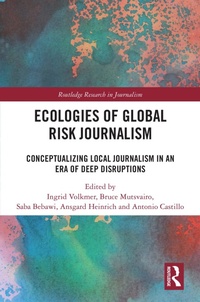
Ecologies of Global Risk Journalism
Conceptualizing Local Journalism in an Era of Deep Disruptions
1st Edition
Published on 30. December 2024
342 pages
978-1-040-30437-2 (ISBN)
Description

This volume investigates the practice and challenges of journalism addressing globalized risk from various world regions.
With chapters written by members of the Global Risk Journalism Hub, an international research network of leading scholars from the Global North and Global South, this collection brings together international journalism researchers from a wide range of theoretical and methodological backgrounds to uncover key issues of "global risk journalism" within their regional contexts. Using the climate crisis and the COVID-19 pandemic as a point of departure, this book explores the effect of digital platforms on news production, how the reporting of these transnational emergencies affects the misinformation ecosystem, the power relations between global and local news sources and the ethics of conducting research in the face of globalized crises.
This truly international and comparative volume will interest researchers and students of global and local journalism, risk journalism, journalism practice, media and communication studies, intercultural communication, political science and sociology.
With chapters written by members of the Global Risk Journalism Hub, an international research network of leading scholars from the Global North and Global South, this collection brings together international journalism researchers from a wide range of theoretical and methodological backgrounds to uncover key issues of "global risk journalism" within their regional contexts. Using the climate crisis and the COVID-19 pandemic as a point of departure, this book explores the effect of digital platforms on news production, how the reporting of these transnational emergencies affects the misinformation ecosystem, the power relations between global and local news sources and the ethics of conducting research in the face of globalized crises.
This truly international and comparative volume will interest researchers and students of global and local journalism, risk journalism, journalism practice, media and communication studies, intercultural communication, political science and sociology.
More details
Series
Edition
1. Auflage
Language
English
Place of publication
London
United Kingdom
Publishing group
Taylor & Francis Ltd
Target group
College/higher education
Illustrations
6 Tables, black and white; 20 Line drawings, black and white; 3 Halftones, black and white; 23 Illustrations, black and white
ISBN-13
978-1-040-30437-2 (9781040304372)
Copyright in bibliographic data and cover images is held by Nielsen Book Services Limited or by the publishers or by their respective licensors: all rights reserved.
Schweitzer Classification
Other editions
Additional editions
Ingrid Volkmer | Bruce Mutsvairo | Saba Bebawi
Ecologies of Global Risk Journalism
Conceptualizing Local Journalism in an Era of Deep Disruptions
Book
approx. 06/2026
1st Edition
Routledge
€60.00
Not yet published

Ecologies of Global Risk Journalism
Conceptualizing Local Journalism in an Era of Deep Disruptions
Book
03/2025
Routledge
Unfortunately, price unknown
Available (delivery time upon request)
Ingrid Volkmer | Bruce Mutsvairo | Saba Bebawi
Ecologies of Global Risk Journalism
Conceptualizing Local Journalism in an Era of Deep Disruptions
Book
12/2024
1st Edition
Routledge
€196.90
Shipment within 10-20 days
Persons
Ingrid Volkmer, Professor, University of Melbourne, specializes in globalized communication, transnational public communication, and digital policy. She has published widely in this area. Her work on globalization and journalism has a focus on globalized risks and the way journalists communicate the globalized crisis dimension. Among her publications in this area is the book 'Risk Journalism - between transnational politics and climate change' with Kasim Sharif (2018).
Bruce Mutsvairo is a Professor in the Department of Media and Culture Studies at Utrecht University in the Netherlands. He has authored and edited several books on journalism and media and studies the development of journalism in non-Western societies.
Saba Bebawi is Professor of Journalism and Dean of Humanities and Communication Arts at Western Sydney University. She has published on the role of digital journalism within social, cultural, and economic frameworks of news-making, particularly in relation to democracy building and the Global South. Bebawi is author of 'Media Power and Global Television News: The role of Al Jazeera English', 'Investigative Journalism in the Arab World: Issues and Challenges', and co-author of 'The Future Foreign Correspondent'.
Ansgard Heinrich is Associate Professor of Media and Journalism Studies at the University of Groningen, the Netherlands. She specializes in the study of contemporary journalistic practice, and her primary research interests include global conflict reporting, digital disinformation and social media use in journalism.
Antonio Castillo is a journalist and academic who teaches journalism and supervises postgraduate students at RMIT University in Melbourne, Australia. He is the author of "Journalism in the Chilean Transition to Democracy" and co-author of "Cosmopolitan Sydney". His forthcoming book, "Up to the Neck in Contradictions", is a journalistic work that delves into the last few decades of Latin American society.
Bruce Mutsvairo is a Professor in the Department of Media and Culture Studies at Utrecht University in the Netherlands. He has authored and edited several books on journalism and media and studies the development of journalism in non-Western societies.
Saba Bebawi is Professor of Journalism and Dean of Humanities and Communication Arts at Western Sydney University. She has published on the role of digital journalism within social, cultural, and economic frameworks of news-making, particularly in relation to democracy building and the Global South. Bebawi is author of 'Media Power and Global Television News: The role of Al Jazeera English', 'Investigative Journalism in the Arab World: Issues and Challenges', and co-author of 'The Future Foreign Correspondent'.
Ansgard Heinrich is Associate Professor of Media and Journalism Studies at the University of Groningen, the Netherlands. She specializes in the study of contemporary journalistic practice, and her primary research interests include global conflict reporting, digital disinformation and social media use in journalism.
Antonio Castillo is a journalist and academic who teaches journalism and supervises postgraduate students at RMIT University in Melbourne, Australia. He is the author of "Journalism in the Chilean Transition to Democracy" and co-author of "Cosmopolitan Sydney". His forthcoming book, "Up to the Neck in Contradictions", is a journalistic work that delves into the last few decades of Latin American society.
Content
1. Theorizing global risk journalism
2. Planetary risks and emerging dimensions of journalism in transnational interdependence - towards a conception of global 'risk' journalism
Section 1: Global risk journalism and local challenges
3. Transformation of journalism practices in Colombia: response to a pandemic risk
4. General trends in Arab Post-COVID-19 journalism: digitalization, practices and job stability
5. Discrediting official sources and technological adaptations - the case of Brazil in a time of a pandemic
6. COVID-19 disinformation & fake news circulation from the perspective of Global South Countries
Section 2: Global risk journalism and the transformation of local practice
7. From disruption to a perfect storm: insights from a holistic analysis of British journalists' pandemic experiences
8. Implications of the stratification of journalistic work in Mexico - in the context of the global pandemic
9. Who wins the battle between risks and protective factors of journalism? A social-ecological perspective of reporting in Macedonia during the COVID-19 pandemic
10. Making sense of pandemic-induced changes in professional ideology: evidence from Greece and Cyprus.
11. Journalism and risk in Peru: from deadly tolls and economic survival to dangers in news production and framing
12. Managing mental health risks and safety: practical experiences and challenges faced by Global South journalists
Section 3: Global risk journalism: establishing standards and practices in contexts of different types of global crisis
13. The role of journalism in promoting the science-based framing of climate change in the public agenda and the public's attitudes: Israel as a case study
14. Climate change reporting and narratives: bridging risk disparities with youth and marginalised voices in Tunisia
15. Doing journalism research in times of a contagious global health crisis: methodological dilemmas and reflections from sub-Saharan Africa
16. There are many reasons to fail: journalism standards and climate change reporting in Russia
17. From pity to indifference: analysing affect in visual motifs of animals and climate emergency in Spanish media
18. Climate coverage and its intersections with food security. A content analysis of Mexico's printed media
19. Climate change journalism in Egypt: roles, challenges and opportunities
2. Planetary risks and emerging dimensions of journalism in transnational interdependence - towards a conception of global 'risk' journalism
Section 1: Global risk journalism and local challenges
3. Transformation of journalism practices in Colombia: response to a pandemic risk
4. General trends in Arab Post-COVID-19 journalism: digitalization, practices and job stability
5. Discrediting official sources and technological adaptations - the case of Brazil in a time of a pandemic
6. COVID-19 disinformation & fake news circulation from the perspective of Global South Countries
Section 2: Global risk journalism and the transformation of local practice
7. From disruption to a perfect storm: insights from a holistic analysis of British journalists' pandemic experiences
8. Implications of the stratification of journalistic work in Mexico - in the context of the global pandemic
9. Who wins the battle between risks and protective factors of journalism? A social-ecological perspective of reporting in Macedonia during the COVID-19 pandemic
10. Making sense of pandemic-induced changes in professional ideology: evidence from Greece and Cyprus.
11. Journalism and risk in Peru: from deadly tolls and economic survival to dangers in news production and framing
12. Managing mental health risks and safety: practical experiences and challenges faced by Global South journalists
Section 3: Global risk journalism: establishing standards and practices in contexts of different types of global crisis
13. The role of journalism in promoting the science-based framing of climate change in the public agenda and the public's attitudes: Israel as a case study
14. Climate change reporting and narratives: bridging risk disparities with youth and marginalised voices in Tunisia
15. Doing journalism research in times of a contagious global health crisis: methodological dilemmas and reflections from sub-Saharan Africa
16. There are many reasons to fail: journalism standards and climate change reporting in Russia
17. From pity to indifference: analysing affect in visual motifs of animals and climate emergency in Spanish media
18. Climate coverage and its intersections with food security. A content analysis of Mexico's printed media
19. Climate change journalism in Egypt: roles, challenges and opportunities
