

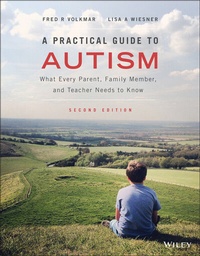
A Practical Guide to Autism
Description

The revised and updated second edition of A Practical Guide to Autism offers an authoritative guide to the diagnosis, assessment, and treatment of Autism/Autism Spectrum Disorder. Written by two highly regarded medical professionals, the book offers parents, family memberts, and teachers a useful review of the concept of autism, its diagnosis, and the most current treatments available. This comprehensive resource covers the range of the condition in infants, young, and school age children, adolescents, and adults.
The authors explore evidence-based treatments and review of some of the alternative and complementary treatments proposed for autism. Information on educational programs and entitlement services are also provided. In addition, the book contains information on issues, such as medical care, medication use, safety, behavioral, and mental health problems. The book covers the range of ages and entire spectrum of autism and provides an introduction to the diagnostic concept. With the expanding number of treatments and interventions this book is a useful guide for all those involved in caring for individuals on the autism spectrum. This important guide:
* Offers lists of resources for parents and professionals compiled by experts in the field and reviewed by parents.
* Includes updated research that adheres to DSM-5 standards
* Provides an accessible resource with succinct content delivery
* Contains new discussions on modern treatments that have been identified since the publication of the first edition
Written for parents, teachers, and caregivers, A Practical Guide to Autism, Second Edition offers an updated and expanded edition to the practical guide to autism.
More details
Other editions
Additional editions
Persons
LISA A. WIESNER, MD, is a pediatrician, now retired, and previously a Clinical Assistant Professor, Department of Pediatrics, Yale University School of Medicine, New Haven, CT.
Content
Chapter 1 An Introduction to Autism: What Is It and How Do We Understand It? 1
Chapter 2 Getting a Diagnosis 21
Appendix 1 Understanding Assessment Results 43
Chapter 3 Overview of Educational Programs and Interventions 45
Chapter 4 Securing Services 71
Chapter 5 Infants and Young Children with ASD 89
Chapter 6 The School-Age Child With ASD 109
Chapter 7 Adolescents and Adults on the Autism Spectrum 135
Chapter 8 Medical Care 155
Chapter 9 Safety 173
Chapter 10 Sleep and Sleep Problems 185
Chapter 11 Sensory Issues 197
Chapter 12 Behavioral and Mental Health Problems: Issues and Interventions 207
Chapter 13 Considering Medications for Behavior and Mental Health Problems 225
Chapter 14 Considering Complementary, Alternative, and Emerging Treatments 243
Chapter 15 Supporting Families 257
Appendix 1: Glossary 269
Index 283
Chapter 1
An Introduction to Autism
What Is It and How Do We Understand It?
What Is Autism?
There are many ways to talk about autism. Perhaps the simplest one is to think of autism as a social learning disability. Like other "hidden" learning disabilities/differences (e.g., reading problems/dyslexia) it is not immediately apparent just by looking at the child. The reason autism is so significant is that if you don't learn from others from the first days of life you really lose out on many important things. Given a lack of interest in people and social interaction, many early processes don't come into play; for example, you don't engage in joint attention (not looking where and at what your parents are looking at, thus missing out on what is important), you don't engage in what is called incidental learning (learning by watching) or imitation. If you don't "play the social game" you have trouble multitasking and organizing the world (what psychologists call executive functioning). Unlike other infants you don't go rapidly back and forth between different aspects of the world, what the person is saying, doing, how the person is feeling, what the tone of voice or gestures tell you. You do not like change. You easily develop unusual interests in things-particularly if they are stable and unchanging like street signs, alphabet letters, or hood ornaments on cars. This lack of interest in others also means you have less interest in understanding what they say and feel, and as a result you have less interest in communicating and less ability to understand and communicate feelings, wants, and needs. These problems get even worse as you go to school and are expected to sit in a chair and share attention with other children focused on a teacher!
This is a simple (but not incorrect) way to start thinking about autism. Of course, things are much more complex than this, particularly when you discover that there can be a broad range of outcomes in autism-the child who sits and body rocks and rarely talks, all the way to the overly talkative adolescent who wants to talk to you about his toaster collection! The pervasiveness of autism leads to major difficulties in efficient learning. This chapter gives some background on autism and related autism spectrum disorders (ASDs) and sets the stage for more detailed explanations later on in the book
When Was Autism First Recognized as a Disorder?
The recognition of autism as a disorder is a pretty recent one-the disorder was first described in 1943 but not "officially" used as a diagnosis until 1980. Other conditions such as Asperger's disorder were "officially" recognized even more recently. Given that our understanding of autism and related conditions has changed, you may hear many different terms used to describe your child's difficulties. Because knowledge has changed over the years there are also some misconceptions about autism that persist and that you may encounter (particularly among people who haven't kept up with the field!). Finally, if you are looking at this book you are probably wondering if a child you know has autism-we think it would be helpful to you to know something about autism and the autism spectrum.
Autism also known as autistic disorder, childhood autism, or infantile autism and now as autism spectrum disorder (all the names mean more or less the same thing!) was first described as a medical condition by Dr. Leo Kanner back in 1943. Dr. Kanner, the first child psychiatrist in the country, reported on 11 children who appeared to exhibit what he called "an inborn disturbance of affective contact." By this he meant that, in contrast to normal babies, these children came into the world without the usual interest in other people. This was in contrast to normally developing babies for whom people are the single most interesting things in the environment. He believed that the difficulty in dealing with the social world was congenital in nature that is the children were born with it. Dr. Kanner gave a careful description of the unusual behaviors these first cases exhibited. He discussed at great length some of the unusual behaviors they exhibited (see Box 1.1).
BOX 1.1 KANNER QUOTE
The outstanding, "pathognomonic," fundamental disorder is in the children's inability to relate themselves in the ordinary way to people and situations from the beginning of life. Their parents referred to them as having always been "self-sufficient"; "like in a shell"; "happiest when left alone"; "acting as if people weren't there"; "perfectly oblivious to everything about him"; "giving the impression of silent wisdom"; "failing to develop the usual amount of social awareness"; "acting almost as if hypnotized." This is not, as in schizophrenic children or adults, a departure from an initially present relationship; it is not a "withdrawal" from formerly existing participation. There is from the start an extreme autistic aloneness that, whenever possible, disregards, ignores, shuts out anything that comes into the child from outside. Direct physical contact or such motion or noise as threatens to disrupt the aloneness is either treated "as if it weren't there," or, if this is longer and sufficient, resented painfully as a distressing interference.
This insistence on sameness led several children to become greatly disturbed upon the sight of anything broken or incomplete. A great part of the day was spent in demanding not only the sameness of the wording of a request but also the sameness of the sequence of events.
The dread of change and incompleteness seems to be a major factor in the explanation of the monotonous repetitiousness and the resulting limitation in the variety of spontaneous activity. A situation, a performance, a sentence is not regarded as complete if it is not made up of exactly the same elements that were present at the time the child was first confronted with it. If the slightest ingredient is altered or removed the total situation is no longer the same and therefore is not accepted as such, or it is resented with impatience or even with a reaction of profound frustration.
From Leo Kanner, Autistic disturbances of affective contact, Nervous Child, 2, 217-250, 1943.
In addition to emphasizing the importance of autism (living in your own world) he emphasized that the children exhibited "resistance to change." By this, he meant that they literally had what he termed "insistence on sameness." For example, a child might require that the parents take the same route to school or church and become very upset if there was any deviation from this routine. They might be very rigid about what kinds of clothes they would wear or foods they would eat. The term "resistance to change" as used by Kanner in 1943 also refers to some of the unusual behaviors frequently seen in dealing with changes in the environment or routine; for example, the apparently purposeless motor behaviors (stereotyped movements) such as body rocking, and hand flapping, often exhibited in autism. Kanner viewed these as purposeful and a way for the child to maintain sameness, a feeling of comfort with an unchanged environment. Dr. Kanner mentioned that when language developed at all it was unusual. For example, the child with autism might fail to give the proper tone to his or her speech (that is, might speak like a robot) or might echo language (echolalia) or confuse personal pronouns (pronoun reversal). For example, when asked if he or she wanted a cookie, the child might respond "Wanna cookie, wanna cookie, wanna cookie." Sometimes the language that was echoed was from the distant past (delayed echolalia). Sometimes it happened at once (immediate echolalia). Sometimes part of it was echoed but part had been changed (mitigated echolalia). In his original report Kanner thought there were two things essential for a diagnosis of autism: (1) the autism or social isolation and (2) the unusual behaviors and insistence on sameness.
As time went on, it became clear that language/communication problems were also important in the diagnosis (when you think about it, of course, language is an important aspect of social development!). Including these problems along with the early onset of the condition that Kanner mentioned we have what continue to be the four hallmarks of autism: (1) impaired social development of a type quite different from that in normal children, (2) impaired language and communication skills-again of a distinctive type, (3) resistance to change or insistence on sameness as reflected in inflexible adherence to routines, motor mannerisms and stereotypies, and other behavioral oddities, and (4) an onset in the first years of life.
Of course, autism existed before Kanner described it. Likely children who were described as "wild" or "feral," presumed to have been living in the wild or raised by animals, may well have been the first children with autism. They may have been abandoned or ran away from their parents (the problem of bolting that we'll talk about when we discuss safety). In their excellent history of autism, Donvan and Zuker (2016) gave examples of individuals with autism in the 1800s, before autism was recognized as a condition as such. There are some other...
