

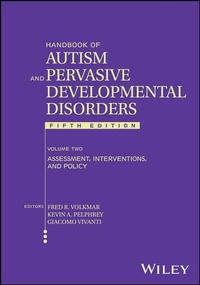
Handbook of Autism and Pervasive Developmental Disorders, Volume 2
Description

The definitive guide to autism and related conditions, with in-depth multidisciplinary coverage spanning clinical, developmental, biological, social, and public health perspectives
The Handbook of Autism and Pervasive Developmental Disorders is the most influential reference work in the field of autism and related conditions. This Fifth Edition reflects updated diagnostic frameworks in the DSM-5 and ICD-11, as well as evolving societal perspectives on autism. Across two volumes, it addresses evolving and emerging topics such as gene-environment interactions, theoretical frameworks, developmental neurobiology, mental health care, clinical assessment, gender and minority issues, naturalistic developmental behavioral interventions, new learning technologies, economic aspects, and interactions with the law.
Inside Volume Two: Assessment, Interventions, and Policy, readers will find the most authoritative information on screening, assessment, interventions, services and supports, as well as cultural and policy ramifications. Volume One (available separately), covers diagnostic, developmental, and neurobiological aspects of autism, alongside its genetic, environmental, biochemical, social, medical and theoretical dimensions.
Students and practitioners in psychology, special education, and related fields will appreciate this thorough update for the authoritative guide to autism spectrum disorder. It is a must-read resource discussing scientifically validated approaches to understanding and supporting individuals on the autism spectrum.
More details
Other editions
Additional editions
Persons
FRED R. VOLKMAR, MD, is the Irving B Harris Professor Emeritus of Child Psychiatry at Yale University and the Dorothy B. Goodwin Family Chair in Special Education at Southern Connecticut State University. The author of several hundred articles on autism, Dr. Volkmar was the main author of the DSM-IV autism section and served as editor of the Journal of Autism for 15 years.
KEVIN A. PELPHREY, PhD, is Harrison Wood Jefferson Scholars Foundation Distinguished Professor at the University of Virginia. He also leads the NIH Autism Center for Excellence.
GIACOMO VIVANTI, PhD, is an Associate Professor at the A.J. Drexel Autism Institute, where he leads the Early Detection and Intervention research program. He is also an Associate Editor of the Journal of Autism and Developmental Disorders.
Content
CHAPTER 25
Screening for Autism in Young Children
SHANA M. ATTAR, LISA V. IBANEZ, AND WENDY L. STONE
- CHARACTERISTICS OF AUTISM IN YOUNG CHILDREN
- IMPORTANCE OF EARLY SCREENING FOR AUTISM
- THE SCREENING PROCESS
- Dimensions of Screening Measures
- Evaluating Screening Measures
- Psychometric Properties of Screening Measures
- Implementation Properties of Screening Measures
- REVIEW OF LEVEL 1 AUTISM SCREENING MEASURES
- Autism-Specific Screening Measures
- Broad-Based Screening Measures
- Level 1 Summary
- REVIEW OF LEVEL 2 SCREENING MEASURES
- Screening Tool for Autism in Toddlers (STAT)
- Childhood Autism Rating Scale (CARS/CARS2)
- Gilliam Autism Rating Scale (GARS/GARS-2)
- Social-Communication Questionnaire (SCQ)
- Other Promising Measures
- Level 2 Summary
- CONCLUSION AND FUTURE DIRECTIONS
- REFERENCES
Evidence from early intervention (EI) research clearly indicates that participation in autism-specialized services at young ages can optimize the social-communicative and cognitive skills of children on the autism spectrum (ASD or autism; Dawson et al., 2010; Ingersoll & Lalonde, 2010; Kasari et al., 2010; Landa et al., 2011; Zwaigenbaum et al., 2015) and may even positively impact patterns of brain activity (Dawson, 2008; Dawson et al., 2012). Although caregiver concerns about their child's development are often present by 17-19 months (Coonrod & Stone, 2004; De Giacomo & Fombonne, 1998), an autism diagnosis is often not conferred until preschool or school-age (Oswald et al., 2017; Sheldrick et al., 2017), and the median diagnostic age in the United States is 49 months (Maenner, 2023). As a result, many children miss the opportunity to benefit from early, autism-focused services. Screening for autism in young children has the potential to promote earlier identification and more widespread, systematic referrals to appropriately specialized programs and services. This chapter addresses several topics related to the screening of young children for autism, including the early behavioral features, early screening practices and models, and the current state of the science regarding early screening measures for autism.
CHARACTERISTICS OF AUTISM IN YOUNG CHILDREN
Autism is a neurodevelopmental condition that emerges early in life. The past 25 years have seen a dramatic increase in research focused on identifying the earliest signs and features of autism. Underlying the push for earlier identification is the possibility of preventing or mitigating some of the challenges associated with autism by providing targeted intervention strategies during the period of rapid brain growth and development that occurs in infancy and toddlerhood. It is now well established that the social-emotional and social-communicative differences observed in preschool-aged children on the autism spectrum are also present by the second year of life in children later diagnosed with autism. For example, social-communication behaviors such as socially directed gaze, motor imitation, social smiling, response to adult social bids and expressions of distress, and initiation of joint attention by pointing to and showing objects have been shown to differentiate infants with and without autism using both retrospective (Adrien et al., 1993; Baranek, 1999; Osterling et al., 2002; Werner et al., 2000) and prospective research designs (Charman et al., 1997; Hutman et al., 2010; Landa et al., 2007; Ozonoff et al., 2010; Rozga et al., 2011; Yoder et al., 2009), and these findings have been confirmed across independent research groups. In a similar vein, repetitive motor behaviors and atypical object use have also been found in children on the autism spectrum by the second year of life (Ozonoff et al., 2008; Watt et al., 2008).
Behavioral findings such as these have informed the development and refinement of many screening tools currently used for the early detection of autism. However, the identification of this pattern of behavioral characteristics in a young child can be challenging for several reasons. First, social-communication differences, often considered to be the core feature of autism, represent "negative" characteristics-the reduced frequency of behaviors expected for a child's developmental level (Filipek et al., 1999). It can be very difficult to interpret the relative absence of an expected behavior in young children, whose moment-to-moment behavioral variations are more vulnerable to the influence of internal state and setting factors. For example, the failure to observe social smiling in an 18-month-old during a routine well-child clinic visit may be consistent with autism, but may also reflect fatigue, hunger, or a host of other contributing causes. Second, social-communicative behavior is not an all-or-none phenomenon. It is rarely the case that young children on the autism spectrum never make eye contact, or never imitate the actions of others. Rather, the differences between children with and without autism tend to be in the consistency with which these behaviors are exhibited and the effort required to elicit them (Baranek, 1999), both of which can be difficult to measure or assess. Third, there are no established norms or milestones for social behaviors in the same way they exist for motor skills or language development. What percentage of time is a child expected to look at a caregiver who calls their name, and how does one quantify social reciprocity during everyday interactions? There is much greater ambiguity in the definitions and expectations for social behaviors than for other developmental milestones.
Additionally, social-communication cues may be perceived and scaffolded by caregivers differentially based on the cultural context of their family. For example, certain social behaviors encouraged in some cultural contexts, such as reciprocal, turn-taking play with adults, may be absent or limited in other cultural contexts. Also, prior research has confirmed that caregivers from distinct cultural backgrounds report different social-communication differences depending on the cultural importance of a particular delayed or absent skill (Blacher et al., 2019; Daley, 2004; De Giacomo & Fombonne, 1998; Donohue et al., 2019; Mandell & Novak, 2005; Ohta et al., 1987; Ratto et al., 2016) even when children may exhibit similar behaviors. For example, caregivers of children on the autism spectrum in India tend to report that their children lack warmth or are "aloof" with their mothers (Daley, 2004), which violates cultural expectations for child-maternal behavior, whereas caregivers in the United States have focused on children's speech irregularities (i.e., odd pitch, tonality, or idiosyncratic use of words) which conflicts with cultural norms that prioritize early verbal skills (Coonrod & Stone, 2004). Accordingly, it can be difficult to select social-communication targets for screening tools that are appropriate across cultures.
IMPORTANCE OF EARLY SCREENING FOR AUTISM
Many studies have provided support for the importance of early formal screening for autism. For example, one study conducted in a large, community-based pediatric practice found that the use of formal autism screening tools was more effective in identifying autism than was pediatrician's clinical judgment alone (Miller et al., 2011). Other studies have found that training health care workers in the use of autism screening instruments is not only associated with increased knowledge about early social and communication markers of autism, but also contributes to significant practice change (Charman et al., 2001; Oosterling et al., 2010; Steinman et al., 2021; Swanson et al., 2014; Warren et al., 2009). Perhaps the most compelling support, however, comes from an early detection program conducted in the Netherlands (Oosterling et al., 2010), in which health care providers in a specific region were trained in the use of a formal autism screening tool, the Early Screening of Autistic Traits Questionnaire (ESAT; (Dietz et al., 2006; Swinkels et al., 2006)). The mean age of diagnosis in the region participating in the program dropped from 82.9 months to 63.5 months, whereas no change was observed in a region not participating in the program. In addition, children in the targeted region were over nine times more likely to be diagnosed before 36 months relative to those in the comparison region. Similarly, in a more recent study (Guthrie et al., 2019) the mean time to diagnosis was 7.5 months shorter for children who screened positive on a formal autism measure than for those who screened as false negatives. Thus, the routine use of formal screening tools has been shown to increase providers' knowledge about early autism indicators, reduce bias in referrals...
