

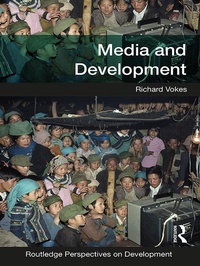
Media and Development
Published on 15. November 2017
316 pages
978-1-317-75470-1 (ISBN)
Description

At the start of the 21st century, the relationship between media and development has never felt more important. Following a series of 'media revolutions' throughout the developing world - beginning with the advent of cheap transistor radio sets in the late-1960s, followed by the rapid expansion of satellite television networks in the 1990s, and the more recent explosion of mobile telephony, social media and the internet - a majority of people living in the Global South now have access to a wide variety of Information and Communications Technologies (ICTs), and live in media saturated environments.
Yet how can radio, television and mobile phones be most effectively harnessed towards the goals of purposive economic, social, and political change? Should they be seen as primarily a provider of channels through which 'useful information' can be delivered to target populations - in the hope that such information will alter those populations' existing behaviours? Or should they be seen as a tool for facilitating 'two-way communication' between development providers and their recipients (i.e. as technologies for improving 'participatory development')? Or should new media environments be approached simply as sites in which people living in the developing world can define 'development' on their own terms?
This timely and original book - which is based on a critical reading of the relevant literatures, and on the author's own extensive primary research - introduces readers to all of these questions, and helps them to reach their own informed positions on each. It also examines the history of, and current debates regarding, media representations of development. Drawing on case studies from all over the world - including: 'hate radio' in Rwanda; theatre for development in India; telenovelas in Latin America; mobile banking and money in Africa, and; GIS and humanitarianism in Haiti - it will be of interest to all undergraduate and postgraduate students of media and development; international development professionals, and; simply to anyone with an interest in how media does, can, or should, change the world.
Yet how can radio, television and mobile phones be most effectively harnessed towards the goals of purposive economic, social, and political change? Should they be seen as primarily a provider of channels through which 'useful information' can be delivered to target populations - in the hope that such information will alter those populations' existing behaviours? Or should they be seen as a tool for facilitating 'two-way communication' between development providers and their recipients (i.e. as technologies for improving 'participatory development')? Or should new media environments be approached simply as sites in which people living in the developing world can define 'development' on their own terms?
This timely and original book - which is based on a critical reading of the relevant literatures, and on the author's own extensive primary research - introduces readers to all of these questions, and helps them to reach their own informed positions on each. It also examines the history of, and current debates regarding, media representations of development. Drawing on case studies from all over the world - including: 'hate radio' in Rwanda; theatre for development in India; telenovelas in Latin America; mobile banking and money in Africa, and; GIS and humanitarianism in Haiti - it will be of interest to all undergraduate and postgraduate students of media and development; international development professionals, and; simply to anyone with an interest in how media does, can, or should, change the world.
More details
Series
Language
English
Place of publication
London
United Kingdom
Publishing group
Taylor & Francis Ltd
Target group
College/higher education
Illustrations
45 s/w Abbildungen, 36 s/w Photographien bzw. Rasterbilder, 9 s/w Zeichnungen
9 Line drawings, black and white; 36 Halftones, black and white; 45 Illustrations, black and white
File size
16,98 MB
ISBN-13
978-1-317-75470-1 (9781317754701)
Copyright in bibliographic data and cover images is held by Nielsen Book Services Limited or by the publishers or by their respective licensors: all rights reserved.
Schweitzer Classification
Other editions
Additional editions
Richard Vokes
Media and Development
Book
11/2017
1st Edition
Routledge
€60.60
Shipment within 15-20 days
Richard Vokes
Media and Development
Book
11/2017
1st Edition
Routledge
€252.54
Shipment within 15-20 days
Person
Richard Vokes is a Senior Lecturer in Anthropology and Development Studies at the University of Adelaide. He has long-standing research interests in the Great Lakes region of East Africa, especially in the areas of visual and media anthropology.
Content
Acknowledgements Introduction: Media and Development, A Complicated Relationship 1. The Rise and Rise of Media for Development 2. Development in the News: From Iconographies of Disaster to Post-Humanitarian Communication 3. Media, Empowerment and Agency: The Promises of Participatory Communication 4. Structural-Adjustment and Media Globalization 5. ICT4D in New Media Worlds 6. Development and Celebrity Bibliography Index
