

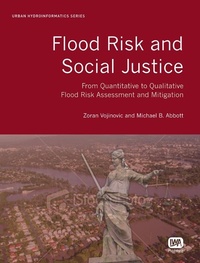
Flood Risk and Social Justice
From Quantitative to Qualitative Flood Risk Assessment and Mitigation
Published on 5. March 2012
581 pages
978-1-78040-082-2 (ISBN)
Description

Flood Risk and Social Justice is a response to the rising significance of floods and flood-related disasters worldwide, as an initiative to promote a socially just approach to the problems of flood risk. It integrates the human-social and the technological components to provide a holistic view.
This book treats flooding as a multi-dimensional human and natural world tragedy that must be accommodated using all the social and technological means that can be mobilised before, during and after the flooding event. It covers socially just flood risk mitigation practices which necessitate a wide range of multidisciplinary approaches, starting from social and wider environmental needs, including feedback cycles between human needs and technological means. Flood Risk and Social Justice looks at how to judge whether a risk is acceptable or not by addressing an understanding of social and phenomenological considerations rather than simple calculations of probabilities multiplied by unwanted outcomes and their balancing between costs and benefits.
It is argued that the present 'flood management' practice should be largely replaced by the social justice approach where particular attention is given to deciding what is the right thing to do within a much wider context. Thus it insists upon the validity of modes of human understanding which cannot be addressed within the limited context of modern science. Flood Risk and Social Justice is written to support a wide range of audiences and seeks to improve the dialogue between researchers and practitioners from different disciplines (including post-graduate engineering, environmental and social science students, industry practitioners, academics, planners, environmental advocacy groups and environmental law professionals) who have a strong interest in a new kind of social justice work that can act as a continuous counter-balance to the various mechanisms that unceasingly give rise to profound injustices.
More information about this book can be found in this article written for the WaterWiki by the author: http://www.iwawaterwiki.org/xwiki/bin/view/Articles/FloodRiskandSocialJustice
Authors: Zoran Vojinovic is Associate Professor at the UNESCO-IHE Institute for Water Education, Delft, the Netherlands, with almost 20 years of consulting and research experience in various aspects of water industry in New Zealand, Australia, Asia, Europe, Central/South America and the Caribbean. Michael B. Abbott is Emeritus Professor at the UNESCO-IHE Institute for Water Education, Delft, the Netherlands, and a Director of the European Institute for Industrial Leadership in Brussels. He founded and developed the disciplines of Computational Hydraulics and Hydroinformatics and co-founded, the Journal of Hydroinformatics with Professor Roger Falconer.
This book treats flooding as a multi-dimensional human and natural world tragedy that must be accommodated using all the social and technological means that can be mobilised before, during and after the flooding event. It covers socially just flood risk mitigation practices which necessitate a wide range of multidisciplinary approaches, starting from social and wider environmental needs, including feedback cycles between human needs and technological means. Flood Risk and Social Justice looks at how to judge whether a risk is acceptable or not by addressing an understanding of social and phenomenological considerations rather than simple calculations of probabilities multiplied by unwanted outcomes and their balancing between costs and benefits.
It is argued that the present 'flood management' practice should be largely replaced by the social justice approach where particular attention is given to deciding what is the right thing to do within a much wider context. Thus it insists upon the validity of modes of human understanding which cannot be addressed within the limited context of modern science. Flood Risk and Social Justice is written to support a wide range of audiences and seeks to improve the dialogue between researchers and practitioners from different disciplines (including post-graduate engineering, environmental and social science students, industry practitioners, academics, planners, environmental advocacy groups and environmental law professionals) who have a strong interest in a new kind of social justice work that can act as a continuous counter-balance to the various mechanisms that unceasingly give rise to profound injustices.
More information about this book can be found in this article written for the WaterWiki by the author: http://www.iwawaterwiki.org/xwiki/bin/view/Articles/FloodRiskandSocialJustice
Authors: Zoran Vojinovic is Associate Professor at the UNESCO-IHE Institute for Water Education, Delft, the Netherlands, with almost 20 years of consulting and research experience in various aspects of water industry in New Zealand, Australia, Asia, Europe, Central/South America and the Caribbean. Michael B. Abbott is Emeritus Professor at the UNESCO-IHE Institute for Water Education, Delft, the Netherlands, and a Director of the European Institute for Industrial Leadership in Brussels. He founded and developed the disciplines of Computational Hydraulics and Hydroinformatics and co-founded, the Journal of Hydroinformatics with Professor Roger Falconer.
Reviews / Votes
"The book fills this gap in the current literature by broadening the focus of traditional flood management practice. It offers, in one place, an overview on issues that range from the social and ethical, to the scientific and practical. I commend this most interesting book to people of good will who are concerned with the risk of flooding, and with the education of new model engineers, and say to them: Read on!" J. PHILIP O'KANE, Emeritus Professor, University College Cork, Ireland."This monumental volume is surely entirely unique in the world of practical hydrology and engineering. The introductory sections on the "technocratic" way of thinking versus Wisdom include references to and quotations from Heidegger, Corbin, Nasr and others whose very existence is unknown to many of the usual readers of such a volume. The author's vision of how technology might be used to contribute wisely to a more just and sustainable world is compelling, inclusive and of the utmost importance." DR. TOM CHEETHAM, Fellow Of The Temenos Academy
More details
Language
English
Place of publication
London
United Kingdom
Target group
College/higher education
Professional and scholarly
File size
32,77 MB
ISBN-13
978-1-78040-082-2 (9781780400822)
Copyright in bibliographic data and cover images is held by Nielsen Book Services Limited or by the publishers or by their respective licensors: all rights reserved.
Schweitzer Classification
Other editions
Additional editions
Zoran Vojinovic | Michael B. Abbott
Flood Risk and Social Justice
Book
03/2012
IWA Publishing
€197.50
Shipment within 3-4 weeks
Content
Table of contents: Foreword by Prof J. Philip O'Kane; Foreword by Prof Jean A. Cunge Introduction; The Nature of Urban Flood Risk; Urban areas and flooding, Tracing the roots of urban flood risk, The nature of risk, Adding Social and Ethical Aspects into Flood Risk Mitigation; The technocratic way of thinking, Historical perspectives of social justice, Characterisations of social justice, Realising social justice in the context of flood risk mitigation, Leadership and social justice, On sociotechnology, Data-Information-Knowledge-Understanding-Wisdom, The role of hydroinformatics in active stakeholder participation, Scientific and Technical Aspects of Flooding; Floods and drainage systems, Quantifying urban processes, Data collection for modelling, Rainfall data analysis and catchment delineation, Modelling wet weather and dry weather flows, Hydraulic modelling, Numerical solutions of equations, Modelling practice, Practical Aspects of Flood Risk Assessment and Mitigation; Flood risk assessment, Flood mitigation measures, Production of plans
