

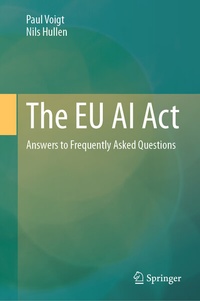
The EU AI Act
Description

The AI Act of the European Union regulates the development and use of AI comprehensively and for all sectors. Companies, as well as NGOs and public authorities, are subject to obligations under the new European regulation, even if they are located outside of the EU. Readers of this handbook are introduced to the EU AI Act in an easy-to-read Q&A-style. The book addresses all relevant questions and provides guidance on how to deal with the obligations for providers, deployers and other stakeholders of the AI ecosystem, enabling compliance with the requirements of the AI Act: What is 'Artificial Intelligence' in terms of the EU AI Act? Which AI systems and operators are in scope? What general requirements apply to AI systems and general-purpose AI models? Which AI practices are prohibited? How does the risk-based approach of the AI Act work? How do GDPR and AI Act interact? What technical standards can be implemented to comply with the AI Act? Which fines apply in case of infringements? The book will address these questions and many more in order to facilitate the application and implementation of the EU AI Act for stakeholders of all shapes and sizes.
More details
Other editions
Additional editions
Persons
Dr. Paul Voigt is a lawyer specialising in IT law and partner at the international law firm Taylor Wessing, where he heads the German Technology, Media & Telecoms practice group. He advises his clients on national and international data protection projects and has proven expertise in IT security law and AI matters.
Dr. Nils Hullen has been working in the technology sector at the intersection of policy, regulation and business for more than 15 years. He is responsible for the global regulatory strategy in the field of AI and privacy at a large US technology company.
Content
1 Scope and General Requirements.- 2 What AI Practices are Prohibited?.- 3 What Requirements Apply to High-Risk AI Systems?.- 4 Which AI Systems are Subject to Specific Transparency Requirements?.- 5 What Requirements Apply to GPAI Models?.- 6 How is the AI Act Implemented and Enforced?.- 7 What Other Legislation is Particularly Relevant with Regard to AI?.
