

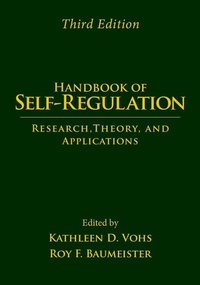
Handbook of Self-Regulation
Research, Theory, and Applications
3rd Edition
Published on 1. June 2016
640 pages
978-1-4625-2637-6 (ISBN)
Description

Researchers and students in social, cognitive, personality, developmental, and clinical psychology. May serve as a supplemental text in graduate-level courses.
More details
Other editions
Additional editions
Kathleen D. Vohs | Roy F. Baumeister
Handbook of Self-Regulation, Third Edition
Research, Theory, and Applications
Book
11/2017
3rd Edition
Guilford Press
€67.00
Shipment within 15-20 days
Kathleen D. Vohs | Roy F. Baumeister
Handbook of Self-Regulation, Third Edition
Research, Theory, and Applications
Book
07/2016
3rd Edition
Guilford Press
€100.50
Shipment within 15-20 days
Persons
Kathleen D. Vohs, PhD, is Associate Professor of Marketing at the Carlson School of Management at the University of Minnesota. She holds a McKnight Presidential Fellowship and is the Board of Overseers Professor of Marketing. Dr. Vohs has more than 120 professional publications, including six books. Her research is concerned with self-regulation, particularly in regard to impulsive spending and eating, decision making, self-esteem, the fear and feeling of being duped, self-escape behaviors, and the psychology of money.
Roy F. Baumeister, PhD, is Professor Emeritus of Psychology at Florida State University and at the University of Queensland in Australia. One of social psychology's most highly cited researchers, Dr. Baumeister has been conducting research, teaching, and thinking about the human self since the 1970s. His work spans multiple topics, including self and identity, self-control, interpersonal rejection and the need to belong, sexuality and gender, violence and evil, self-esteem, self-presentation, emotion, decision making, consciousness and free will, and finding meaning in life. He has written approximately 700 professional publications as well as numerous books for professionals and the general public. Dr. Baumeister is a recipient of awards including the Distinguished Lifetime Achievement Award from the International Society for Self and Identity and the William James Fellow Award, the highest honor of the Association for Psychological Science.
Roy F. Baumeister, PhD, is Professor Emeritus of Psychology at Florida State University and at the University of Queensland in Australia. One of social psychology's most highly cited researchers, Dr. Baumeister has been conducting research, teaching, and thinking about the human self since the 1970s. His work spans multiple topics, including self and identity, self-control, interpersonal rejection and the need to belong, sexuality and gender, violence and evil, self-esteem, self-presentation, emotion, decision making, consciousness and free will, and finding meaning in life. He has written approximately 700 professional publications as well as numerous books for professionals and the general public. Dr. Baumeister is a recipient of awards including the Distinguished Lifetime Achievement Award from the International Society for Self and Identity and the William James Fellow Award, the highest honor of the Association for Psychological Science.
Content
I. Basic Regulatory Processes
1. Self-Regulation of Action and Affect, Charles S. Carver & Michael F. Scheier
2. The Self-Regulation of Emotion: Theoretical and Empirical Advances, Sander L. Koole & Amelia Aldao
3. Self-Control and Ego Depletion, Heather M. Maranges & Roy F. Baumeister
4. Self-Regulation of Implicit Social Cognition, Andrew M. Rivers, Jimmy Calanchini, & Jeffrey W. Sherman
5. Desire and Self-Regulation, Wilhelm Hofmann & Kathleen D. Vohs
6. The Role of Habits in Self-Control, Wendy Wood
II. Cognitive, Physiological, and Neurological Dimensions of Self-Regulation
7. The Cognitive Neuroscience of Self-Regulatory Failure, Dylan D. Wagner & Todd F. Heatherton
8. Pause and Plan: The Physiology of Self-Regulation, Suzanne C. Segerstrom, Ian A. Boggero, & Daniel R. Evans
9. Consensus versus Anarchy in the Senate of the Mind: On the Roles of High Level versus Low Level Construal in Self-Control, Jessica J. Carnevale & Kentaro Fujita
10. Beyond Limited Resources: Self-Control Failure as the Product of Shifting Priorities, Michael Inzlicht & Brandon J. Schmeichel
11. The Essential Role of Sleep in Self-Regulation, Zlatan Krizan & Garret Hisler
12. Automatic Self-Regulation: From Habit to Goal Pursuit, Esther K. Papies & Henk Aarts
13. Planning Promotes Goal Striving, Peter M. Gollwitzer & Gabrielle Oettingen
III. Social, Organizational, and Cultural Dimensions of Self-Regulation
14. Trust and the Perception of Self-Control: Knowing When to Trust Others, Catrin Finkenauer & Francesca Righetti
15. Self-Regulation as a Transactive Process: Reconceptualizing the Unit of Analysis for Goal Setting, Pursuit, and Outcomes, Eli J. Finkel, Gráinne M. Fitzsimons, & Michelle R. vanDellen
16. Regulation Processes in Romantic Relationships, Jeffry A. Simpson, Nickola C. Overall, Allison K. Farrell, & Yuthika U. Girme
17. Religion and Self-Regulation: Integrating Skills-Based and Motivation-Based Accounts, Kristin Laurin & Aaron C. Kay
18. Focusing in on the Emotion Laborer: Emotion Regulation at Work, Drew B. Mallory & Deborah E. Rupp
IV. Personality and Self-Regulation
19. Impulsivity as a Personality Trait, Colin G. DeYoung & Amanda R. Rueter
20. The Emerging Field of Positive Emotion Dysregulation, Alta du Pont, Keith Welker, Kirsten E. Gilbert, & June Gruber
21. Grit: Sustained Self-Regulation in the Service of Superordinate Goals, Lauren Eskreis-Winkler, James J. Gross, & Angela L. Duckworth
22. Varieties of Self-Control and Their Personality Correlates, Rick H. Hoyle & Erin K. Davisson
V. Development and Self-Regulation
23. The Development of Executive Functions and Self-Regulation: A Bidirectional Psychobiological Model, Clancy Blair
24. Self-Regulation Training, Elliot T. Berkman
25. Effortful Control: Relations with Emotion Regulation, Adjustment, and Socialization in Childhood, Nancy Eisenberg, Cynthia L. Smith, & Tracy L. Spinrad
26. Aging and Self-Regulation, William von Hippel & Julie D. Henry
VI. Self-Regulation Challenges
27. Attention-Deficit/Hyperactivity Disorder and Self-Regulation: Taking an Evolutionary Perspective on Executive Functioning, Russell A. Barkley
28. Self-Control and Crime: Theory, Research, and Remaining Puzzles, Michael Rocque, Chad Posick, & Alex R. Piquero
29. Deciding to Curtail Persistence, Joseph T. McGuire & Joseph W. Kable
30. Problems with Positive Thinking and How to Overcome Them, Gabriele Oettingen & Julie Y. A. Cachia
31. Self-Regulatory Failure and Addiction, Michael A. Sayette & Kasey G. Creswell
32. The Role of Self-Regulation in Financial Well-Being, Poornima Vinoo, Kim Ly, & Dilip Soman
Supplemental E-book Featuring Selected Chapters from the Second Edition:
*Self-Efficacy Beliefs and the Architecture of Personality: On Knowledge, Appraisal, and Self-Regulation, Daniel Cervone, Nilly Mor, Heather Orom, William G. Shadel, & Walter D. Scott
*Promotion and Prevention Systems: Regulatory Focus Dynamics within Self-Regulatory Hierarchies, Abigail A. Scholer & E. Tory Higgins
