

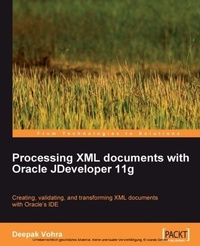
Processing XML documents with Oracle JDeveloper 11g
Creating, validating, and transforming XML documents with Oracle's IDE
Published on 13. January 2025
384 pages
978-1-84719-667-5 (ISBN)
Description

Create, validate, and transform XML documents with Oracle\'s JDeveloper IDE using this book and eBook
Key Features
Will get the reader developing applications for processing XML in JDeveloper 11g quickly and easily
Self-contained chapters provide thorough, comprehensive instructions on how to use JDeveloper to create, validate, parse, transform, and compare XML documents.
The only title to cover XML processing in Oracle JDeveloper 11g, this book includes information on the Oracle XDK 11g APIs.
Packed with example code and detailed commentary, the book is fully illustrated with functional step-by-step examples.
Book DescriptionXML is an open standard for creating markup languages and exchanging structured documents and data over the Internet. JDeveloper 11g presents an effective, quick, and easy-to-use means of processing XML documents. Inspired by the author's previous XML articles for the Oracle community, this expanded hands-on tutorial guides newcomers and intermediate users through JDeveloper 11g and XML document development. It offers up-to-date information on working with the latest version of JDeveloper, and brand new information on JAXB 2.0 support in JDeveloper 11g. Filled with illustrations, explanatory tables, and comprehensive instructions, this book walks the reader through the wide assortment of JDeveloper's capabilities. Oracle's JDeveloper 11g is an Integrated Development Environment that provides a visual and declarative approach to application development. Over the course of 14 chapters, readers will get hands-on with JDeveloper as the comprehensive and self-contained tutorials provide clear instruction on the key XML tasks that JDeveloper can accomplish. Filled with practical information and illustrated examples, this book shows the reader how to create, parse, and store XML documents quickly, as well as providing step-by-step instructions on how to construct an XML schema and use the schema to validate an XML document. Oracle's XML Developer Kit (XDK) offers a set of components, tools, and utilities for developing XML-based applications, and developers will find the detailed XDK coverage invaluable. Later chapters are given over to using XPath, transforming XML with XSLT, and using the JSTL XML Tag Library. Moving through the book, a chapter on the JAXB 2.0 API shows you how to bind, marshal and unmarshal XML documents, before we finally delve into comparing XML documents, and converting them into PDF and Excel formats. In all, this book will enable the reader to gain a good and wide-ranging understanding of what JDeveloper has to offer for XML processing.What you will learn
Learn what JDeveloper 11g can do for XML document generation.
Rapidly create, format, compare, and schema validate XML documents.
Master the built-in XML features in JDeveloper 11g including schema validation, the XSD Visual Editor for creating an XML schema, the XPath Search tool for selecting XML nodes with XPath, and the JAXB compiler for generating JAXB 2.0 Content Model from an XML Schema.
See how to work quickly and efficiently with the Oracle XML Developer Kit (XDK 11g)
Gain a valuable understanding of JAXP, XPath, XSLT, JAXB 2.0, DOM 3.0, and the JSTL XML Tag Library.
Convert XML to Excel and PDF formats, store XML in Oracle Berkeley DB XML, and create Oracle XML Publisher Reports.
Who this book is forEmploying a comprehensive tutorial-based approach, this easy-to-follow book shows the reader various means of processing XML documents using the power of Oracle's JDeveloper 11g. In next to no time, the reader will be able to create, format, transform, compare, and schema validate XML documents with Oracle's IDE.
Key Features
Will get the reader developing applications for processing XML in JDeveloper 11g quickly and easily
Self-contained chapters provide thorough, comprehensive instructions on how to use JDeveloper to create, validate, parse, transform, and compare XML documents.
The only title to cover XML processing in Oracle JDeveloper 11g, this book includes information on the Oracle XDK 11g APIs.
Packed with example code and detailed commentary, the book is fully illustrated with functional step-by-step examples.
Book DescriptionXML is an open standard for creating markup languages and exchanging structured documents and data over the Internet. JDeveloper 11g presents an effective, quick, and easy-to-use means of processing XML documents. Inspired by the author's previous XML articles for the Oracle community, this expanded hands-on tutorial guides newcomers and intermediate users through JDeveloper 11g and XML document development. It offers up-to-date information on working with the latest version of JDeveloper, and brand new information on JAXB 2.0 support in JDeveloper 11g. Filled with illustrations, explanatory tables, and comprehensive instructions, this book walks the reader through the wide assortment of JDeveloper's capabilities. Oracle's JDeveloper 11g is an Integrated Development Environment that provides a visual and declarative approach to application development. Over the course of 14 chapters, readers will get hands-on with JDeveloper as the comprehensive and self-contained tutorials provide clear instruction on the key XML tasks that JDeveloper can accomplish. Filled with practical information and illustrated examples, this book shows the reader how to create, parse, and store XML documents quickly, as well as providing step-by-step instructions on how to construct an XML schema and use the schema to validate an XML document. Oracle's XML Developer Kit (XDK) offers a set of components, tools, and utilities for developing XML-based applications, and developers will find the detailed XDK coverage invaluable. Later chapters are given over to using XPath, transforming XML with XSLT, and using the JSTL XML Tag Library. Moving through the book, a chapter on the JAXB 2.0 API shows you how to bind, marshal and unmarshal XML documents, before we finally delve into comparing XML documents, and converting them into PDF and Excel formats. In all, this book will enable the reader to gain a good and wide-ranging understanding of what JDeveloper has to offer for XML processing.What you will learn
Learn what JDeveloper 11g can do for XML document generation.
Rapidly create, format, compare, and schema validate XML documents.
Master the built-in XML features in JDeveloper 11g including schema validation, the XSD Visual Editor for creating an XML schema, the XPath Search tool for selecting XML nodes with XPath, and the JAXB compiler for generating JAXB 2.0 Content Model from an XML Schema.
See how to work quickly and efficiently with the Oracle XML Developer Kit (XDK 11g)
Gain a valuable understanding of JAXP, XPath, XSLT, JAXB 2.0, DOM 3.0, and the JSTL XML Tag Library.
Convert XML to Excel and PDF formats, store XML in Oracle Berkeley DB XML, and create Oracle XML Publisher Reports.
Who this book is forEmploying a comprehensive tutorial-based approach, this easy-to-follow book shows the reader various means of processing XML documents using the power of Oracle's JDeveloper 11g. In next to no time, the reader will be able to create, format, transform, compare, and schema validate XML documents with Oracle's IDE.
All prices
More details
Edition
Digital original
Language
English
Place of publication
Birmingham
United Kingdom
Edition type
Digital original
File size
16,96 MB
ISBN-13
978-1-84719-667-5 (9781847196675)
Copyright in bibliographic data and cover images is held by Nielsen Book Services Limited or by the publishers or by their respective licensors: all rights reserved.
Schweitzer Classification
Other editions
Additional editions
Deepak Vohra
Processing XML documents with Oracle JDeveloper 11g
Book
05/2009
Packt Publishing
€69.70
Shipment within 3-4 weeks
Person
Deepak Vohra is consultant and principle a member of the NuBean software company. He is a Sun Certified Java Programmer (SCJP) and Sun Certified Web Component Developer (SCWCD) and has worked in the fields of XML, Java programming, and J2EE for over 10 years. He is the coauthor of the Apress book Pro XML Development with Java Technology. Deepak is the author of several Packt Publishing books, including Processing XML documents with Oracle JDeveloper 11g and Java EE Development with Eclipse. Deepak is also a Docker Mentor and has published four other Docker-related books.
Content
Table of Contents

