

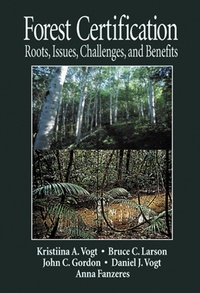
Forest Certification
Roots, Issues, Challenges, and Benefits
Published on 29. November 1999
400 pages
978-1-000-61193-9 (ISBN)
Description

Forest Certification examines the historical roots of forest certification, the factors that guide the development of protocols, the players involved, the factors determining the customers to be certified, and the benefits of certification. It covers terminology and issues that direct the structure of standards, the similarities between indicators of different human disturbances within the ecosystem/landscape, and certification standards. It documents the roles of human values in the development of assessment protocols and demonstrates how elements should be used to produce non-value based standards.
More details
Language
English
Place of publication
London
United Kingdom
Publishing group
Taylor & Francis Ltd
Target group
Professional and scholarly
Product notice
Reflowable
File size
1,21 MB
ISBN-13
978-1-000-61193-9 (9781000611939)
Copyright in bibliographic data and cover images is held by Nielsen Book Services Limited or by the publishers or by their respective licensors: all rights reserved.
Schweitzer Classification
Other editions
Additional editions
Daniel J. Vogt | Bruce C. Larson | John C. Gordon
Forest Certification
Roots, Issues, Challenges, and Benefits
Book
12/2019
1st Edition
CRC Press
€76.87
Shipment within 15-20 days
Kristiina A. Vogt | Bruce C. Larson | John C. Gordon
Forest Certification
Roots, Issues, Challenges and Benefits
Book
11/1999
1st Edition
CRC Press
€223.21
Shipment within 15-20 days
Persons
Daniel J. Vogt is a lecturer on soils and ecosystem ecology and an associate research scientist at the Yale School of Forestry and Environmental Studies. His expertise is in the different aspects of the properties and processes of soils related to ecosystem ecology, sustainable forestry, and biological conservation. He has been involved in research in Belize, Brazil, Iceland, Malaysia, and Mexico, and his experience includes work in Alaska, Connecticut, Hawaii, New Hampshire, New Mexico, New York, Oregon, Vermont, and Washington. Kristiina A. Vogt is professor of forest ecosystem ecology at Yale University's School ofForestry and Environmental Studies. She is also the chairman of the Yale Forest Forum. John C. Gordon is currently a Pinchot professor of forestry at Yale's School of Forestry and Environmental Studies, a position he has held since 1990. Bruce C. Larson is director of the forests belonging to Yale University and a lecturer in forest management at Yale's School of Forestry and Environmental Studies. He is also a member of the Scientific Advisory Board and a consultant to Mistik Management Ltd. Anna Fanzeres is a candidate for a doctorate in forestry and environmental studies from Yale, where she also earned her M.S. in environmental studies.
Content
Preface 1 Issues in forest certification 1.1 Improvements crucial to successful implementation of forest certification 1.2 Why certification is relevant 2 Roots of forest certification: its developmental history, types of approaches, and statistics 2.1 Origins of the concept of forest certification 2.2 Other relevant initiatives in forest certification 2.3 The certification of environmental claims in industrialized countries 2.4 Analysis of forest certification approaches 2.5 Current statistics and characterization of certified forests by ownership type and land area 3 Definitions and current values integrated into certification protocols 3.1 Defining terminology 3.2 Value-laden issues of certification 4 Case study and evaluation of the dominant certification protocols 4.1 Relevance of Toumey Forest to assess certification protocols 4.2 Analysis of the elements comprising the dominant certification protocols as structured in January 1998 4.3 Case study: student evaluation of protocols at Yale's Toumey Forest 5 Indicators relevant for inclusion in assessments: types, minimum number, and those derived from non-human values 5.1 Indicators selection criteria 5.2 Non-value-based parameters relevant for incorporation into certification 5.3 Social legacies constraining natural resource uses 6 Direct and indirect impacts of natural resource management practices on the ecosystem 6.1 Introduction 6.2 Forest management activities leading to regeneration 6.2.1 Processing of logs for transport (from stump to landing) 6.2.2 Methods of log transport (from stump to landing) 6.3 Forest management activities not associated with regeneration 6.4 Infrastructure related to forest management activities 6.5 Summary 7 Synthesis discussion of issues relevant to certification 7.1 Necessity of assessing the landscape's matrix within which a management unit is embedded 7.2 Social and natural science links 7.3 Public participation in certification 7.4 Importance and participation of non-industrial private forests 7.5 Certification: constraints and opportunities for non-industrial private forestland owners 7.6 Estimating price premiums necessary to pay for forest certification 7.7 Chain of custody as an impediment to certification 7.8 Challenges and opportunities for tropical timber certification: Mexico's experience 8 Challenges and benefits of certification 8.1 Summary discussion of the advantages and challenges of certification 8.2 Opportunities and challenges identified by certifiers and certified owners 8.3 Factors affecting future use of certification as an assessment tool 8.4 Reason for forestland owners not to become certified 8.5 The past and future goals of certification.
