

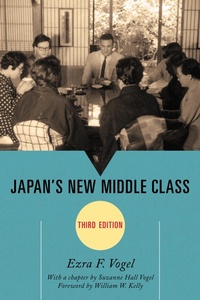
Japan's New Middle Class
3rd Edition
Published on 18. July 2013
1 pages
979-8-216-24077-8 (ISBN)
Description

This classic study on the sociology of Japan remains the only in-depth treatment of the Japanese middle class. Now in a fiftieth-anniversary edition that includes a new foreword by William W. Kelly, this seminal work paints a rich and complex picture of the life of the salaryman and his family.
In 1958, Suzanne and Ezra Vogel embedded themselves in a Tokyo suburb, living among and interviewing six middle-class families regularly for a year. Tracing the rapid postwar economic growth that led to hiring large numbers of workers who were provided lifelong employment, the authors show how this phenomenon led to a new social class-the salaried men and their families. It was a well-educated group that prepared their children rigorously for the same successful corporate or government jobs they held. Secure employment and a rising standard of living enabled this new middle class to set the dominant pattern of social life that influenced even those who could not share it, a pattern that remains fundamental to Japanese society today.
In 1958, Suzanne and Ezra Vogel embedded themselves in a Tokyo suburb, living among and interviewing six middle-class families regularly for a year. Tracing the rapid postwar economic growth that led to hiring large numbers of workers who were provided lifelong employment, the authors show how this phenomenon led to a new social class-the salaried men and their families. It was a well-educated group that prepared their children rigorously for the same successful corporate or government jobs they held. Secure employment and a rising standard of living enabled this new middle class to set the dominant pattern of social life that influenced even those who could not share it, a pattern that remains fundamental to Japanese society today.
More details
Series
Edition
3rd edition
Language
English
Place of publication
United States
Publishing group
Bloomsbury Publishing Plc
Illustrations
7 tables
ISBN-13
979-8-216-24077-8 (9798216240778)
Copyright in bibliographic data and cover images is held by Nielsen Book Services Limited or by the publishers or by their respective licensors: all rights reserved.
Schweitzer Classification
Other editions
Additional editions
Ezra F. Vogel
Japan's New Middle Class
Book
07/2013
3rd Edition
Rowman & Littlefield Publishers
€67.80
Shipment within 10-20 days
Persons
Ezra F. Vogel is the Henry Ford II Professor of Social Sciences Emeritus at Harvard University. Suzanne Hall Vogel (1931-2012) was a psychotherapist with University Health Services at Harvard University. William W. Kelly is professor of anthropology and Sumitomo Professor of Japanese Studies at Yale University.
Content
Foreword: Looking Backward at a Book That Looked Forward
William W. Kelly
Part I: The Significance of Salary
Chapter 1: The Problem and Its Setting
Chapter 2: The Bureaucratic Setting in Perspective
Chapter 3: The Gateway to Salary: Infernal Entrance Examinations
Part II: The Family and Other Social Systems
Chapter 4: The Consumer's "Bright New Life"
Chapter 5: Families View Their Government
Chapter 6: Community Relationships
Chapter 7: Basic Values
Part III: Internal Family Processes
Chapter 8: The Decline of the Ie Ideal
Chapter 9: The Division of Labor in the Home
Chapter 10: Authority in the Family
Chapter 11: Family Solidarity
Chapter 12: Child-Rearing
Part IV: Mamachi in Perspective
Chapter 13: Order Amidst Rapid Social Change
Part V: Mamachi Revisited
Chapter 14: Beyond Salary
Chapter 15: Beyond Success: Mamachi Thirty Years Later
Afterword
Ezra F. Vogel
Appendix: A Report on the Field Work
Selected Bibliography
William W. Kelly
Part I: The Significance of Salary
Chapter 1: The Problem and Its Setting
Chapter 2: The Bureaucratic Setting in Perspective
Chapter 3: The Gateway to Salary: Infernal Entrance Examinations
Part II: The Family and Other Social Systems
Chapter 4: The Consumer's "Bright New Life"
Chapter 5: Families View Their Government
Chapter 6: Community Relationships
Chapter 7: Basic Values
Part III: Internal Family Processes
Chapter 8: The Decline of the Ie Ideal
Chapter 9: The Division of Labor in the Home
Chapter 10: Authority in the Family
Chapter 11: Family Solidarity
Chapter 12: Child-Rearing
Part IV: Mamachi in Perspective
Chapter 13: Order Amidst Rapid Social Change
Part V: Mamachi Revisited
Chapter 14: Beyond Salary
Chapter 15: Beyond Success: Mamachi Thirty Years Later
Afterword
Ezra F. Vogel
Appendix: A Report on the Field Work
Selected Bibliography
