

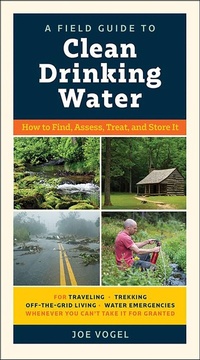
A Field Guide to Clean Drinking Water
How to Find, Assess, Treat, and Store It
Published on 22. September 2023
271 pages
978-1-61519-568-8 (ISBN)
Description

How to find and prepare safe drinking water-anywhere, any time! Clean drinking water may be the last thing we think about day to day-but it's the first thing we need in an emergency. Now, survival expert and biologist Joe Vogel explains how to find, treat, and store safe drinking water-even in the most extreme conditions. A Field Guide to Clean Drinking Water includes information about: ·The role of water in the body and how to calculate your water requirement ·Plants, geographical features, and more indicators that signal the presence of water ·How to collect dew and precipitation, and extract water from plants ·How to screen "raw water" for bacteria, pesticides, and other contaminants ·Every purifying method from boiling techniques to chemical disinfection ·And storage options that meet every need.Small enough to take anywhere-and broad enough to cover everything-this is a vital manual for backpackers, survivalists, and anyone who may need to know how to create their own drinking water.
More details
Other editions
Additional editions
Book
08/2019
The Experiment LLC
€16.50
Shipment within 3-4 weeks
Person
Joe Vogel is Germany's most renowned survival expert. From expeditions in the Australian outback to journeys through Africa, Central and Southern Europe, Asia, and South America, he has spent years traveling the remotest regions on Earth-accumulating extensive experience and putting his survival skills to the test in the process. He teaches via his website, survival courses, videos, and books, of which this is the second to be published in English.
Content
- Intro
- Cover
- Preface
- 1 Basics
- Water and its role
- Water's purpose in the body
- From dehydration to exsiccosis
- Hyperhydration-water poisoning
- Water in emergencies-and while traveling
- Water requirement
- Formula for the calculation of the daily water requirement
- Model calculation for moderate consumption
- Model calculation for high consumption
- Water on trekking tours
- Reserves and rationing
- Water stores
- Water stores as domestic reserves
- Water stores as emergency provisions
- Drinking properly
- Dealing with a water emergency
- Water stress
- Water shortage
- Water crisis
- 2 How to find water
- Properties of water
- How to read terrain structures
- Indicators for the presence of water
- Important indicators for moist soil
- Potential groundwater locations
- Wells
- Infiltration wells
- Suction wells
- Other sources
- Freshwater lenses
- Submarine freshwater sources
- Ice and snow
- Model calculation for two people with 3.5 liters drinking water each
- Humidity-dew
- Dew point
- Extracting water from the air
- Fog catchers
- Collecting dew
- Dew in the tent
- Further condensation methods
- Precipitation
- Cisterns and roof stores
- Water from food
- Water from plants
- Transpiration
- Extraction
- Simple Collection
- Water from animals
- 3 How to assess water
- Properties of raw water
- Turbidity
- Discoloration
- Sensory assessment
- Raw water vs. drinking water
- Pathogens
- Viruses
- Rotaviruses
- Hepatitis A
- Bacteriophages
- Bacteria
- Cholera (Vibrio cholerae/El Tor)
- Typhoid (Salmonella Typhi), paratyphoid (Salmonella Paratyphi), salmonellosis (Salmonella enterica), and others
- E. coli (EHEC, ETEC, and similar bacteria)
- Single-celled organisms and parasites
- Cryptosporidia (Cryptosporidium parvum and others)
- Giardia (Giardia duodenalis)
- Amoebas (Entamoeba histolytica/dispar)
- Multicellular parasite larvae (e.g., Schistosoma haematobium, Trichobilharzia ocellata)
- Blue-green algae
- Chemical components of raw water
- Sodium chloride (table salt)
- Salinity levels of the seas
- Determining salinity
- Other minerals and heavy metals
- Radioactivity
- Nitrite, nitrate, and other nitrogen compounds
- Pesticides and other organic compounds
- The saprobic index
- Indicator species
- Trophic state
- Assessing water quality
- Indicator organisms
- 4 How to make water safe to drink
- Preparation methods
- Sedimentation
- Heat precipitation
- Oxygen precipitation
- Chemical precipitation
- Decanting
- Prefiltration
- Nonwoven fabric filters
- Disinfection
- Drip filtration
- Filter housing
- Sediment filtration
- Clay pot filtration
- Candle filters
- Suction filters
- Backpacking water filters
- Hollow fiber filters
- Minisart filters
- Charcoal filters
- Boiling
- Solar heat
- UV radiation
- Electric UV radiation
- SODIS
- Chemical disinfection
- Iodine
- Chlorine dioxide
- Hypochlorites
- MOS (mixed oxidant solution)
- Desalination
- Reverse osmosis
- Functionality
- Passive osmosis
- Distillation
- Improvised distillation methods
- Small water supply systems
- Home water supply systems
- Filter housing
- Filtration stages
- Pressure system
- Stationary systems
- Stationary UV radiation
- 5 How to preserve and store water
- Recontamination
- Tyndallization
- Repeated SODIS
- Chilling and shading
- Silver ions and other chemical substances
- Emergency water pouches
- Transport and storage containers
- Stationary storage tanks
- Mobile medium-size storage containers
- Bottles and drinking vessels
- Improvised transportation and storage methods
- Storage ponds
- Emergency containers
- Conclusion
- Acknowledgments
- Appendix
- Drinking water and diseases
- Water treatment process
- Glossary
- Index
- About the Author
- Copyright
