

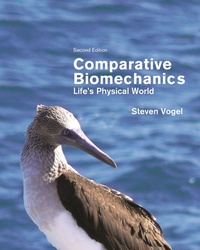
Comparative Biomechanics
Description

The classic textbook on comparative biomechanics-revised and expanded
Why do you switch from walking to running at a specific speed? Why do tall trees rarely blow over in high winds? And why does a spore ejected into air at seventy miles per hour travel only a fraction of an inch? Comparative Biomechanics is the first and only textbook that takes a comprehensive look at the mechanical aspects of life-covering animals and plants, structure and movement, and solids and fluids. An ideal entry point into the ways living creatures interact with their immediate physical world, this revised and updated edition examines how the forms and activities of animals and plants reflect the materials available to nature, considers rules for fluid flow and structural design, and explores how organisms contend with environmental forces.
Drawing on physics and mechanical engineering, Steven Vogel looks at how animals swim and fly, modes of terrestrial locomotion, organism responses to winds and water currents, circulatory and suspension-feeding systems, and the relationship between size and mechanical design. He also investigates links between the properties of biological materials-such as spider silk, jellyfish jelly, and muscle-and their structural and functional roles. Early chapters and appendices introduce relevant physical variables for quantification, and problem sets are provided at the end of each chapter. Comparative Biomechanics is useful for physical scientists and engineers seeking a guide to state-of-the-art biomechanics. For a wider audience, the textbook establishes the basic biological context for applied areas-including ergonomics, orthopedics, mechanical prosthetics, kinesiology, sports medicine, and biomimetics-and provides materials for exhibit designers at science museums.
- Problem sets at the ends of chapters
- Appendices cover basic background information
- Updated and expanded documentation and materials
- Revised figures and text
- Increased coverage of friction, viscoelastic materials, surface tension, diverse modes of locomotion, and biomimetics
More details
Other editions
Additional editions
Person
Content
PART ONE Life's Physical Context 1
1 Preambulations 3
2 Setting the Stage 11
3 More Tools 29
PART TWO Fluids 51
4 Gases and Liquids: Fluids at Rest 53
5 Gases Meet Liquids: The Interface 71
6 Viscosity and the Patterns of Flow 87
7 The Forces of Flow 111
8 Fluid Events Near Surfaces 141
9 Where Flows Are Inside 163
10 More about Circulatory Systems 183
11 Flows in Small Worlds 207
12 About Lift 225
13 Thrust for Flying and Swimming 251
14 Motion at the Air-Water Interface 271
PART THREE Solids and Structures 285
15 A Matter of Materials 287
16 Biological Materials: Tuning Properties Properly 313
17 Biological Materials: Cracks and Composites 329
18 More about Complex Materials: Viscoelasticity 347
19 Simple Structures: Beams, Columns, Shells 363
20 Less Simple Structural Matters 389
21 Hydrostatic Structures, Hydraulic Devices 407
22 Structural Systems 425
23 Motility and Mobility 449
24 Using Muscle: Tuning and Transmissions 473
25 Getting Around on Land 491
PART FOUR The Contexts of Biomechanics 513
26 Loose Ends and Perspectives 515
APPENDICES
1 Quantification: Rules of the Road 537
2 Motion and Direction 547
3 Size and Scaling 553
List of Symbols 565
References and Index of Citations 567
Subject Index 601
