

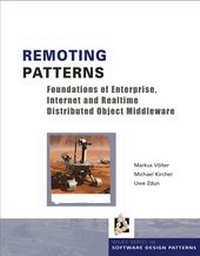
Remoting Patterns
Foundations of Enterprise, Internet and Realtime Distributed Object Middleware
1st Edition
Published on 10. June 2005
424 pages
978-0-470-85666-6 (ISBN)
Description

Remoting offers developers many ways to customize the communications process, for efficiency, security, performance and power, and allows seamless integration of components running on several computers into a single application. This book exposes the full power of remoting to developers working in mixed platform environments in a way that will ensure they have a deep understanding of what remoting is capable of, and how they can make it work the way they want.
More details
Other editions
Additional editions
Markus Volter | Michael Kircher | Uwe Zdun
Object Oriented Remoting
Foundations of Enterprise, Internet and Realtime Distributed Object Middleware
Book
10/2004
Wiley
€47.04
Article exhausted; check different version
Persons
Markus Völter works as an independent consultant onsoftware technology and engineering based in Heidenheim, Germany.His primary focus is software architecture and patterns, middlewareand model-driven software development. Markus has consulted andcoached in many different domains, such as banking, health care,e-business, telematics, astronomy, and automotive embedded systems,in projects ranging from 5 to150 developers.
Markus is also a regular speaker at international conferences onsoftware technology and object orientation. Among others, he hasgiven talks and tutorials at ECOOP, OOPSLA, OOP, OT, JAOO and GPCE.Markus has published patterns at various PLoP conferences andwrites articles for various magazines on topics that he findsinteresting. He is also Co-author of the book Server ComponentPatterns, which is - just like the book you are currently reading -part of the Wiley series in Software Design Patterns.
When not dealing with software, Markus enjoys cross-countryflying in the skies over southern Germany in his glider.
Markus can be reached at voelter@acm.org or via www.voelter.de
Michael Kircher is working currently as Senior softwareEngineer at Siemens AG Corporate Technology in Munich, Germany. Hismain fields of interest include distributed object computing,software architecture, patterns, agile methodologies, andmanagement of knowledge workers in innovative environments. He hasbeen involved in many projects as a consultant and developer withinvarious Siemens business areas, building software for distributedsystems. Among these were the development of software for UMTS basestations, toll systems, postal automation systems, and operationand maintenance software for industry and telecommunicationsystems.
In recent years Michael has published papers at numerousconferences on topics such as patterns, software architecture fordistributed systems, and eXtreme Programming, and has organizedseveral workshops at conferences such as OOPSLA and EuroPLoP. He isalso co-author of the book Pattern-Oriented Software Architecture,Volume 3: Patterns for Resource Management.
In his spare time Michael likes to combine family life withenjoying nature, engaging in sports, or just watching wildlife.
Michael can be reached at michael@kircher-schwanninger.deor Via www.kircher-schwanninger.de
Uwe Zdun is working currently as an assistant professorin the Department of Information Systems at the Vienna Universityof Economics and Business Administration. He received his Doctoraldegree from the University of Essen in 2002, where he worked from1999 to 2002 as research assistant in the software specificationgroup. His research interests include software patterns, scripting,object-orientation, software architecture, and Web engineering. Uwehas been involved as a consultant and developer in many softwareprojects. He is author of a number of open-source software systems,including Extended Object Tcl (XOTcl), ActiWeb, Frag, and Leela, aswell as many other open-source and industrial software systems.
In recent years he has published in numerous conferences andjournals, and co-organized a number of workshops atconferences such as EuroPLoP, CHI, and OOPSLA.
He enjoys hiking, biking, pool, and guitar playing.
Uwe can be reached at zdun@acm.org or viawi.wu-wien.ac.at/~uzdun
Markus is also a regular speaker at international conferences onsoftware technology and object orientation. Among others, he hasgiven talks and tutorials at ECOOP, OOPSLA, OOP, OT, JAOO and GPCE.Markus has published patterns at various PLoP conferences andwrites articles for various magazines on topics that he findsinteresting. He is also Co-author of the book Server ComponentPatterns, which is - just like the book you are currently reading -part of the Wiley series in Software Design Patterns.
When not dealing with software, Markus enjoys cross-countryflying in the skies over southern Germany in his glider.
Markus can be reached at voelter@acm.org or via www.voelter.de
Michael Kircher is working currently as Senior softwareEngineer at Siemens AG Corporate Technology in Munich, Germany. Hismain fields of interest include distributed object computing,software architecture, patterns, agile methodologies, andmanagement of knowledge workers in innovative environments. He hasbeen involved in many projects as a consultant and developer withinvarious Siemens business areas, building software for distributedsystems. Among these were the development of software for UMTS basestations, toll systems, postal automation systems, and operationand maintenance software for industry and telecommunicationsystems.
In recent years Michael has published papers at numerousconferences on topics such as patterns, software architecture fordistributed systems, and eXtreme Programming, and has organizedseveral workshops at conferences such as OOPSLA and EuroPLoP. He isalso co-author of the book Pattern-Oriented Software Architecture,Volume 3: Patterns for Resource Management.
In his spare time Michael likes to combine family life withenjoying nature, engaging in sports, or just watching wildlife.
Michael can be reached at michael@kircher-schwanninger.deor Via www.kircher-schwanninger.de
Uwe Zdun is working currently as an assistant professorin the Department of Information Systems at the Vienna Universityof Economics and Business Administration. He received his Doctoraldegree from the University of Essen in 2002, where he worked from1999 to 2002 as research assistant in the software specificationgroup. His research interests include software patterns, scripting,object-orientation, software architecture, and Web engineering. Uwehas been involved as a consultant and developer in many softwareprojects. He is author of a number of open-source software systems,including Extended Object Tcl (XOTcl), ActiWeb, Frag, and Leela, aswell as many other open-source and industrial software systems.
In recent years he has published in numerous conferences andjournals, and co-organized a number of workshops atconferences such as EuroPLoP, CHI, and OOPSLA.
He enjoys hiking, biking, pool, and guitar playing.
Uwe can be reached at zdun@acm.org or viawi.wu-wien.ac.at/~uzdun
Content
Foreword.
Series Foreword.
Preface.
1. Introduction to Distributed Systems.
2. Pattern Language Overview.
3. Basic Remoting Patterns.
4. Identification Patterns.
5. Lifecycle Management Patterns.
6. Extension Patterns.
7. Extended Infrastructure Patterns.
8. Invocation Asynchrony Patterns.
9. Technology Projections.
10. .NET Remoting Technology Projection.
11. Web Services Technology Projection.
12. CORBA Technology Projection.
13. Related Concepts, Technologies, and Patterns.
Appendix: Extending AOP Frameworks for Remoting.
References.
Index.
Series Foreword.
Preface.
1. Introduction to Distributed Systems.
2. Pattern Language Overview.
3. Basic Remoting Patterns.
4. Identification Patterns.
5. Lifecycle Management Patterns.
6. Extension Patterns.
7. Extended Infrastructure Patterns.
8. Invocation Asynchrony Patterns.
9. Technology Projections.
10. .NET Remoting Technology Projection.
11. Web Services Technology Projection.
12. CORBA Technology Projection.
13. Related Concepts, Technologies, and Patterns.
Appendix: Extending AOP Frameworks for Remoting.
References.
Index.
