

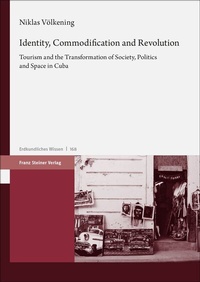
Identity, Commodification and Revolution
Description

This e-book explores how the commodification of the Cuban Revolution affects Cuban identities. Contrary to prevailing beliefs, commodification does not inevitably lead to identity loss or alienation. Instead, it serves as a potent heuristic tool for comprehending social and political transformation.
The Cuban Revolution, a powerful force shaping Cuban identities, presents an intriguing paradox. Surprisingly, tourism-driven commodification of the Revolution does not induce alienation, challenging prevailing assumptions. Rather, the waning identification with the Cuban Revolution stems from a complex interplay of perceived dysfunctionality, unmet aspirations, and economic inadequacies.
Commodification in tourism is thus merely a symptom of alienation, revealing the discontent of marginalized individuals who criticize and disengage from the Revolution. This indicates transforming identities and socioeconomic realities, which are not caused by commodification, but are exposed through its examination. The e-book further explores the current state of the Cuban Revolution, where criticism and calls for market reforms challenge the state's authority and imply a decline in its power.
More details
Other editions
Additional editions
Person
ISNI:
Content
- Intro
- Preface
- Summary
- Contents
- List of Figures
- List of Tables
- List of Abbreviations
- Formal Remarks
- Prologue
- 1. Identity, Revolution and Tourist Commodification
- 1.1. Aim of the Book and Research Questions
- 1.2. Structure of the Book
- 2. Identity
- 2.1. How Identities are Constructed
- 2.1.1. Overcoming Essentialist Notions of Identity
- 2.1.2. Symbolic Interactionism and Discursive Identity Formation
- 2.2. A Sociopsychological History of the Conditions for Identity Formation
- 2.2.1. Cogito, ergo sum: Pre-Modern Identities
- 2.2.2. Modern Identities
- 2.2.3. Postmodern Identities
- 2.2.4. Bauman's Defeatist Foursome of Postmodern Identities
- 2.2.5. Do-It-Yourself Identities, Patchworks and Crazy Quilts
- 2.2.6 Born in Blood and Violence: Postcolonial Identities
- 2.3. Resources for Identity Formation
- 2.3.1. Accessing Identity Resources through Derrida's Deconstructivism
- 2.3.2. Nation
- 2.3.3. Culture
- 2.3.4. Religion
- 2.3.5. Family, Relationships and Community
- 2.3.6. Race and Ethnicity
- 2.3.7. Gender
- 2.4. Identity Formation as an Ever-changing Process
- 3. Commodification
- 3.1. Fundamental Insights into Commodities
- 3.2. Commodification from a Marxist Perspective
- 3.2.1. Marx on Capital: The Roots of Commodification Theory
- 3.2.2. Neoliberalism Fostering Commodification
- 3.3. A Contradiction in Itself? Commodification in Socialist Societies
- 3.4. The Commodifying Power of Tourism
- 3.4.1. Tourism as a Commodifying Practice
- 3.4.2. Does Marxist Value Theory Require a 'Tourist Upgrade'?
- 3.4.3 Who or What Becomes Commodified in Tourism?
- 3.5. Touristic Commodification: Consequences for Identities?
- 3.6. Noel Castree's Six Principles of Commodification
- 3.7. Materialisations and Spatial Manifestations of Commodification
- 4. Historical Background and Cuban Transformations
- 4.1. Colonial Roots and the Transcultural Cuban ajiaco
- 4.1.1. The 1762 Occupation of Havana and its Consequences: Slavery and Patriotismo Habanero
- 4.1.2. Cubanidad Developing in the Cuban Cooking Pot
- 4.2. National Conscience and the Long Struggle for Independence
- 4.2.1. The Awakening National Conscience
- 4.2.2. José Martí: Mastermind of Independence and Projection Surface for National Identity
- 4.2.3. Cuban Independence and American Intervention
- 4.3. The Cuban Republic: Political Instability Setting the Stage for Fidel Castro
- 4.3.1. Dependence on Independence: Cuba under US Influence
- 4.3.2. Machado and Batista Undermining Politics and Civil Society
- 4.3.3. Gangsterismo and Desperation
- 4.3.4. Social and Moral Decay during Batista's Second Dictatorship
- 4.3.5. Fidel Castro Steps up: Beginnings of the Cuban Revolution
- 4.3.6. Meeting Che in Exile and Returning to Cuba
- 4.4. The Cuban Revolution: A Universal Framework for Life and Society in Cuba
- 4.4.1. The Revolution: Founding Myth and Anchor of Identity
- 4.4.2. Collectivisation and Agrarian Reforms as First Revolutionary Measures
- 4.4.3. Excursus: Cuban Emigration to the United States
- 4.4.4. Rapprochement with the USSR, Bay of Pigs and Socialism
- 4.4.5. Conflating Revolutionary and Socialist Consciousness
- 4.4.6. Revolutionary Conquistas Contributing to a Socialist Society
- 4.4.7. Domestic Stabilisation and External (In-)dependence
- 4.4.8. Revolutionary 'Offensives' of the 1970s and 1980s
- 4.4.9. On the Nature of the Cuban Revolution
- 4.4.10. The 'Correction of Errors': Refusing Gorbachev's Reforms
- 4.5. El Período Especial: Cuba's (Post-)Socialist Transformation
- 4.5.1. A Period of Acute Crisis
- 4.5.2. Can Capitalism Save Socialism? Reforms of the 1990s
- 4.5.3. Social Repercussions and Liberalisations
- 4.5.4. Excursus: Religion and Religiosity in Cuba
- 4.5.5. Strengthening Ideology and Identity in Times of Crisis
- 4.6. From Fidel to Raúl: Transfer of Power after 47 Years in Charge
- 4.6.1. Raúl Castro's Economic Agenda
- 4.6.2. Raúl's Reforms: Economic Revival, Social Restratification
- 4.6.3. Reapproaching the United States under President Obama
- 4.6.4. The Phenomenon of Lasting Support for the Revolution
- 4.6.5. The Dawn of the Post-Castro Era
- 5. Tourism in Cuba
- 5.1. The Political Setting for Tourism in Cuba
- 5.1.1. Tourism in Cuba before the Período Especial
- 5.1.2. Fidel Castro on Tourism: Concerns and Necessities
- 5.1.3. A Separation not to Last: A Cuba for Tourists and a Cuba for Cubans
- 5.1.4. International Tourism: From a Makeshift to a Long-Term Strategy and American Influence
- 5.1.5. The Social Costs of International Tourism
- 5.2. Economic Success of Tourism in Cuba: Numbers and Data
- 5.3. Co-Producing Cuba: Tourist Imagination and Cuban Performance
- 6. Methodology
- 6.1. Semi-Structured Interviewing within Grounded Theory
- 6.1.1. Grounded Theory
- 6.1.2. Sampling
- 6.1.3. Description of the Interview Sample
- 6.2. Mapping
- 7. Cuban Perceptions of Tourism, Commodification and Revolution
- 7.1. Ambivalent Evaluations of International Tourism in Cuba
- 7.1.1. Positive Perspectives on Tourism, and their Rationales
- 7.1.2. Reasons for Negative Attitudes towards Tourism
- 7.1.3. Touristification of Cuban Cities
- 7.1.4. Concluding Remarks on International Tourism in Cuba
- 7.2. Cuentapropismo and its Assessment
- 7.2.1. Reasons for Positive Views on Cuban Cuentapropismo
- 7.2.2. Negative Voices towards Cuentapropismo
- 7.2.3. Cuentapropismo as a Capitalist Practice?
- 7.3. Capitalist Practices in the Cuban Socialist Framework
- 7.3.1. Capitalism in Cuba: Pros and Cons
- 7.3.2. Socialism in Cuba: Pros and Cons
- 7.3.3. Current Appraisal of Socialism in Cuba
- 7.3.4. "It's a Frankenstein": Simultaneity of Socialism and Capitalism
- 7.3.5. Beyond the Horizon: Other Socialist Countries as a Paragon?
- 7.4. Tourism's Effects on Cuban Society
- 7.4.1. Increase in Crime
- 7.4.2. Discrimination and Segregation
- 7.4.3. A Taste of the Future? Fears for Society Falling apart
- 7.5. Cuban Identities: An Inevitably Fragmentary Picture
- 7.5.1. Cuban Identity as a Product of History
- 7.5.2. Music, Dance and Humour to Escape from Dismal Reality
- 7.5.3. The Significance of La Lucha for Cuban Identities
- 7.5.4. Mutual Support, Solidarity and Humility
- 7.5.5. Identification with the Revolution, and Pride in Being Cuban
- 7.6. What Does the Cuban Revolution Signify?
- 7.6.1. Revolution, Socialism and their Popular Support
- 7.6.2. The Revolution as a Perpetual Backdrop to Cuban Life
- 7.6.3. Idolised Heroes as Identification Figures and Personifications of the Revolution
- 7.6.4. The Revolution as the Root of Cuban Freedom
- 7.6.5. Conquistas, Tranquillity and Social Security
- 7.6.6. Critical Perspectives on the Revolution
- 7.7. Effects of Tourism on Cuban Identities
- 7.7.1. Scope of Cuban Identities Transformed by Tourism
- 7.7.2. Changes in Cuban Culture
- 7.7.3. Change and Loss of Values
- 7.7.4. Decreasing Identification with the Revolution?
- 7.8. Commodifying the Cuban Revolution: Differences in Symbols, Materialisation and Spatial Patterns
- 7.8.1. Commodifying Reproductions of the Cuban Revolution
- 7.8.2. Non-Commodifying Reproductions of the Cuban Revolution
- 7.8.3. Spatial Differences of the Reproductions of the Cuban Revolution
- 7.9. Commodification of the Revolution and its Impact on Cuban Identities
- 7.9.1. Rejecting the Commodification of the Revolution
- 7.9.2. Agreeing with Commodifying the Revolution
- 7.9.3. Impacts of the Commodification of the Revolution on Cuban Identities?
- 7.10. Summary of the Findings
- 8. Towards an Enhanced Understanding of Commodification
- 8.1. International Tourism in Cuba: Consequences and Perceptions
- 8.1.1. Undesired Disparities and Transformations
- 8.1.2. Transforming Urban Spaces into Spaces of 'Spectacle'
- 8.1.3. Politics and Power Causing Unequal Opportunities: Positive Assessments of Tourism Prevail
- 8.2. The Cuban Revolution as a Commodity
- 8.2.1. Is there Human Labour in the Cultural Common 'Revolution'?
- 8.2.2. The Process of Commodifying the Revolution
- 8.2.3. Spatial Effects of the Commodification of the Revolution
- 8.2.4. Discourses on Commodification: Locally and Theoretically
- 8.3. Implications of Commodification for the Revolution's Identity-Forming Power
- 8.3.1. Commodification and its Impact on Identities
- 8.3.2. The Constructivist Character of Commodities
- 8.3.3. Commodification Fostering Creative Identity Re-interpretation?
- 8.4. Cuban Views on the Commodification of the Revolution
- 8.4.1. Commodification as a Proxy for Evaluations of the Revolution
- 8.4.2. Factors for Assessing the Commodification of the Revolution
- 8.4.3. Stances and Demands in Relation to the Revolution
- 8.4.4. Reasons for prior Alienation from the Revolution
- 8.5. Resources for Cuban Identities beyond the Revolution
- 8.5.1. Individualisation and Globalisation
- 8.5.2. A Society of 'Vagabonds'
- 8.5.3. Identity Optimism only for a Few?
- 8.5.4. The Rise of Non-Revolutionary Cuban Nationalism
- 8.5.5. Religion Gaining Importance Again
- 8.5.6. Identification and Self-Fulfilment through Labour?
- 8.6. Summary of the Key Insights
- 8.7. Critical Reflections on Methodology and Positionality
- 8.8 Normative (Self-)Reflection on Commodification
- 9. The Fading Power of the Revolution
- 9.1. Commodification as an Indicator of Transformed Identities
- 9.2. Conceptualising the Cuban Revolution as a Tourist Commodity
- 9.3. Socioeconomic and Political Realities of the Revolution: Beyond a mere Explanatory Context
- Epilogue
- References
- Appendix: Information on Interview Partners
- Index
