

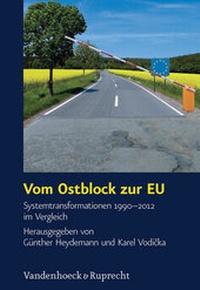
Vom Ostblock zur EU
Systemtransformationen 1990-2012 im Vergleich
1st Edition
Published on 19. June 2013
387 pages
978-3-647-36960-0 (ISBN)
Description

Im vorliegenden Band analysieren und vergleichen Politikwissenschaftler und Zeithistoriker politische, ökonomische und gesellschaftliche Transformationsprozesse all jener ehemaligen Ostblockländer, die EU-Mitglieder wurden, einschließlich der ostdeutschen Bundesländer. Dieser komparative Ansatz hat sich als ausgesprochen ertragreich erwiesen. Für den postkommunistischen EU-Raum sind strukturelle Gemeinsamkeiten und analoge Entwicklungstrends kennzeichnend, die ihn sowohl von den etablierten Demokratien in der EU als auch von den übrigen Ländern des ehemaligen Ostblocks, die nicht EU-Mitglieder sind, markant unterscheiden. Aus den einzelnen Länderbeiträgen wie auch aus der vergleichenden Gesamtanalyse wird deutlich, welchen Konsolidierungsstand Politik, Wirtschaft und Gesellschaft im postkommunistischen EU-Raum inzwischen erreicht haben, welche Defizite weiter bestehen und welche Entwicklungstrends zu erwarten sind.
In the post-Communist countries of the EU a number of structural parameters have survived the transition that distinguish them from the other, more established democracies of the European Union - as well as from the other nations of the former Eastern Bloc. The authors of this volume address these differences and analyse the political, economic and social transformation processes that took place or are still taking place in this region. It becomes clear what role politics, the economy and society in general now play in these countries, where deficits are still prominent, and what the future holds.
In the post-Communist countries of the EU a number of structural parameters have survived the transition that distinguish them from the other, more established democracies of the European Union - as well as from the other nations of the former Eastern Bloc. The authors of this volume address these differences and analyse the political, economic and social transformation processes that took place or are still taking place in this region. It becomes clear what role politics, the economy and society in general now play in these countries, where deficits are still prominent, and what the future holds.
More details
Other editions
Additional editions
Book
06/2013
1st Edition
Vandenhoeck & Ruprecht
€89.00
Shipment within 5-7 days
Persons
Editor
Dr. Karel Vodicka flüchtete 1985 aus der ?SSR ins politische Exil. Er arbeitet als Politikwissenschaftler am Hannah-Arendt-Institut für Totalitarismusforschung an der TU Dresden und ist Lehrbeauftragter an der Philosophischen Fakultät der Jan-Evangelista-Purkyn?-Universität Ústí nad Labem, Tschechien.
Prof. Dr. Günther Heydemann war bis 2016 Direktor am Hannah-Arendt-Institut und hatte von 1993-2016 den Lehrstuhl für Neuere und Zeitgeschichte an der Universität Leipzig inne.
Contributions
Dr. Karel Vodicka flüchtete 1985 aus der ?SSR ins politische Exil. Er arbeitet als Politikwissenschaftler am Hannah-Arendt-Institut für Totalitarismusforschung an der TU Dresden und ist Lehrbeauftragter an der Philosophischen Fakultät der Jan-Evangelista-Purkyn?-Universität Ústí nad Labem, Tschechien.
Content
- Cover
- Title Page
- Copyright
- Table of Contents
- Body
- Vorwort: Vladimir Spidla
- Einleitung
- Estland: Ralph Michael Wrobel
- Lettland: Claudia-Yvette Matthes
- Litauen: Rolf Winkelmann
- DDR: Günther Heydemann
- Polen: Klaus Ziemer
- Tschechien: Karel Vodicka
- Slowakische Rebublik: Rüdiger Kipke
- Slowenien: Bozo Repe
- Ungarn: Jürgen Dieringer
- Rumänien: Bogdan Murgescu
- Bulgarien: Karel Vodicka
- Postkommunistischer EU-Raum: Konsolidierungsstand und Perspektiven: Karel Vodicka / Günther Heydemann
- Abkürzungsverzeichnis
- Autorenverzeichnis
