

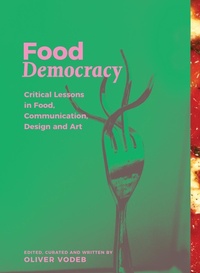
Food Democracy
Critical Lessons in Food, Communication, Design and Art
1st Edition
Published on 1. August 2017
200 pages
978-1-78320-797-8 (ISBN)
Description

In a world where privatisation and capitalism dominate the global economy, the essays in this book ask how to make socially responsive communication, design and art that counters the role of the food industry as a machine of consumption. Food Democracy brings together contributions from leading international scholars and activists, critical case studies of emancipatory food practices and reflections on possible models for responsive communication design and art. A section of visual communication works, creative writings and accounts of participatory art for social and environmental change - curated by the Memefest Festival of Socially Responsive Communication and Art on the theme of "Food Democracy" - are also included here. The beautifully designed book also includes a unique and delicious compilation of socially engaged recipes by the academic, artist and activist community. Aiming not just to advance scholarship, but to push ahead real change in the world, Food Democracy is essential reading for scholars and citizens alike.
Reviews / Votes
'Food Democracy concludes with editor Vodeb's visual essay, "Living Out a Situation: The Memefest Food Democracy Brisbane Sessions," which highlights how the 2013 Festival symposium and workshop applied an extradisciplinary approach that merged experimental research with art and design. As the form and subject of this conclusion show, Food Democracy is not your traditional academic book. By including contributions from academics, activists, and professionals in fields from art, design, the social sciences, and philosophy, Vodeb expands the topic's scope and shows the benefit of interweaving a variety of approaches and research tactics. In other words, Food Democracy offers everyone a seat at the table.' -- Jennifer A. Vokoun, Design and Culture 10.2 'In this compelling collection, Memefest contributors remind us why food lies at the heart of contemporary political struggle. The single most damning truth about contemporary global society is that people continue to starve on a planet that produces enough food to nourish its entire population. This tragedy results from the use of food as a medium of control and a source of profit. The essays in this collection provide a crucial source for developing the tools and practices to support sustainable democracy in a time of global instability. Now more than ever we need the Memefest organization's prescient blend of theory and practice, aesthetics and politics.' -- Mark Andrejevic, Monash University, Pomona College 'The most effective step you can take to save the world, and yourself, is to change the way you eat. The food industry is responsible for more health problems, environmental damage, and social strife than any other. By choosing what to put in our mouths, we can heal ourselves, save the topsoil, feed the hungry, and overturn neoliberalism. Food Democracy shows the many easy, powerful, and delicious ways to achieve a sustainable future. We are what you eat.' -- Douglas Rushkoff, author, Throwing Rocks at the Google Bus 'This extraordinary new book challenges us to reclaim the role of design and public communication in imagining a democratic future of food. By recognizing that representation, as well as production, distribution and consumption, is a key element in the way the global food system works, this book shows that design is crucial to determine how we think about food. As an answer to this, Oliver Vodeb has curated an inspiring collection of examples of alternative food design bringing together activists, cultural producers and academics and in the process has redefined what food design may mean.' -- Ilaria Vanni, University of Technology Sydney 'What can tactical sustenance be in a world where hunger is a part and parcel of our current strategic market systems and governance that function to maintain "food insecurity" on a global scale. Food Democracy is a direct response to navigating this Meat-Market-State by focusing on community research initiatives and artist practices of avant-gardening and beyond that can help us re-configure how our food is designed, how our food is sold, and who has access to food. This book is not just about what the problems are - but what can we do about it.' -- Ricardo Dominguez, Electronic Disturbance Theater 'This large volume is a thought-provoking hybrid between a traditional collection of essays, a set of recipes (one for each essay), and a catalogue of visual and participatory art pieces and social engagement interventions. The format is the direct reflection of Memefest and its Festival of Socially Responsive Communication, Design, and Art, whose participants and contributors believe that academia, social movements, and professional environments should not operate in silos, but interact and cross-pollinate beyond the customary institutional distinctions. Full review to be published in the International Journal of Food Design.' -- Fabio Parasecoli, The Huffington PostMore details
Edition
1. Auflage
Language
English
Place of publication
Bristol
United Kingdom
Publishing group
Intellect
Target group
Professional and scholarly
College/higher education
ISBN-13
978-1-78320-797-8 (9781783207978)
Copyright in bibliographic data and cover images is held by Nielsen Book Services Limited or by the publishers or by their respective licensors: all rights reserved.
Schweitzer Classification
Other editions
Additional editions
Book
12/2017
Intellect Books
€86.80
Shipment within 3-4 weeks
Person
Oliver Vodeb is a researcher and lecturer at Swinburne University of Technology and the founder, principal curator, and editor of the Memefest Festival of Socially Responsive Communication and Art.
Content
Hungry for Change + Thirsty for Life: Socially Responsive Communication, Design and Art Kitchen and its Dishes
Oliver Vodeb
Mean Cuisine: Being a Polemical Discussion of Food in Excess of Necessity, its Uses and Abuses
Darren Tofts
The Global eat Autocracy: An Issue of Social Injustice: Cartelization of the Global Meat Industry
Cirila Toplak
A Shortage of Democracy, Not of Food and Water: Trends Shaping Today's Food Industry
Nikola Janovic Kolenc
Making Time: Food Preservation and Ontological Design
Abby Mellick Lopes, Tessa Zettel
Everything Has a Story: Decolonization, First Nations Sovereignity, and the Seventh Pillar of Food Sovereignty in the Australian Context
Sam Burch
Hungry: Self-Employment on Street Food Markets and the Political Dimension of Consumption
Aida Baghernejad
Marti Guixe's Food Designing: A Critique of Consumerism
Katherine Moline
Somewhere over the Rainbow: Cooking a Slovenian Path to a 'Better' Future
Tanja Kamin, Andreja Vezovnik, Pavlina Japelj
$$TM - The Sociosoma
Renfah
Urban Agriculture in Havana Everything Fresh Including Design
Claudio Sotolongo
Food for Thought Visual Practice as Activist Research
George Petelin
Geographies of Hope
The Laboratory of Insurrectionary Imagination
What Lies Outside the Cavern
Eugenio Tisselli
Trisikaideka | 13 | UMAMI
Veeranganakumari Solanki
The Hidden Sacrifice
Mariano Mussi
Designed Pleasure How Advertising Is Selling Food as Drugs
Oliver Vodeb
Pleasure Praxis
Oliver Vodeb
Food Democracy - Friendly Competition 2013 - Visual Communication Practice
Curated by Oliver Vodeb
Eat for Democracy
Miha Mazzini, Marko Plahuta
Edible Illusions
Ashlea Gleeson, Jack Loel
Merry Kurban Bayrami and Happy New Year
Rodolfo Medina Flores, Jakub Fiser
Seeds of Hope/Destruction
Mohammad Naser
What Are You Really Eating?
Jessica Nuzum
Michael Pollan's Food Rules
Marija Jacimovic, Benoit Detalle
Orto Diffuso
Mariella Bussolati
The DIY High Fructose Corn Syrup Kit
Maya Weinstein
Consciencia
Sandra Rojas
What Do We Know about the Andean Quinoa Industry?
Lucy Datyner
Happy Cow
Kate Simpson
Who do You Feed with the Food You Eat?
Maria Isabel Isaza Echeverry
Migrants in Europe
Marko Damis, Zdravko Papic (mentor and friend)
Untitled
Stephan Gross
El Futuro se construye en el Campo
Andres Rodriguez
Land Grab - The Game
Katherine Jauczius
Guerilla Torches
Dylan Leak
The Perfect Tomato
Hayley Smith
Just a Little Money Involved
Sybille Neumeyer
Pick Me
Zayra Dolores
Food Democracy
Liam Matthews
The Patch
Oscar Waugh
Facing (orig. Im Angesicht)
Julia Unkel
Engineered Corn
Khaula Al Ameri
The Food Trade Apparatus (FTA)
Thomas Roohan
Info(od)graphics
Scott Burns
Meet & Two Veg
Sophie Van Der Drift
How Much Is Enough?
Eugenia Demeglio, Alberto Novello
Los Ojos de las Milpa (The Eyes of Milpa)
Eugenio Tisselli (Et All)
Seed Matter
Christine Matter
Conflict in the Kitchen: Dawn Weleski and Jon Rubin
Oliver Vodeb
Living Out a Situation: The Memefest Food Democracy Brisbane Sessions, Visual Essay
Oliver Vodeb
Eat Me - Recipes
Various
Oliver Vodeb
Mean Cuisine: Being a Polemical Discussion of Food in Excess of Necessity, its Uses and Abuses
Darren Tofts
The Global eat Autocracy: An Issue of Social Injustice: Cartelization of the Global Meat Industry
Cirila Toplak
A Shortage of Democracy, Not of Food and Water: Trends Shaping Today's Food Industry
Nikola Janovic Kolenc
Making Time: Food Preservation and Ontological Design
Abby Mellick Lopes, Tessa Zettel
Everything Has a Story: Decolonization, First Nations Sovereignity, and the Seventh Pillar of Food Sovereignty in the Australian Context
Sam Burch
Hungry: Self-Employment on Street Food Markets and the Political Dimension of Consumption
Aida Baghernejad
Marti Guixe's Food Designing: A Critique of Consumerism
Katherine Moline
Somewhere over the Rainbow: Cooking a Slovenian Path to a 'Better' Future
Tanja Kamin, Andreja Vezovnik, Pavlina Japelj
$$TM - The Sociosoma
Renfah
Urban Agriculture in Havana Everything Fresh Including Design
Claudio Sotolongo
Food for Thought Visual Practice as Activist Research
George Petelin
Geographies of Hope
The Laboratory of Insurrectionary Imagination
What Lies Outside the Cavern
Eugenio Tisselli
Trisikaideka | 13 | UMAMI
Veeranganakumari Solanki
The Hidden Sacrifice
Mariano Mussi
Designed Pleasure How Advertising Is Selling Food as Drugs
Oliver Vodeb
Pleasure Praxis
Oliver Vodeb
Food Democracy - Friendly Competition 2013 - Visual Communication Practice
Curated by Oliver Vodeb
Eat for Democracy
Miha Mazzini, Marko Plahuta
Edible Illusions
Ashlea Gleeson, Jack Loel
Merry Kurban Bayrami and Happy New Year
Rodolfo Medina Flores, Jakub Fiser
Seeds of Hope/Destruction
Mohammad Naser
What Are You Really Eating?
Jessica Nuzum
Michael Pollan's Food Rules
Marija Jacimovic, Benoit Detalle
Orto Diffuso
Mariella Bussolati
The DIY High Fructose Corn Syrup Kit
Maya Weinstein
Consciencia
Sandra Rojas
What Do We Know about the Andean Quinoa Industry?
Lucy Datyner
Happy Cow
Kate Simpson
Who do You Feed with the Food You Eat?
Maria Isabel Isaza Echeverry
Migrants in Europe
Marko Damis, Zdravko Papic (mentor and friend)
Untitled
Stephan Gross
El Futuro se construye en el Campo
Andres Rodriguez
Land Grab - The Game
Katherine Jauczius
Guerilla Torches
Dylan Leak
The Perfect Tomato
Hayley Smith
Just a Little Money Involved
Sybille Neumeyer
Pick Me
Zayra Dolores
Food Democracy
Liam Matthews
The Patch
Oscar Waugh
Facing (orig. Im Angesicht)
Julia Unkel
Engineered Corn
Khaula Al Ameri
The Food Trade Apparatus (FTA)
Thomas Roohan
Info(od)graphics
Scott Burns
Meet & Two Veg
Sophie Van Der Drift
How Much Is Enough?
Eugenia Demeglio, Alberto Novello
Los Ojos de las Milpa (The Eyes of Milpa)
Eugenio Tisselli (Et All)
Seed Matter
Christine Matter
Conflict in the Kitchen: Dawn Weleski and Jon Rubin
Oliver Vodeb
Living Out a Situation: The Memefest Food Democracy Brisbane Sessions, Visual Essay
Oliver Vodeb
Eat Me - Recipes
Various
