

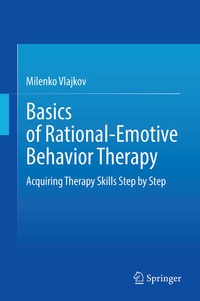
Basics of Rational-Emotive Behavior Therapy
Description

This book presents a structured, pragmatic approach to Rational Emotive and Cognitive Behavioral Therapy (RE&CBT), emphasizing the identification and restructuring of irrational beliefs that underlie emotional disturbances. It outlines the ABC model-Activating event, Belief, Consequence-as the foundation for understanding and treating emotional blockages, using techniques like inference chaining, disputation, and rational alternative formulation. The book integrates cognitive, emotional, and behavioral strategies, supported by extensive examples, therapeutic session structures, and homework assignments to foster emotional insight and behavioral change. It also addresses common errors in psychotherapy, relapse prevention, and therapist development, aiming to empower both clients and practitioners toward lasting emotional resilience and self-sufficiency.
More details
Other editions
Additional editions
Person
Prof. Milenko Vlajkov is a psychologist who moved to Germany in 1991 after positions in HR and clinical practice in Novi Sad. He specialized in CBT in Oxford and REBT at the Albert Ellis Institute in NY, was elected to the ITCPR committee, founded an affiliated training center of AEI, and works as a psychotherapist, coach, consultant, and international supervisor.
Content
Chapter 1: Theoretical Foundations Of Rebt.- Chapter 2: Thinking Errors.- Chapter 3: The Three Insights.- Chapter 4: Wishes And Demands.- Chapter 5: The Therapeutic Process.- Chapter 6: Questioning About The Problem.- Chapter 7: Model Of Development Of Emotional Blockades.- Chapter 8: Frustration Tolerance.- Chapter 9: The Search For The Specific Emotional Problem (C) Or After The Activating Event (A).- Chapter 10: Agreement On The Therapeutic Goal.- Chapter 11: Secondary Emotional Problem (Symptom Stress).- Chapter 12: The Explanation Of The B-C Connection.- Chapter 13: Searching For Irrational Beliefs - B.- Chapter 14: Wishes, Preferences, Conditional And Absolutistic (Unconditional) Demands.- Chapter 15: Inference Chaining.- Chapter 16: Dispute - Review Of Irrational Thinking Patterns.- Chapter 17: The Absolutistic Demands And Their Questioning.- Chapter 18: Catastrophizing And Questioning The Catastrophizing.- Chapter 19: Global Rating And Challenging The Global Rating.- Chapter 20: Low Frustration Tolerance And Challenging The Statements That Relate To It.- Chapter 21: Formulation Of Rational Alternatives.- Chapter 22: Homework Assignments.- Chapter 23: Euphemisms And Dysphemisms.- Chapter 24: Further Therapeutic Work.- Chapter 25: One-Session Treatment.- Chapter 26: Errors In The Psychotherapy.- Chapter 27: Incorrebt Application Of The Theory-Driven Approach.- Chapter 28: Errors Arising From The Inconsistent Application Of The Learning Principles.- Chapter 29: Errors Due To Misunderstanding Patients' Answers.- Chapter 30: Errors Due To Inadequate Knowledge And Lack Of Therapeutic Skill.- Chapter 31: Termination Of Therapy.- Chapter 32: Strategy And Tactics Of Therapeutic Work.- Chapter 33: Humor In Psychotherapy.- Chapter 34: Forms Of Therapeutic Work.- Chapter 35: Opening An Independent Therapeutic Practice.- Chapter 36: The First Contact.- Chapter 37: The Psychodiagnostics Examination.- Chapter 38: Conclusions.- Chapter 39: Recommendations For Future Research.
