

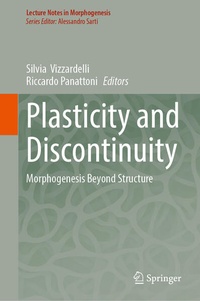
Plasticity and Discontinuity
Description

This book analyses the concept of creation from the perspective of philosophy, psychoanalysis, and Life sciences. What does it mean to think life beyond form? The essays gathered in this book enact a shared gesture: to interrogate the living, the subject, the body, and knowledge not from the standpoint of what is given, but from that which erupts, from that which emerges without guarantee, from that which occurs without having been foreseen. Situated at the intersections of ethics and science, biology and psychoanalysis, ontology and aesthetics, these texts compose a theoretical cartography of discontinuity. They traverse conceptual figures such as fulguratio, the ontological leap, generative regression, the infans, the infinitesimal, intensity, and modulation-not fixed categories, but vital tensions capable of opening the real to non-deductive, non-identitarian, non-evolutionary modes of thought. At the core of this inquiry, the germ cell emerges as a theoretical figure: not as a biological foundation, but as a symbolic locus of openness, a crossing point between writing and generation, where the living exposes itself to its own originary discontinuity. Here, the living is no longer the object of science, but a field of inscription, a surface traversed by forces, modulations, and drifts, every subject is an unstable trace, every beginning a rupture. Knowledge, in this perspective, does not describe the world; it accompanies its becoming, attending to the unforeseen of its emergence.
More details
Other editions
Additional editions
Content
Ex nihilo.- Fulguratio.- Genus.- Infans.- Intensio.- Modus.- Thalassa.
