

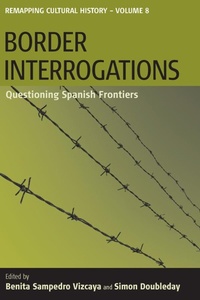
Border Interrogations
Description

Under the current cartographies of globalism, where frontiers mutate, vacillate, and mark the contiguity of discourse, questioning the Spanish border seems a particularly urgent task. The volume engages a wide spectrum of ambivalent regions-subjects that currently are, or have been seen in the past, as spaces of negotiation and contestation. However, they converge in their perception of the "Spanish" nation-space as a historical and ideological construct that is perpetually going through transformations and reformations. This volume advocates the position that intellectual responsibility must lead us to engage openly in the issues underlying current social and political tensions.
More details
Other editions
Additional editions
Persons
Benita Samperdro Vizcaya is Associate Professor of Colonial Studies in the Department of Romance Languages and Literatures at Hofstra University. Her research interests focus on issues of Spanish colonialism in both Africa and Latin America, specifically on processes of decolonization and postcolonial legacies. She has published extensively on empire, exile, colonial discourse and resistance, and most recently on topics relating to Equatorial Guinea, the only African state where Spanish remains the official language. She is currently working on a book manuscript entitled Spanish Colonialism, African Decolonizations, and the Politics of Place.
Content
Acknowledgements
Introduction
Benita Sampedro and Simon Doubleday
Chapter 1. Europe's 'Last' Wall: Contiguity, Exchange and Heterotopia in Ceuta, the confluence of Spain and North Africa
Parvati Nair
Chapter 2. Migration, Gender, and Desire in Contemporary Spanish Cinema
Rosi Song
Chapter 3. State Narcissism: Racism, Neoimperialism, and Spanish Opposition to Multiculturalism (On Mikel Azurmendi)
Joseba Gabilondo
Chapter 4. Constructing Convivencia: Miquel Barceló, José Luis Guerín, and Spanish-African Solidarity
Susan Martín Márquez
Chapter 5. Galicia Beyond Galicia: A man dos paíños and the Ends of Territoriality
Cristina Moreiras-Menor
Chapter 6. Foreignness and Vengeance: On Rizal's El Filibusterismo
Vicente Rafael
Chapter 7. Through the Eyes of Strangers: Building Nation and Political Legitimacy in Eighteenth-Century Spain
Alberto Medina
Chapter 8. On Imperial Archives and the Insular Vanishing Point. The Canary Islands in Viera y Clavijo's Noticias
Francisco-J. Hernández Adrián
Chapter 9. Manso de Contreras' Relación of the Tehuantepec Rebellion (1660-1661): Violence, Counter-Insurgency Prose and the Frontiers of Colonial Justice
David Rojinsky
Chapter 11. (The) Patria Besieged: Border-Crossing Paradoxes of National Identity in Cervantes's Numancia
Michael Armstrong
Chapter 12. Border Crossing and Identity Consciousness in the Jews of Medieval Spain Mariano
Gómez Aranda
Chapter 13. Seven Theses Against Hispanism
Eduardo Subirats
Notes on contributors
Bibliography
Index
