

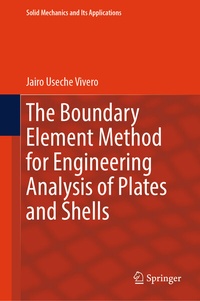
The Boundary Element Method for Engineering Analysis of Plates and Shells
Description

This book provides a comprehensive and practical introduction to the Boundary Element Method (BEM) as applied to the analysis of plates, shells, and thin-walled structures in solid mechanics. Addressing a significant gap in the existing literature, the book offers a detailed and accessible exploration of BEM, covering a wide range of engineering problems including static, dynamic, fracture, buckling and nonlinear analysis. It combines theoretical foundations with practical applications, making complex concepts approachable for final-year students, graduate students, and practicing engineers. The book also introduces open-source computational tools, allowing readers to implement and apply BEM theories in real-world engineering scenarios, a resource scarcely available in current literature. By covering both classical and advanced topics in plate and shell theory, including the analysis of isotropic and laminated composites, the book serves as a vital guide for anyone looking to deepen their understanding of BEM in solid mechanics, with a clear focus on its practical application in engineering.
More details
Other editions
Additional editions
Person
Professor Jairo F. Useche, Ph.D., M.Sc., is Mechanical Engineer from the Technological University of Bolı´var-UTB ( located in Cartagena, Colombia)-with a master's degree in mechanical engineering in solid mechanics from the Universidad de los Andes-Colombia. He has Ph.D. in mechanical engineering in computational solid mechanics and structures from the State University of Campinas, São Paulo-Brazil. He is Titular Professor in the Department of Mechanical Engineering at UTB. Professor Useche was Dean of the Engineering School at the UTB from 2011 until 2017. He has been Director of the Research Office at UTB since 2017. Also, he is Consulting Engineer in Colombia and worked as Mechanical Engineer in the industry for over 20 years. He has participated in projects related to numerical modeling in structural mechanics, composite materials, vibrations in structures, and evaluating the structural reliability of pipelines.
Content
1.Mechanics of plates and shells.- 2.The Boundary Element Method for Plane Elasticity.- 3.The boundary element method in thin plates and shells.- 4.The Boundary Element Method in Thick Plates and Shells.- 5.Boundary Element Analysis of Cracked Thick Plates and Shells.- 6.Analysis of Thin Walled Spatial Structures.- 7.Buckling Analysis of plates and shells.- 8.Computational Implementation.
