


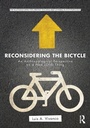
Reconsidering the Bicycle
An Anthropological Perspective on a New (Old) Thing
1st Edition
Published on 5. March 2013
184 pages
978-1-136-65677-4 (ISBN)
Description

In cities throughout the world, bicycles have gained a high profile in recent years, with politicians and activists promoting initiatives like bike lanes, bikeways, bike share programs, and other social programs to get more people on bicycles. Bicycles in the city are, some would say, the wave of the future for car-choked, financially-strapped, obese, and sustainability-sensitive urban areas.
This book explores how and why people are reconsidering the bicycle, no longer thinking of it simply as a toy or exercise machine, but as a potential solution to a number of contemporary problems. It focuses in particular on what reconsidering the bicycle might mean for everyday practices and politics of urban mobility, a concept that refers to the intertwined physical, technological, social, and experiential dimensions of human movement.
This book is for Introductory Anthropology, Cultural Anthropology, Cultural Sociology, Environmental Anthropology, and all undergraduate courses on the environment and on sustainability throughout the social sciences.
This book explores how and why people are reconsidering the bicycle, no longer thinking of it simply as a toy or exercise machine, but as a potential solution to a number of contemporary problems. It focuses in particular on what reconsidering the bicycle might mean for everyday practices and politics of urban mobility, a concept that refers to the intertwined physical, technological, social, and experiential dimensions of human movement.
This book is for Introductory Anthropology, Cultural Anthropology, Cultural Sociology, Environmental Anthropology, and all undergraduate courses on the environment and on sustainability throughout the social sciences.
Reviews / Votes
A vivid, ethnographically and historically rich contribution to transportation studies and the study of commodities. The bicycle emerges as one of the most fascinating and unexpectedly important objects of our world.- Catherine Lutz, Watson Institute for International Studies, Brown University
With care and clarity, Luis Vivanco draws upon intensive fieldwork and meticulous research to produce a rich cultural analysis of the bicycle and the complex ways in which bicycling is made meaningful. Reconsidering the Bicycle not only carves new terrain for the study of bicycles as material culture, it effectively grapples with the socioeconomic, symbolic, personal, and political dimensions of bicycling in everyday life. Beyond its unique contribution to and expansion of existing work on urban cycling, Vivanco's engaging book demonstrates how and why anthropology and ethnographic inquiry should play central roles in the future of transportation research. Highly recommended."
-Zack Furness, author of One Less Car: Bicycling and the Politics of Automobility, Communications, Penn State University
Reconsidering the Bicycle gives an urgently needed critical context to the recent explosition of bicycle cultures in the United States and emphasizes the important distinction between passing cultural fads and the more durable social change brought about by bicycle mobility. To achieve this Vivanco traces the historical relationship between bicycles and mobility to illustrate a previously unrecognized continuity between contemporary social activists' concerns about community and the social history of automobiles, urban planning and issues of mobility in three cities; Amsterdam, Bogota and Burlingon, Vermont. The diversity of the locations are brought together by a complex analysis of the simple fact of people needing to find solidarity and confidence in their physical engagement with the place they live and spaces in which they move about.
--Brian Joseph Gilley, Anthropology, Director, First Nations Educational & Cultural Center, Indiana University, Bloomington
"'Reconsidering the Bicycle' explores, among other things, the bicycle's social history, its cultural context in various urban settings, the newly energized bicycle movement, and the need for anthropologists to give some serious attention to this thing and how it's used."-Tim Johnson, Burlington Free Press
More details
Series
Language
English
Place of publication
London
United Kingdom
Publishing group
Taylor & Francis Ltd
Target group
College/higher education
Product notice
Reflowable
Illustrations
9 s/w Tabellen
9 Tables, black and white
File size
17,11 MB
ISBN-13
978-1-136-65677-4 (9781136656774)
Copyright in bibliographic data and cover images is held by Nielsen Book Services Limited or by the publishers or by their respective licensors: all rights reserved.
Schweitzer Classification
Other editions
Additional editions
Book
02/2013
1st Edition
Routledge
€58.30
Shipment within 15-20 days

Book
02/2013
1st Edition
Routledge
€230.20
Shipment within 15-20 days
Person
Luis A. Vivanco is Associate Professor of Anthropology and Director of Global and Regional Studies at the University of Vermont.
Content
Preface: The Bicycle, A New (Old) Thing Acknowledgements 1. Anthropology, Bicycles, and Urban Mobility 2. What (and When) is a Bicycle? 3. Constructing Urban Bicycle Cultures: Perspectives on Three Cities 4. "Good for the Cause:" The Bike Movement as Social Action and Cultural Politics 5. Conclusion: On the Need for the Bicycle
