

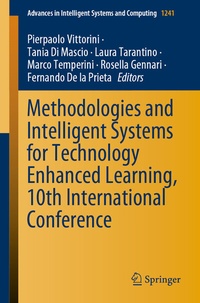
Methodologies and Intelligent Systems for Technology Enhanced Learning, 10th International Conference
Description

This book intends to bring together researchers and developers from industry, the education field, and the academic world to report on the latest scientific research, technical advances, and methodologies. The 10th International Conference in Methodologies and Intelligent Systems for Technology Enhanced Learning is hosted by the University of L'Aquila and is going to be held in L'Aquila (Italy). Initially planned on the 17th to the 19th of June 2020, it was postponed to the 7th to the 9th of October 2020, due to the COVID-19 outbreak. The 10th edition of this conference and its related workshops expand the topics of the evidence-based TEL workshops series in order to provide an open forum for discussing intelligent systems for TEL, their roots in novel learning theories, empirical methodologies for their design or evaluation, stand-alone solutions, or web-based ones. This bridge has been realized also thanks to the sponsor of this edition of MIS4TEL: the Armundia Group https://www.armundia.com, the support from national associations (AEPIA, APPIA, CINI, and EurAI), and organizers (UNIVAQ, UNIROMA1, UNIBZ, UCV, UFSC, USAL, AIR institute, UNC, and UNIBA)
More details
Other editions
Additional editions
Content
- Intro
- Preface
- Organisation of MIS4TEL 2020
- General Co-chairs
- Technical Program Co-chairs
- Paper Co-chairs
- Proceedings Co-chairs
- Publicity Chairs
- Workshop Chair
- Program Committee
- Local Organising Committee
- Organising Committee
- Contents
- Effects of Time in Virtual Reality Learning Environments Linked with Materials Science and Engineering
- Abstract
- 1 Introduction
- 2 Design Considerations of VRLEs
- 2.1 Design of Guidance Protocol
- 2.2 Obsolescence Effects on Students' Motivation
- 3 Meaningful Learning Analysis
- 3.1 Methodology
- 3.2 Results
- 4 Discussion
- 5 Conclusions
- References
- HEMOT®, Helmet for EMOTions: A Web Application for Children on Earthquake-Related Emotional Prevention
- Abstract
- 1 Introduction
- 1.1 The Development of HEMOT®
- 1.2 The Present Study
- 2 Method
- 2.1 Participants
- 2.2 Material and Procedure
- 2.3 Analysis Procedure
- 3 Results and Discussion
- 3.1 Children's Usability of HEMOT®
- 3.2 Children's Performance in HEMOT®
- 4 Conclusions
- References
- Social Video Learning - Creation of a Reflection-Based Course Design in Teacher Education
- Abstract
- 1 Introduction
- 2 Rationale of the Research Project
- 3 Theoretical Base and Method
- 3.1 Theoretical Framework and Adaptation to Course Setting
- 3.2 Course Characteristics and Research Method
- 3.3 Learning Analytics to Enhance SVL
- 4 Results and Discussion
- 4.1 Blended Learning Design
- 5 Conclusion and Limitations
- References
- Engaging Pre-teens in Ideating and Programming Smart Objects Through Play
- 1 Introduction
- 2 Related Work
- 3 Workshop Design
- 3.1 Participants and Setting
- 3.2 Research Questions
- 3.3 Protocol
- 3.4 Data Collection
- 4 Workshop Results
- 4.1 Survey Results
- 4.2 Observation Results
- 5 Discussion and Conclusions
- References
- Advanced Placement Physics Exam Performance of High School Graduates in Mexico with the Aid of Online Assignments Designed in Open-EdX
- Abstract
- 1 Introduction
- 2 Theoretical Framework
- 3 Methodology
- 4 Results and Discussion
- 5 Conclusions
- Acknowledgements
- References
- Hand Robotics Rehabilitation in Patients with Multiple Sclerosis: A Pilot Study
- Abstract
- 1 Introduction
- 2 Materials and Methods
- 2.1 Participants
- 2.2 Experimental Protocol
- 2.3 Intervention
- 2.4 Statistical Analysis
- 3 Results
- 4 Discussion
- 4.1 Limitation of the Study
- 4.2 Conclusions
- Ethics Statement
- References
- When Something Useful Is Also Enjoyable: An Empirical Study on the Intention to Use Web-Based Simulations in Higher Education
- Abstract
- 1 Introduction
- 2 Theoretical Framework
- 2.1 Interaction Between PU and PE and Web-Based Simulations Adoption
- 3 Research Method
- 3.1 Sample and Data Collection
- 4 Findings
- 5 Discussion and Conclusions
- References
- TEL Adoption in the Riconnessioni Project
- Abstract
- 1 EdTech and the Italian School System
- 1.1 Educational Inequality
- 1.2 Obsolete Pedagogy
- 1.3 Unequal Access to Knowledge
- 1.4 The Case for EdTech
- 2 The Riconnessioni Model
- 2.1 Riconnessioni in Turin
- 2.2 Riconnessioni in Cuneo
- 3 Conclusions
- References
- Cognitive Complexity Analysis of Learning-Related Texts: A Case Study on School Textbooks
- 1 Introduction
- 2 Literature Review
- 2.1 Cognitive Domain of Bloom's Taxonomy and Action Verbs
- 2.2 Informational Text Structure and Signal Words
- 3 Methodology of SVM Algorithm for Text Classification
- 4 Details of NCERT Dataset
- 4.1 Inter-annotator Agreement for Gold-Standard Data
- 5 Experiments
- 5.1 Experiment with Bloom's Taxonomy Action Verbs
- 5.2 Experiment with Signal Words of Informational Text Structure
- 5.3 Experiment with Support Vector Machine
- 6 Observation and Discussion
- 7 Future Work and Conclusion
- References
- Lessons Clustering Using Topics Inferred by Unsupervised Modeling from Textbooks
- 1 Introduction
- 2 Method
- 2.1 Data Collection
- 2.2 Data Analysis
- 3 Results
- 3.1 Description of a Lesson
- 3.2 Clustering
- 4 Discussion and Conclusion
- References
- Automatic Content Analysis of Computer-Supported Collaborative Inquiry-Based Learning Using Deep Networks and Attention Mechanisms
- Abstract
- 1 Introduction
- 2 Related Work
- 3 Methodology
- 3.1 Data Set
- 3.2 Data Pre-processing
- 3.3 Feature Engineering
- 3.4 The Neural Network Classifier
- 3.5 Model Evaluation
- 4 Results
- 5 Discussion and Conclusion
- Acknowledgements
- References
- The Impact of Personality, Attitude and Visual Decision-Making Dashboard Tools on the Learning Engagement of Economist Students
- Abstract
- 1 Introduction
- 2 Literature Review
- 3 Learning Scenario - Personality, Attitude and Visual Decision-Making Dashboard Tools
- 4 Research Methodology
- 5 Findings and Discussion
- 6 Conclusions
- References
- HRS-EDU: Architecture to Control Social Robots in Education
- 1 Introduction
- 2 Tools for Enhancing Learning
- 3 Robots as Tools in Education
- 4 Methodology
- 4.1 Theoretical Proposal
- 5 HRS-EDU Architecture
- 5.1 Desires and Intentions to Control the Robot Behavior
- 6 Validation of the HRS-EDU Architecture
- 7 Conclusions
- References
- Authoring Interactive Videos for e-Learning: The ELEVATE Tool Suite
- 1 Introduction
- 2 Application Domain and Tool Suite
- 2.1 The ELEVATE Tool Suite Components
- 3 The ELEVATE Tool Suite at Use
- 3.1 Collaborative Authoring
- 3.2 Exercise Evolution
- 4 Related Work
- 5 Conclusion and Future Work
- References
- Early Detection of Gender Differences in Reading and Writing from a Smartphone-Based Performance Support System for Teachers
- Abstract
- 1 Introduction
- 2 Methods
- 3 Results
- 4 Conclusion and Discussion
- Acknowledgements
- References
- An Assessment of Students' Satisfaction in Higher Education
- Abstract
- 1 Introduction
- 2 Fundamentals
- 2.1 A Thermodynamic Approach to Knowledge Representation and Reasoning
- 2.2 Artificial Neural Networks
- 3 Methods
- 4 Case Study
- 4.1 A Thermodynamic Approach to Data Acquisition and Processing
- 4.2 Evaluation of Students' Satisfaction - a Computational Logic Approach
- 5 Conclusions and Future Work
- Acknowledgments
- References
- Methodological Guidelines to Build Collaborative Serious Games Based on Intelligent Agents
- Abstract
- 1 Introduction
- 2 Conceptual Framework
- 3 Related Works
- 4 Methodological Guidelines Proposal
- 4.1 Step 1. System Specification and Analysis
- 4.2 Step 2. Architecture Design and Development
- 4.3 Step 3. Implementation and Validation of the Collaborative Game System
- 5 Conclusions and Future Work
- Acknowledgments
- References
- An Augmented Reality-Based mLearning Approach to Enhance Learning and Teaching: A Case of Study in Guadalajara
- 1 Introduction
- 2 Related Work
- 3 Approach to Enhance Learning and Teaching Through Augmented Reality and Mobile Computing
- 3.1 Introduction
- 3.2 Methodology for the Development of AR-Based mLearning Systems
- 4 cuceAR: An AR-Based Mobile Application to Improve Education
- 5 Survey to Validate User Experience in AR-Based mLearning Applications
- 6 Conclusions
- References
- Supporting the Construction of Learning Paths in a Competency-Based Informatics Curriculum
- 1 Introduction
- 2 Background
- 3 Resource Catalogue
- 4 Learning Paths Design
- 5 User Roles and Functionalities
- 6 Conclusions and Future Works
- References
- Personalized Recommender System Using Learners' Metacognitive Reading Activities
- 1 Introduction
- 2 Related Work
- 3 Our Approach
- 4 User Study and Experimental Design
- 5 Results and Findings
- 6 Conclusion and Future Work
- References
- Technology-Enhanced Learning (TEL) in Anaesthesia: Ultrasound Simulation Training for Innovative Locoregional Anaesthesia
- Abstract
- 1 Introduction
- 2 The Study
- 2.1 Study Design
- 2.2 Sampling and Participants
- 2.3 Course Description
- 2.4 Measures
- 2.5 Outcomes
- 2.6 Statistical Analysis
- 3 Results
- 3.1 Primary Outcome
- 3.2 Secondary Outcomes
- 4 Conclusion
- References
- Profiles in Brain Type in Programming Performance for Non-vocational Courses
- Abstract
- 1 Introduction
- 2 Method
- 2.1 Participants and Context
- 2.2 Measures
- 2.3 Data Analysis
- 3 Results and Discussion
- 3.1 Descriptive Statistics and Bivariate Correlations
- 3.2 Profile of Students on the Basis of EQ-SQ and Sex
- 3.3 Students' Profiles and Performance in Programming
- 4 Conclusions
- References
- Towards a Gamified Musical Skill Learning Model (MuS-LM): Structural Aspects
- Abstract
- 1 Introduction
- 2 The Organizational Situation
- 2.1 The Methodological Approach
- 2.2 Diagnosis of the Problem
- 3 The deejay-Based Process of CrazySquare
- 3.1 Research-Client Agreement (RCA)
- 3.2 The Cyclical Process
- 3.3 MuS-LM: The Learning Space
- 3.4 Validation and Gamification of Mus-LM
- 4 Conclusions
- Acknowledgement
- References
- Philosophical Approaches to Smart Education and Smart Cities
- 1 Introduction
- 1.1 Scenario, Content and Horizon of Education
- 2 Smart Education and Smart City
- 2.1 Smart Education and XXI's Skills
- 2.2 Smart Cities Philosophical Issues
- 3 Methodology, Design and Educational Environment
- 4 Digital Skills and Educational Content
- 4.1 Computational Thinking
- 4.2 Algorithmic Thinking
- 4.3 Learn to Program
- 4.4 Advantages of Trivium Disciplines for 21st Century Education
- 5 Conclusions
- References
- Experiences in a Differential Equations Massive Course
- Abstract
- 1 Introduction
- 2 Theoretical Framework
- 3 Blended Learning Proposal
- 4 Methodology
- 5 Results
- 6 Discussion
- 7 Conclusion
- Acknowledgements
- References
- A Protocol for Simulated Experimentation of Automated Grading Systems
- 1 Introduction
- 2 Schema of a Simulated Experiment
- 3 Background
- 3.1 Peer Assessment
- 3.2 Feature-Based Automated Grading
- 4 Simulative Data Generation
- 5 Case Studies
- 5.1 Case Study 1
- 5.2 Case Study 2
- 6 Conclusions
- References
- Author Index
