

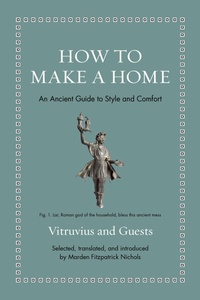
How to Make a Home
An Ancient Guide to Style and Comfort
1st Edition
Published on 5. June 2025
328 pages
978-0-691-27166-8 (ISBN)
Description

An entertaining and enlightening collection of ancient Roman writings about home design and decoration
The idea that our homes can communicate professional as well as personal identities may seem as new as the work-from-home revolution. But it was second nature to the ancient Romans, for whom the home was in many ways the center of public and private life. Roman authors saw infinite practical and symbolic value in houses, and they have much to say about them. How to Make a Home presents some of the best Roman writings on houses-from buying and selling to designing and decorating.
Edited and elegantly translated by Marden Fitzpatrick Nichols, How to Make a Home gathers selections by Cicero, Vitruvius, Seneca, and others, with the original Latin or Greek on facing pages. These writings reveal the pleasures and pitfalls of the Roman practice of making one's home a cornerstone of self-expression. While the ideal home enshrined Roman virtues and could make a career, lavish building projects could lead to financial ruin and moral condemnation. These authors memorably describe such travails as deceptive staging, decorators run amok, know-it-all owners, unsupervised contractors, and buyer's remorse. Along the way, they also explain why simplicity is bliss, privacy is for nobodies, a neglected house is a sign of a neglected soul, and much more.
A unique and charming introduction to Roman domestic architecture and its cultural significance, How to Make a Home reveals that the obsession with house and home has a long and fascinating history.
The idea that our homes can communicate professional as well as personal identities may seem as new as the work-from-home revolution. But it was second nature to the ancient Romans, for whom the home was in many ways the center of public and private life. Roman authors saw infinite practical and symbolic value in houses, and they have much to say about them. How to Make a Home presents some of the best Roman writings on houses-from buying and selling to designing and decorating.
Edited and elegantly translated by Marden Fitzpatrick Nichols, How to Make a Home gathers selections by Cicero, Vitruvius, Seneca, and others, with the original Latin or Greek on facing pages. These writings reveal the pleasures and pitfalls of the Roman practice of making one's home a cornerstone of self-expression. While the ideal home enshrined Roman virtues and could make a career, lavish building projects could lead to financial ruin and moral condemnation. These authors memorably describe such travails as deceptive staging, decorators run amok, know-it-all owners, unsupervised contractors, and buyer's remorse. Along the way, they also explain why simplicity is bliss, privacy is for nobodies, a neglected house is a sign of a neglected soul, and much more.
A unique and charming introduction to Roman domestic architecture and its cultural significance, How to Make a Home reveals that the obsession with house and home has a long and fascinating history.
More details
Language
English
Place of publication
Princeton, NJ
United States
Publishing group
De Gruyter
Target group
Professional and scholarly
Edition type
Digital original
Product notice
Reflowable
Illustrations
3 b/w illus.
File size
0,78 MB
ISBN-13
978-0-691-27166-8 (9780691271668)
Schweitzer Classification
Other editions
Additional editions
Book
08/2025
Princeton University Press
€19.00
Available immediately
Persons
Marden Fitzpatrick Nichols is Provost's Distinguished Associate Professor and Chair of Classics at Georgetown University and the author of Author and Audience in Vitruvius' "De architectura."
Content
- Cover
- Contents
- List of Illustrations
- Preface
- Acknowledgments
- Introduction
- 1. Simplicity Is Bliss (Ovid)
- 2. How Houses Came to Be (Vitruvius)
- 3. Why Infrastructure Matters (Strabo)
- 4. Privacy Is for Nobodies (Velleius Paterculus)
- 5. A Home Should Reflect Its Owner (Vitruvius)
- 6. Don't Be Upstaged by Your House (Cicero)
- 7. Prime Real Estate Won't Solve All Your Problems (Seneca)
- 8. Displaying Portraits of Your Ancestors Could Make You Look Shabby (Juvenal)
- 9. Unless You Have Deep Pockets, the Big City Is a Death Trap (Juvenal)
- 10. Caveat Emptor (Cicero)
- 11. New Construction Requires Your Presence and Input (Cicero)
- 12. The Decorator Must Understand Your Vision (Cicero)
- 13. So Your Architect Blew Through the Budget: Now What? (Vitruvius)
- 14. When Redecorating, Use the Most Expensive Materials the Least (Vitruvius)
- 15. Overspend, and Your Home Could Ruin You (Bibaculus)
- 16. Neglected House, Neglected Soul (Plautus)
- 17. They Don't Make Them Like They Used To (Seneca)
- 18. The Golden Mean (Cornelius Nepos)
- 19. The Consummate Villa, the Perfect Home (Pliny the Younger)
- Notes
- Passages Translated
- Further Reading
