

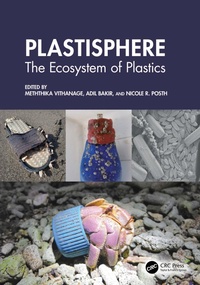
Plastisphere
The Ecosystem of Plastics
1st Edition
Published on 30. June 2025
384 pages
978-1-040-36615-8 (ISBN)
Description

The plastisphere provides a unique man-made habitat for organisms and microbial communities. Investigating the interactions and functions of these organisms helps us understand how fouling communities can settle on these novel platforms and be moved beyond their natural ranges as well as their contribution to nutrient cycling and biogeochemical processes. This book examines the plastisphere and reveals a secret world of microbes that have adapted to live on plastic surfaces. It explains the ecological effects of plastic pollution, human health concerns, microbial ecology, and mitigation techniques and advocates sustainable solutions. Readers will dive into this enthralling ecosystem rich with microscopic life and explore its mysteries in this thought-provoking book.
Features:
Presents recent insights into the fundamentals of the plastisphere, with a specific focus on environmental interactions
Introduces the work of global experts and their ongoing studies, creative approaches, and new discoveries
Highlights the macro and molecular interactions of environmental domains with the plastisphere
Explores the notion of bioinvasion that can threaten the health and productivity of our ecosystems
Includes detailed multidisciplinary data on the behavior of plastic materials and environmental microbiome
Explains the main factors causing ecosystems to evolve and to live in human-made plastic environments
Helps readers from various backgrounds to gain a thorough understanding of the topic of the plastisphere
This book is an insightful reference for researchers, academics, students, and professionals in Environmental Science, Microbiology, Environmental Engineering, Oceanography, and Material Science.
Features:
Presents recent insights into the fundamentals of the plastisphere, with a specific focus on environmental interactions
Introduces the work of global experts and their ongoing studies, creative approaches, and new discoveries
Highlights the macro and molecular interactions of environmental domains with the plastisphere
Explores the notion of bioinvasion that can threaten the health and productivity of our ecosystems
Includes detailed multidisciplinary data on the behavior of plastic materials and environmental microbiome
Explains the main factors causing ecosystems to evolve and to live in human-made plastic environments
Helps readers from various backgrounds to gain a thorough understanding of the topic of the plastisphere
This book is an insightful reference for researchers, academics, students, and professionals in Environmental Science, Microbiology, Environmental Engineering, Oceanography, and Material Science.
More details
Edition
1. Auflage
Language
English
Place of publication
London
United Kingdom
Publishing group
Taylor & Francis Ltd
Target group
College/higher education
Professional and scholarly
Illustrations
19 Tables, black and white; 36 Line drawings, color; 27 Line drawings, black and white; 4 Halftones, color; 3 Halftones, black and white; 40 Illustrations, color; 30 Illustrations, black and white
File size
52,31 MB
ISBN-13
978-1-040-36615-8 (9781040366158)
Copyright in bibliographic data and cover images is held by Nielsen Book Services Limited or by the publishers or by their respective licensors: all rights reserved.
Schweitzer Classification
Other editions
Additional editions
Book
06/2025
1st Edition
CRC Press
€203.20
Shipment within 10-20 days
Persons
Meththika Suharshini Vithanage's contribution to science has been recognized by The World Academy of Sciences (TWAS) presenting the Fayzah M. Al-Kharafi award in 2020. She is listed as a Highly Cited Researcher in 2021 by Clarivate. She is a Fellow of the National Academy of Sciences, Sri Lanka and Institute of Chemistry, Ceylon. She was selected as one of the Early Career Women Scientists by the Organization for Women Scientists in Developing Countries, Italy. Additionally, she received the Best Graduate Researcher Award for Natural Hazards by the American Geophysical Union in 2010. Her outstanding performance in research publications was recognized by the Presidential Awards, Sri Lanka for consecutive 8 years from 2011.
Adil Bakir is a Principal Scientist at the Centre for Environment, Fisheries, and Aquaculture Science (Cefas) in the UK. He has been involved in the field of microplastic research for about 10 years, starting as a postdoctoral researcher for a Defra funded project at Plymouth University in the UK. Dr. Bakir joined the marine litter team at Cefas in 2018 and is currently leading the Cefas microplastic laboratory aiming at developing faster and cheaper techniques for the monitoring of microplastics in environmental matrices. Adil is also co-leading the OSPAR microplastic expert group (MPEG) and is currently being involved in the ICES working group on Marine Litter.
Nicole R. Posth is an Associate Professor of Geomicrobiology in the Sedimentary Systems Research Group at the University of Copenhagen. She is head of the Geomicrobiology & Biogeochemistry Lab focused on the interactions between microorganisms, minerals, and plastics mediated within biogeochemical cycles in water and sediment at the macro, micro and nanoscale. She is a geomicrobiologist and sediment biogeochemist studying microbial element cycling, biomineralization, and microbe-surface interactions. Bridging field and laboratory experiments, her projects range from interpreting the role of microorganisms in the evolution of life on Earth to the impact of microbial life in driving biogeochemical cycles in the Anthropocene.
Adil Bakir is a Principal Scientist at the Centre for Environment, Fisheries, and Aquaculture Science (Cefas) in the UK. He has been involved in the field of microplastic research for about 10 years, starting as a postdoctoral researcher for a Defra funded project at Plymouth University in the UK. Dr. Bakir joined the marine litter team at Cefas in 2018 and is currently leading the Cefas microplastic laboratory aiming at developing faster and cheaper techniques for the monitoring of microplastics in environmental matrices. Adil is also co-leading the OSPAR microplastic expert group (MPEG) and is currently being involved in the ICES working group on Marine Litter.
Nicole R. Posth is an Associate Professor of Geomicrobiology in the Sedimentary Systems Research Group at the University of Copenhagen. She is head of the Geomicrobiology & Biogeochemistry Lab focused on the interactions between microorganisms, minerals, and plastics mediated within biogeochemical cycles in water and sediment at the macro, micro and nanoscale. She is a geomicrobiologist and sediment biogeochemist studying microbial element cycling, biomineralization, and microbe-surface interactions. Bridging field and laboratory experiments, her projects range from interpreting the role of microorganisms in the evolution of life on Earth to the impact of microbial life in driving biogeochemical cycles in the Anthropocene.
Content
1. Global Microplastic Cycle in The Ecosphere. 2. Plastic-Associated Contaminants. 3. Microbiome in Atmospheric Microplastics and Microplastic Deposition on Symbiotic Organisms. 4. Phyllosphere as a Signature of Microplastic Deposition in Peri-Urban Environments. 5. Exploring the Microbiome of the Marine Microplastisphere: Implications for Microplastic Fate and Ecological Impacts. 6. Plastisphere Community Assemblage in Freshwater. 7. Biofilm Dynamics and Environmental Implications on Plastic Surfaces. 8. How Do Microplastics Distribute through Freshwater Ecosystems? Which Biota, Feeding Groups, and Trophic Levels are Most at Risk?. 9. Plastisphere in Aquatic Food Production Systems and Seafood Safety. 10. Community Ecology and Gene Flow within Biofilms formed on Plastic Surfaces. 11. Plastic Pollution in Macrophyte Systems: Impacts on Habitat Integrity. 12. Rhizobiome of Terrestrial Plastisphere. 13. Plant Health Effects of Terrestrial Plastisphere. 14. Beyond Biofilm - The Role of Bio-Minerals and Metals in the Plastisphere - Implications for Elemental Cycling, Biogeochemical Processes, and Human Health. 15. Engineering Microbiosphere for Degradation of Plastics. 16. Environmental Health Impact of Plastisphere. 17. Insights into Microbial Enzyme-Mediated Hydrolysis of Fossil-Based Polymers in Plastisphere: Prospects for Environmental Sustainability. 18. Plastisphere as a Vector for Pathogenic Microbes and Antibiotic Resistance. 19. Plastisphere Nomads: An Overview of Organism Dispersal via Marine Plastic Litter. 20. Data Gaps in Assessing the Risks of Microplastics into the Food Chain.
