

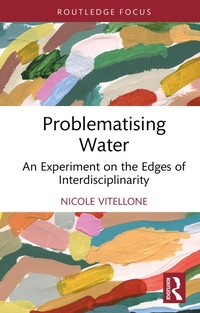
Problematising Water
An Experiment on the Edges of Interdisciplinarity
1st Edition
Published on 1. May 2026
148 pages
978-1-040-57423-2 (ISBN)
Description

Problematising Water: An Experiment on the Edges of Interdisciplinarity is a manifestation of thinking with water across a range of disciplines including human geography, sociology, anthropology, science and technology studies, and ethnomethodology.
In this book, Vitellone reveals the alliances between Michel Foucault's concept of problematisation and a new methodological approach for water- focused research, as seen through her study of London's #OneLess refill water fountain pilot, an intervention to reduce plastic bottled water. Situating the refill water fountain as a problematic space for collaborating with marine scientists, marine conservationists, systems change practitioners, and publics engaged in the making and doing of refill, the book discusses how Foucault's notion of problematisation forces a re- thinking of knowledge making practices in environmental research on water. It also synthesises a large body of literature by key thinkers, including Bruno Latour, Isabelle Stengers, Andrea Ballestero, Astrida Neimanis, Noortge Marres, Gay Hawkins, Andrew Barry, Mike Michael, and others, and links to current debates across a variety of disciplines.
Problematising Water: An Experiment on the Edges of Interdisciplinarity is a timely and provocative contribution to debates around the climate crisis and environmental interventions and the role that different research methods and objects play within them. It will be of value to science and technology scholars, social scientists, natural scientists, and academics interested in the environmental humanities.
In this book, Vitellone reveals the alliances between Michel Foucault's concept of problematisation and a new methodological approach for water- focused research, as seen through her study of London's #OneLess refill water fountain pilot, an intervention to reduce plastic bottled water. Situating the refill water fountain as a problematic space for collaborating with marine scientists, marine conservationists, systems change practitioners, and publics engaged in the making and doing of refill, the book discusses how Foucault's notion of problematisation forces a re- thinking of knowledge making practices in environmental research on water. It also synthesises a large body of literature by key thinkers, including Bruno Latour, Isabelle Stengers, Andrea Ballestero, Astrida Neimanis, Noortge Marres, Gay Hawkins, Andrew Barry, Mike Michael, and others, and links to current debates across a variety of disciplines.
Problematising Water: An Experiment on the Edges of Interdisciplinarity is a timely and provocative contribution to debates around the climate crisis and environmental interventions and the role that different research methods and objects play within them. It will be of value to science and technology scholars, social scientists, natural scientists, and academics interested in the environmental humanities.
Reviews / Votes
"Nicole Vitellone's Problematising Water: An Experiment on the Edges of Interdisciplinarity is a tour de force of conceptual and empirical invention. Tracing a path that takes in Foucault's problematisation of problematisation through Stengers' experimental constructivism and Garfinkelian ethnomethodology, Vitellone unpicks the methodological and ontological complexities of practically engaging with water in its multiple guises. In particular, the sustained focus on the #OneLess refill water fountain experiment yields a sophisticated exploration of the ways in which water is variously enacted by publics and professionals, within and across disciplines, and by the social scientific researcher themselves. Out of this emerges an innovative, insightful and evocative picture - a mosaic - of how an environmental politics can manifest in its specificity."Mike Michael, Professor of Sociology, University of Exeter
More details
Series
Edition
1. Auflage
Language
English
Place of publication
London
United Kingdom
Publishing group
Taylor & Francis Ltd
Target group
College/higher education
Professional and scholarly
Illustrations
4 Halftones, black and white; 4 Illustrations, black and white
File size
65,11 MB
ISBN-13
978-1-040-57423-2 (9781040574232)
Copyright in bibliographic data and cover images is held by Nielsen Book Services Limited or by the publishers or by their respective licensors: all rights reserved.
Schweitzer Classification
Other editions
Additional editions
Book
05/2026
1st Edition
Routledge
€66.00
Shipment within 15-20 days
Person
Nicole Vitellone is AF Warr Senior Lecturer in Sociology in the School of Law and Social Justice and Co-Director of Centre for Health, Arts, Society & Environment (CHASE) at the University of Liverpool, United Kingdom.
Content
Introduction: How to think, research, and write with water - a problematological turn 1. Thinking problematically with the water fountain 2. Probing problematisation in the plastics and climate crises 3. Loitering as a method of interdisciplinary research 4. Sociography of a curious object 5. Using ethnomethodology to make sense of the #OneLess refill water fountain pilot
