

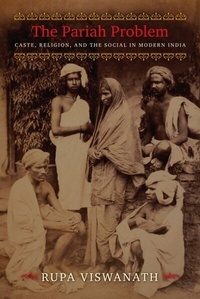
The Pariah Problem
Caste, Religion, and the Social in Modern India
1st Edition
Published on 28. July 2015
416 pages
978-0-231-53750-6 (ISBN)
Description

Once known as "Pariahs," Dalits are primarily descendants of unfree agrarian laborers. They belong to India's most subordinated castes, face overwhelming poverty and discrimination, and provoke public anxiety. Drawing on a wealth of previously untapped sources, this book follows the conception and evolution of the "Pariah Problem" in public consciousness in the 1890s. It shows how high-caste landlords, state officials, and well-intentioned missionaries conceived of Dalit oppression, and effectively foreclosed the emergence of substantive solutions to the "Problem"-with consequences that continue to be felt today.
Rupa Viswanath begins with a description of the everyday lives of Dalit laborers in the 1890s and highlights the systematic efforts made by the state and Indian elites to protect Indian slavery from public scrutiny. Protestant missionaries were the first non-Dalits to draw attention to their plight. The missionaries' vision of the Pariahs' suffering as being a result of Hindu religious prejudice, however, obscured the fact that the entire agrarian political-economic system depended on unfree Pariah labor. Both the Indian public and colonial officials came to share a view compatible with missionary explanations, which meant all subsequent welfare efforts directed at Dalits focused on religious and social transformation rather than on structural reform. Methodologically, theoretically, and empirically, this book breaks new ground to demonstrate how events in the early decades of state-sponsored welfare directed at Dalits laid the groundwork for the present day, where the postcolonial state and well-meaning social and religious reformers continue to downplay Dalits' landlessness, violent suppression, and political subordination.
Rupa Viswanath begins with a description of the everyday lives of Dalit laborers in the 1890s and highlights the systematic efforts made by the state and Indian elites to protect Indian slavery from public scrutiny. Protestant missionaries were the first non-Dalits to draw attention to their plight. The missionaries' vision of the Pariahs' suffering as being a result of Hindu religious prejudice, however, obscured the fact that the entire agrarian political-economic system depended on unfree Pariah labor. Both the Indian public and colonial officials came to share a view compatible with missionary explanations, which meant all subsequent welfare efforts directed at Dalits focused on religious and social transformation rather than on structural reform. Methodologically, theoretically, and empirically, this book breaks new ground to demonstrate how events in the early decades of state-sponsored welfare directed at Dalits laid the groundwork for the present day, where the postcolonial state and well-meaning social and religious reformers continue to downplay Dalits' landlessness, violent suppression, and political subordination.
All prices
More details
Other editions
Additional editions
Book
07/2014
Columbia University Press
€76.82
Article not available at the moment
Person
Rupa Viswanath is professor of Indian religions at the Centre for Modern Indian Studies at the University of Göttingen. She has held positions at the University of Pennsylvania and the University of Cambridge. Her interests include national minorities and practices of minoritization, comparative secularisms, slavery and race, transnational religious movements, religions and representative democracy, and political theory and the global south.
Content
Acknowledgments
Abbreviations
Introduction
1. Land Tenure or Labor Control? The Agrarian Mise-en-Scène
2. Conceptualizing Pariah Conversion: Caste
3. The Pariah-Missionary Alliance: Agrarian Contestation and the Local State
4. The State and the Ceri
5. Settling Land
6. The Marriage of Sacred and Secular Authority: New Liberalism
7. Giving the Panchama a Home: Creating a Friction Where None Exists
8. Everyday Warfare: Caste
9. The Depressed Classes
Conclusion: The Pariah Problem's Enduring Legacies
Glossary
Notes
Bibliography
Index
Abbreviations
Introduction
1. Land Tenure or Labor Control? The Agrarian Mise-en-Scène
2. Conceptualizing Pariah Conversion: Caste
3. The Pariah-Missionary Alliance: Agrarian Contestation and the Local State
4. The State and the Ceri
5. Settling Land
6. The Marriage of Sacred and Secular Authority: New Liberalism
7. Giving the Panchama a Home: Creating a Friction Where None Exists
8. Everyday Warfare: Caste
9. The Depressed Classes
Conclusion: The Pariah Problem's Enduring Legacies
Glossary
Notes
Bibliography
Index
Read the introduction to The Pariah Problem:

