

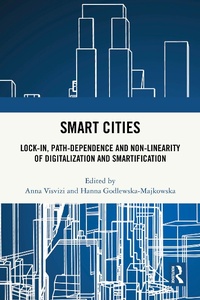
Smart Cities
Lock-in, Path-dependence and Non-linearity of Digitalization and Smartification
1st Edition
Published on 26. August 2024
234 pages
978-1-040-12131-3 (ISBN)
Description

This book seeks to identify and to examine factors and mechanisms underlying the growth and development of smart cities.
It is commonplace to discuss smart cities through the lens of advances in ICT. The resulting overemphasis on what is technologically possible downplays what is politically, socially and economically feasible. This book, by analysing the smart city through a variety of perspectives, offers a more comprehensive insight into and understanding of the complex and the open-ended nature of the growth and development of a smart city. A solid conceptual framework is developed and employed throughout the chapters, and a selection of case studies from Europe, Asia, and the Arab Peninsula grants the readers a hands-on perspective of the matters discussed.
The chapters included in this book address a set of questions, including:
How do the twin-processes of digitalization and smartification unfold in the context of the smart city agenda? How do these processes relate to the concepts of smart city 1.0, 2.0., 3.0. and 4.0?
In which ways have the spatial aspects of city functioning been influenced by the intrusion of ICT? In which ways do the same processes contribute to the attainment of the UN Sustainable Development Goals (SDGs)?
What are the implications of smartification and the emergence of smart organizations (public, private, and voluntary) for the spatial development of smart cities?
Do ICT and its application in the city space boost the processes of revitalization and how does ICT influence the process of gentrification?
To what extent and how does the intrusion of ICT-enhanced tools and applications in the city space impact on a city's relationship with its broader territorially defined context?
Are the administrative borders and divisions inherent in the fabric of a city becoming less/more porous? How should urban sprawl be conceived in the context of the smart city debate?
This book will have a broad appeal to academics, students, and policy makers with interests in urban planning, sustainable development, cities, economics, technology, sociology, urban studies, digitalization, SDGs, wellbeing, and resilience.
It is commonplace to discuss smart cities through the lens of advances in ICT. The resulting overemphasis on what is technologically possible downplays what is politically, socially and economically feasible. This book, by analysing the smart city through a variety of perspectives, offers a more comprehensive insight into and understanding of the complex and the open-ended nature of the growth and development of a smart city. A solid conceptual framework is developed and employed throughout the chapters, and a selection of case studies from Europe, Asia, and the Arab Peninsula grants the readers a hands-on perspective of the matters discussed.
The chapters included in this book address a set of questions, including:
How do the twin-processes of digitalization and smartification unfold in the context of the smart city agenda? How do these processes relate to the concepts of smart city 1.0, 2.0., 3.0. and 4.0?
In which ways have the spatial aspects of city functioning been influenced by the intrusion of ICT? In which ways do the same processes contribute to the attainment of the UN Sustainable Development Goals (SDGs)?
What are the implications of smartification and the emergence of smart organizations (public, private, and voluntary) for the spatial development of smart cities?
Do ICT and its application in the city space boost the processes of revitalization and how does ICT influence the process of gentrification?
To what extent and how does the intrusion of ICT-enhanced tools and applications in the city space impact on a city's relationship with its broader territorially defined context?
Are the administrative borders and divisions inherent in the fabric of a city becoming less/more porous? How should urban sprawl be conceived in the context of the smart city debate?
This book will have a broad appeal to academics, students, and policy makers with interests in urban planning, sustainable development, cities, economics, technology, sociology, urban studies, digitalization, SDGs, wellbeing, and resilience.
More details
Edition
1. Auflage
Language
English
Place of publication
London
United Kingdom
Publishing group
Taylor & Francis Ltd
Target group
College/higher education
Professional and scholarly
Illustrations
1 Tables, color; 15 Tables, black and white; 27 Halftones, black and white; 27 Illustrations, black and white
ISBN-13
978-1-040-12131-3 (9781040121313)
Copyright in bibliographic data and cover images is held by Nielsen Book Services Limited or by the publishers or by their respective licensors: all rights reserved.
Schweitzer Classification
Other editions
Additional editions
Anna Visvizi | Hanna Godlewska-Majkowska
Smart Cities
Lock-in, Path-dependence and Non-linearity of Digitalization and Smartification
Book
12/2025
1st Edition
Routledge
€78.10
Shipment within 10-20 days

Anna Visvizi | Hanna Godlewska-Majkowska
Smart Cities
Lock-In, Path-Dependence, and Non-Linearity of Digitalization and Smartification
Book
09/2024
Taylor & Francis
Unfortunately, price unknown
Available (delivery time upon request)
Anna Visvizi | Hanna Godlewska-Majkowska
Smart Cities
Lock-in, Path-dependence and Non-linearity of Digitalization and Smartification
Book
08/2024
1st Edition
Routledge
€233.80
Shipment within 10-20 days
Persons
Anna Visvizi, PhD (dr hab.), is an economist and political scientist, editor, researcher, and political consultant with extensive experience in academia, think-tank and government sectors in Europe and the United States, including the OECD. She is an Associate Professor at the SGH Warsaw School of Economics, Poland, Visiting Professor at Effat University, Saudi Arabia, and a Research Fellow at the Institute for Hellenic Growth and Prosperity (IHGP), at the American College of Greece. Her expertise covers issues pertinent to the intersection of politics, economics and ICT, especially AI and blockchain, in such domains as smart cities/smart villages, geopolitics, and business management.
Hanna Godlewska-Majkowska - professor, head of Institute of Enterprise, Collegium of Business Administration at SGH Warsaw School of Economics, Poland; vice-rector at SGH Warsaw School of Economics in 2016-2020. Scientific interests, including issues in local and regional development, business location, and investment attractiveness of regions, are related to the function of an expert in local government units.
Hanna Godlewska-Majkowska - professor, head of Institute of Enterprise, Collegium of Business Administration at SGH Warsaw School of Economics, Poland; vice-rector at SGH Warsaw School of Economics in 2016-2020. Scientific interests, including issues in local and regional development, business location, and investment attractiveness of regions, are related to the function of an expert in local government units.
Content
Acknowledgements
Contributors
Introduction
Chapter 1:
Not only technology: From smart city 1.0. through smart city 4.0 and beyond (an introduction)
Anna Visvizi
Hanna Godlewska-Majkowska
Part 1: Spatial aspects of smart cities' growth and development
Chapter 2
Path dependence, lock-in and non-linearity in the growth and development of smart cities
Hanna Godlewska-Majkowska
Chapter 3
The smart city and its contexts: A focus on smart villages and smart territories
Malgorzata Dziembala
Radoslaw Malik
Anna Visvizi
Chapter 4
Smartication, quality of life, and the challenges of urbanism: the case of the Line city
Abeer S. Y. Mohamed
Chapter 5
Unveiling the Role of Urban Discontinuity on Equity in Public Green Open Spaces: The Case of Alexandria, Egypt
Shahira Assem Abdel-Razek
Sara Mohamed Sabry Zakaria Ibrahim
Part 2: Territory, scale, inclusion, and participation in the smart city debate
Chapter 6
Toward the metaverse. Smartification of public space management: what do we learn from smart cities in the EU?
Tomasz Pilewicz
Chapter 7
Algorithms and Geo-Discrimination Risk. What Hazards for Smart Cities' development?
Ciro Clemente De Falco
Emilia Romeo
Chapter 8
Generative AI (GenAI) and smart cities: efficiency, cohesion, and sustainability
Marco Moreno-Ibarra
Magdalena Saldana-Perez
Samuel Perez Rodriguez
Emmanuel Juarez Carbajal
Part 3: Navigating the constraints of time, space, territory, and built environment in the smart city context
Chapter 9
Smart city, ICT and older people: developing inclusive public space and housing conditions
Ewelina Szczech-Pietkiewicz
Zofia Szweda-Lewandowska
Joanna Felczak
Pawel Kubicki
Chapter 10
Smart transport systems and smart cities' growth and development. The case of Poland
Agnieszka Domanska
Radoslaw Malik
Chapter 11
Automated vehicles in smart cities: Challenges pertaining to automated and connected transport. The case of Romania
Liliana Andrei
Oana Luca
Emanuel Rau?a
Chapter 12
Public-private partnership (PPP) and ICT in a mega-smart-city. The case of Istanbul
Sabina Klimek
Chapter 13
An alternative view on smart cities: can small towns become smart?
Giovanni Baldi
Antonio Botti
Contributors
Introduction
Chapter 1:
Not only technology: From smart city 1.0. through smart city 4.0 and beyond (an introduction)
Anna Visvizi
Hanna Godlewska-Majkowska
Part 1: Spatial aspects of smart cities' growth and development
Chapter 2
Path dependence, lock-in and non-linearity in the growth and development of smart cities
Hanna Godlewska-Majkowska
Chapter 3
The smart city and its contexts: A focus on smart villages and smart territories
Malgorzata Dziembala
Radoslaw Malik
Anna Visvizi
Chapter 4
Smartication, quality of life, and the challenges of urbanism: the case of the Line city
Abeer S. Y. Mohamed
Chapter 5
Unveiling the Role of Urban Discontinuity on Equity in Public Green Open Spaces: The Case of Alexandria, Egypt
Shahira Assem Abdel-Razek
Sara Mohamed Sabry Zakaria Ibrahim
Part 2: Territory, scale, inclusion, and participation in the smart city debate
Chapter 6
Toward the metaverse. Smartification of public space management: what do we learn from smart cities in the EU?
Tomasz Pilewicz
Chapter 7
Algorithms and Geo-Discrimination Risk. What Hazards for Smart Cities' development?
Ciro Clemente De Falco
Emilia Romeo
Chapter 8
Generative AI (GenAI) and smart cities: efficiency, cohesion, and sustainability
Marco Moreno-Ibarra
Magdalena Saldana-Perez
Samuel Perez Rodriguez
Emmanuel Juarez Carbajal
Part 3: Navigating the constraints of time, space, territory, and built environment in the smart city context
Chapter 9
Smart city, ICT and older people: developing inclusive public space and housing conditions
Ewelina Szczech-Pietkiewicz
Zofia Szweda-Lewandowska
Joanna Felczak
Pawel Kubicki
Chapter 10
Smart transport systems and smart cities' growth and development. The case of Poland
Agnieszka Domanska
Radoslaw Malik
Chapter 11
Automated vehicles in smart cities: Challenges pertaining to automated and connected transport. The case of Romania
Liliana Andrei
Oana Luca
Emanuel Rau?a
Chapter 12
Public-private partnership (PPP) and ICT in a mega-smart-city. The case of Istanbul
Sabina Klimek
Chapter 13
An alternative view on smart cities: can small towns become smart?
Giovanni Baldi
Antonio Botti
