

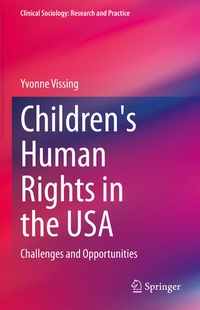
Children's Human Rights in the USA
Challenges and Opportunities
1st Edition
Published on 19. July 2023
XXV, 806 pages
978-3-031-30848-2 (ISBN)
Description

This book critically examines why a human rights framework would improve the wellbeing and status of young people. It explores children's rights to provision, protection, and participation from human rights and clinical sociological perspectives, and from historical to contemporary events. It discusses how different ideologies have shaped the way we view children and their place in society, and how, despite the rhetoric of children's protection, people under 18 years of age experience more poverty, violence, and oppression than other group in society. The book points to the fact that the USA is the only member of the United Nations not to ratify a children's human rights treaty; and the impact of this decision finds US children less healthy and less safe than children in other developed countries. It shows how a rights-respecting framework could be created to improve the lives of our youngest citizens - and the future of democracy.
Authored by a renowned clinical sociologist and international human rights scholar, this book is of interest to researchers, students, social workers and policymakers working in the area of children's wellbeing and human rights.
Authored by a renowned clinical sociologist and international human rights scholar, this book is of interest to researchers, students, social workers and policymakers working in the area of children's wellbeing and human rights.
Reviews / Votes
"This book stands out as "the" book on the topic of children's human rights because it is comprehensive, theoretical, and historical while also offering a wealth of empirical data and support. It is a useful reference book because of its comprehensive coverage. Your passion for children's rights shines through in every chapter. You make an uncontestable case for including and taking seriously that children's rights are human rights. And the book's sober assessment-that the last 100 years our societal approach to children is abysmal and must change-is far from pessimistic. It is a wake-up call to action." (Nazneen Khan - Chair & Associate Professor of Sociology, Randolph-Macon College, Ashland, VA)"Children are the future of countries, and of our world. Current lack of knowledge and realization of their rights limits the ability of those children who deserve the promise for a better and brighter future. From the definition of the child to the debate of whether children are parental property to the active education of children's human rights, this book provides a comprehensive perspective for the children's human rights and addresses the fact that most people lack knowledge about children's rights to have rights. This book is the most welcomed one for academics and professionals advocating for the human rights of the children." (Dr. Pinar Ioannides, Director of Research and Development Division "Hope For Children" CRC Policy Center, Cyprus)
More details
Other editions
Additional editions
Book
07/2023
Springer
€160.49
Shipment within 15-20 days
Person
Yvonne Vissing, Ph.D.
, is a clinical sociologist focusing on pediatrics and community sociology. She is the author of 15 books about children's wellbeing and is the US policy chair for the Hope for Children UN Convention of the Rights of the Child Policy Center. She is a member of the Human Rights Council for the American Association for the Advancement of Science, member of the Steering Committee of the Human Rights Educators USA, former National Institute of Mental Health Post-Doctoral Research Fellow, and 2021 fellow at the University of Connecticut Dodd Human Rights Center Dialogue and Democracy Initiative. She is a former board member of the National Coalition for the Homeless and the New Hampshire Juvenile Parole Board as well as a former family-child mental health counselor in Kentucky. She received the 2021 Distinguished Career Award in the sociology of children for the American Sociological Association's section on Children and Youth.
Vissing is professor and founding director of the Center for Childhood & Youth Studies at Salem State University, USA, where she is also co-founder of its Department of Healthcare Studies. Her research interests include human rights, clinical sociology, mental health, homelessness, community development, instrument development, public health, violence, social movements, sociology of law, mediation, and the use of dialogue to address community problems. She is also a Santa Claus expert who owns a small horse farm in New Hampshire.
Vissing is professor and founding director of the Center for Childhood & Youth Studies at Salem State University, USA, where she is also co-founder of its Department of Healthcare Studies. Her research interests include human rights, clinical sociology, mental health, homelessness, community development, instrument development, public health, violence, social movements, sociology of law, mediation, and the use of dialogue to address community problems. She is also a Santa Claus expert who owns a small horse farm in New Hampshire.
Content
Part I Overview.- Children's Human Rights In The United States: Framing The Dilemma.- What Is A Child?.- Where Are Children And Their Rights In The Academic Disciplines?.- Children's Rights Throughout History.- Part II Provision, Protection And Participation.- Provision Rights: Meeting Children's Essential Needs.- Protection Rights: Keeping Children Safe.- Participation Rights: Recognizing Children's Agency.- An Example: Imagining A Children's Human Rights Framework In Education.- Part III Moving Forward.- Whose Rights Are Right? Constitutional And Legal Debates About Children's Human Rights.- The Children's Rights Movement.- Where Do We Grow From Here?.
