

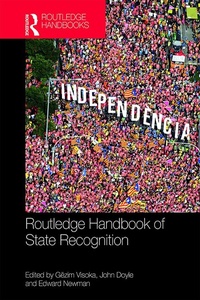
Routledge Handbook of State Recognition
Published on 12. September 2019
520 pages
978-1-351-13173-5 (ISBN)
Description

This new handbook provides a comprehensive and multidisciplinary overview of the theoretical and empirical aspects of state recognition in international politics.
Although the recognition of states plays a central role in shaping global politics, it remains an under-researched and widely dispersed subject. Coherently and innovatively structured, the handbook brings together a group of international scholars who examine the most important theoretical and comparative perspectives on state recognition, including debates about pathways to secession and self-determination, the broad range of actors and strategies that shape the recognition of states and a significant number of contemporary case studies.
The handbook is organised into four key sections:
Theoretical and normative perspectives
Pathways to independent statehood
Actors, forms and the process of state recognition
Case studies of contemporary state recognition
This handbook will be of great interest to students of foreign policy, international relations, international law, comparative politics and area studies.
Chapter 19 of this book is freely available as a downloadable Open Access PDF at http://www.taylorfrancis.com under a Creative Commons Attribution-Non Commercial-No Derivatives (CC-BY-NC-ND) 4.0 license.
Although the recognition of states plays a central role in shaping global politics, it remains an under-researched and widely dispersed subject. Coherently and innovatively structured, the handbook brings together a group of international scholars who examine the most important theoretical and comparative perspectives on state recognition, including debates about pathways to secession and self-determination, the broad range of actors and strategies that shape the recognition of states and a significant number of contemporary case studies.
The handbook is organised into four key sections:
Theoretical and normative perspectives
Pathways to independent statehood
Actors, forms and the process of state recognition
Case studies of contemporary state recognition
This handbook will be of great interest to students of foreign policy, international relations, international law, comparative politics and area studies.
Chapter 19 of this book is freely available as a downloadable Open Access PDF at http://www.taylorfrancis.com under a Creative Commons Attribution-Non Commercial-No Derivatives (CC-BY-NC-ND) 4.0 license.
Reviews / Votes
'The most comprehensive review of the highly relevant and contested doctrine and practice on recognition - a magnificent resource for years to come.'- Marc Weller, University of Cambridge, UK.'The Routledge Handbook of State Recognition offers a unique and valuable collection of contributions to the study of the theory and practice of state recognition that ventures far beyond the traditional concerns of international law. A truly interdisciplinary work that integrates a wide range of theoretical and empirical perspectives on recognition, this handbook should be of great value to scholars and advanced students of international relations, political theory and international law.' - Jens Bartelson, Lund University, Sweden
'This handbook examines how and why the world's political map changes. Gathering experts from multiple fields, it is the best single collection on how certain new states get recognised and how other aspiring states exist in a grey zone, unrecognised on the map but unavoidable on the ground.' - Gerard Toal, Virginia Tech, Washington DC, USA
'The politics of recognition form the core of the state-based international order and its evolution. In this volume, Visoka, Doyle and Newman assemble a top-notch group of scholars with diverse theoretical perspectives and expertise. The resulting conversation, and the handbook, is more than the sum of its parts. It is perhaps even more important, however, for its timeliness as conflicts on the mend are newly raw, cold conflicts are becoming more violent and ever more discontents consider demanding unilateral independence.' - Bridget Coggins, University of California, Santa Barbara, USA
'The Routledge Handbook of State Recognition makes a unique contribution to the literature on state recognition. The editors aim to address a wide audience, as the handbook offers a comprehensive and multidisciplinary take on the theoretical and empirical aspects of state recognition. While the recognition of states influences and shapes the international system, the theory and practice of state recognition remain on the margins. The handbook will therefore be of great interest to scholars, researchers and students working in fields as varied as International Relations, foreign policy, area studies and international law. There is plenty to dwell on and appreciate in this handbook.'--International Affairs, 97, 1, January 2021
'...the volume is an excellent and complete resource for anyone who wants to understand the legal basis, processes, and dynamics of state recognition, including its challenges and main critiques'. -- Ana Carina S. Franco, Journal of Intervention and Statebuilding, July 2022
More details
Language
English
Place of publication
London
United Kingdom
Publishing group
Taylor & Francis Ltd
Target group
College/higher education
Professional and scholarly
Product notice
Reflowable
Illustrations
5 Tables, black and white; 4 Line drawings, black and white
File size
1,82 MB
ISBN-13
978-1-351-13173-5 (9781351131735)
Copyright in bibliographic data and cover images is held by Nielsen Book Services Limited or by the publishers or by their respective licensors: all rights reserved.
Schweitzer Classification
Other editions
Additional editions
Gezim Visoka | John Doyle | Edward Newman
Routledge Handbook of State Recognition
Book
09/2021
1st Edition
Routledge
€73.30
Shipment within 10-20 days
Gezim Visoka | John Doyle | Edward Newman
Routledge Handbook of State Recognition
Book
09/2019
1st Edition
Routledge
€349.69
Shipment within 15-20 days
Persons
Gezim Visoka is Assistant Professor of Peace and Conflict Studies at Dublin City University, Ireland.
John Doyle is Executive Dean of the Faculty of Humanities and Social Sciences and Director of the Institute for International Conflict Resolution and Reconstruction at Dublin City University, Ireland.
Edward Newman is a Professor of International Security in the School of Politics and International Studies at the University of Leeds, UK.
John Doyle is Executive Dean of the Faculty of Humanities and Social Sciences and Director of the Institute for International Conflict Resolution and Reconstruction at Dublin City University, Ireland.
Edward Newman is a Professor of International Security in the School of Politics and International Studies at the University of Leeds, UK.
Content
1. Introduction: Statehood and Recognition in World Politics Gezim Visoka, Edward Newman, and John Doyle PART I: Theoretical and Normative Perspectives 2. Theories of State Recognition Rowan Nicholson and Thomas D. Grant 3. The Evolution of State Recognition Mikulas Fabry 4. International Law and State Recognition Peter Radan 5. Sovereignty, Self-determination, and State Recognition Costas Laoutides 6. The Ethics of State Recognition Christopher Naticchia 7. Power Politics and State Recognition Milena Sterio 8. International Recognition and Human Rights Treaties Ralph Wilde 9. State Recognition in a Transitional International Order Edward Newman PART II: Pathways to Independent Statehood 10. Pathways to Independence and State Recognition James Summers 11. Dynamics of Secession and State Birth Ryan Griffiths 12. Referendums and Recognition of States Matt Qvortrup 13. Unilateral Secession Aleksandar Pavkovic 14. Remedial Secession Michel Seymour PART III: Actors, Forms, and the Process of State Recognition 15. Bilateral Recognition of States Brad R. Roth 16. Recognition of Governments M.J. Peterson 17. Statehood and Collective Recognition: Practice of States and UN Organs Jure Vidmar 18. Collective Non-Recognition of States Nina Caspersen 19. Engagement Without Recognition Bruno Coppieters 20. Parliamentary Recognition Chiara Loda and John Doyle 21. Recognition of States by Regional Organisations: The European Union's Contested Experience Gezim Visoka and Edward Newman 22. International Court of Justice and the Recognition of States Gentian Zyberi 23. The Counter-Diplomacy of State Recognition James Ker-Lindsay 24. State Fragility and Diplomatic Recognition Nicolas Lemay-Hebert 25. The Derecognition of States Gezim Visoka 26. Contested States and their Everyday Quest for Recognition Dimitris Bouris and Irene Fernandez-Molina Part IV: Case Studies of Contemporary State Recognition 27. Palestine Yaser Alashqar 28. Taiwan Timothy S. Rich and Andi Dahmer 29. Western Sahara Irene Fernandez-Molina and Matthew Porges 30. South Sudan Walt Kilroy 31. Kosovo Gezim Visoka 32. Somaliland Scott Pegg 33. Abkhazia and South Ossetia Donnacha O Beachain 34. Transdniestria and Northern Cyprus Daria Isachenko 35. Brexit and the Question of Irish Unity Eileen Connolly and John Doyle 36. Towards a Critical Agenda on State Recognition Gezim Visoka
