

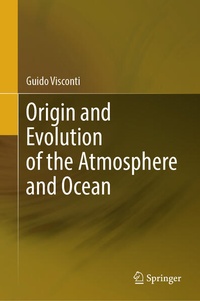
Origin and Evolution of the Atmosphere and Ocean
Description

The book is about the origin and evolution of the atmosphere and the ocean. It spans an impressive number of concepts from radiative theory to geochemistry, from dating methods to climatic theories. Each chapter provides the necessary physics, chemistry and biology tools in such a way to facilitate easy interpretation. The chapters explore the solar system, the formation of the earth, the chemistry of the earths origin, the ancient atmosphere, the origin and evolution of the oceans, biogeochemical cycles, climate evolution, the present status of the atmosphere and oceans, as well as looking at the future of these. Each chapter includes an appendix of further explanation or calculations.
More details
Other editions
Additional editions
Person
Guido Visconti is Professor Emeritus at Università dell'Aquila, Italy and a member of the National Academy of Lincei. He has held a Fulbright Fellowship (1968-69), University of Maryland (USA). NATO Fellowship, Dept of Meteorology, MIT, USA, (1976, 1977). NATO Senior Fellowship, NCAR, USA (1986 -1987). He has served as committee member of the Intergovernmental Panel for Climatic Change (IPCC) and Member of the International Ozone Commission (WMO). In his long career he was the Principal Investigator UARS Correlative Measurements Program (NASA) and Atmospheric Effects of Supersonic Airplane (AESA, NASA). He was the author of the books, Fundamentals of Physics and Chemistry of the Atmosphere , Second Edition, (2016), Problems, Philosophy and Politics of Climate Science, (2018) , Fluid Dynamics (2020) and Fluid Environment of the Earth (2023).
Content
Chapter1: The physics we need. Origin of the solar system. The age of the solar system. Meteorite composition as guide to the history of the solar system. The primitive nebula. The formation of planets: terrestrial planets and jovian planets. The D/H ratio as a guide to the water source. The formation of the oceans.- Chapter 2: The physics and chemistry we need. The role of noble gas inventory. The delivery of volatiles. Degassing and Ingassing. Formation of steam atmosphere. Late bombardment. Volcanic outgassing. Methane. The prebiotic atmosphere. The redox balance of early Earth. The early postbiotic atmosphere.- Chapter 3: Some biology and physics. The appearance of life. Anaerobic metabolism and the anoxygenic photosynthesis. Hydrogen and escape mechanisms. The habitable zone in the Solar System.- Chapter 4: Atmospheric chemistry. The rise of oxygen and ozone. The biogeochemical cycles in the early atmosphere and ocean. The carbon budget. The chemical evolution.- Chapter 5: Radiative notions. The climate evolution from the faint Sun paradox to the geoengineering.- Chapter 6: The future of the Earth. Long terms trend in composition, The future of the atmosphere and the oceans.
