

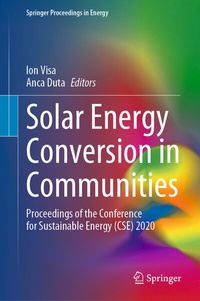
Solar Energy Conversion in Communities
Description

This book presents novel findings concerning the systems, materials and processes used in solar energy conversion in communities. It begins with the core resource - solar radiation - and discusses the restrictions on the wide-scale implementation of conversion systems imposed by the built environment, as well as potential solutions. The book also describes efficient solar energy conversion in detail, focusing on heat and electricity production in communities and water reuse. Lastly, it analyzes the concept of sustainable communities, presenting examples from around the globe, along with novel approaches to improving their feasibility and affordability. Though chiefly intended for professionals working in the field of sustainability at the community level, the book will also be of interest to researchers, academics and doctoral students.
More details
Other editions
Additional editions
Persons
The research activity focused on specific aspects of Renewable Energy Systems with a view on the particular aspects of their implementation in the built environment. More than 30 grants financed by national and EU research programs supported this activity. As example, a structural funds project was granted to the Transilvania University of Brasov, RDI Institute High Tech Products for Sustainable Development, (POSCCE, ID123, 22 million EUR, CO: Prof. Ion VISA) and allowed the development of the R&D Institute of the University, with a specific focus on renewable energy systems implemented in the built environment, consisting of 11 low energy buildings and high level infrastructure fully dedicated to research.
Based on the R&D results and on the capability of extending these results towards education and training, the Center is well involved in EU structures as the European Sustainable Energy Innovation Alliance, ESEIA (where Prof. Visa is Vice-President); additionally, Prof. Visa was the main proposer of a new Technical Commitee (TC) in the frame of the International Federation for the Promotion of Mechanism and Machine Science,IFToMM. The TC is called Sustainable Energy Systems (CO 2011-2019: Prof. Ion VISA) and aims at implementing the complex concept of "sustainability" for mechanisms and mechanical systems, by defining energy efficiency, along with renewables and clean energy in industry and society.
The Renewable Energy group published the R&D results in over 100 scientific papers, part of them in ISI indexed journals as: Renewable Energy, Applied Thermal Engineering, Energy and Buildings, Energy Procedia, International Journal of Green Energy, Journal of Renewable and Sustainable Energy, Journal of Photovoltaics, Journal of Energy Engineering.He is also author of 25 patents in Renewable Energy field. In 2020, the book Solar Energy Conversion Systems in the Built Environment ( authors: Ion Visa, Anca Duta, Macedon Moldovan, Bogdan Burduhos, Mircea Neagoe ) was was published under Springer, Green Energy and Technology.This extensive research activity developed under thecoordination of Prof. Ion VISA was recognized also by the Romanian Academy of Technical Sciences, where prof. VISA is full member and by the Romanian Academy, where prof. VISA is member of the Renewable Energy Commission.
Duta Anca is professor and Ph.D. supervisor on advanced materials for energy and environment. In the beginning her work focused on solar energy conversion in electrical and thermal energy with applications in the built environment; she developed novel photovoltaic materials based on CuInS2 and CuSbS2 associated with TiO2 in photovoltaic cells of the 3rd generation and novel colored solar-thermal coatings (red, blue, green) for flat plate solar-thermal collectors to be integrated on the buildings facades. During the past ten years, the focus of her work was on the use of solar energy in photocatalytic processes for advanced wastewater treatment and for self-cleaning coatings. Following the structure of solid state solar cells, VIS- andsolar-active photocatalysts were proposed, developed, tested and optimized aiming at up-scalable solutions. All these topics were developed by working in close collaboration with Prof. Visa, in an interdisciplinary approach "from material to prototype".
