

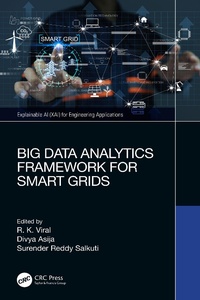
Big Data Analytics Framework for Smart Grids
1st Edition
Published on 22. December 2023
250 pages
978-1-003-82802-0 (ISBN)
Description

The text comprehensively discusses smart grid operations and the use of big data analytics in overcoming the existing challenges. It covers smart power generation, transmission, and distribution, explains energy management systems, artificial intelligence, and machine learning-based computing.
Presents a detailed state-of-the-art analysis of big data analytics and its uses in power grids
Describes how the big data analytics framework has been used to display energy in two scenarios including a single house and a smart grid with thousands of smart meters
Explores the role of the internet of things, artificial intelligence, and machine learning in smart grids
Discusses edge analytics for integration of generation technologies, and decision-making approaches in detail
Examines research limitations and presents recommendations for further research to incorporate big data analytics into power system design and operational frameworks
The text presents a comprehensive study and assessment of the state-of-the-art research and development related to the unique needs of electrical utility grids, including operational technology, storage, processing, and communication systems. It further discusses important topics such as complex adaptive power system, self-healing power system, smart transmission, and distribution networks, and smart metering infrastructure. It will serve as an ideal reference text for senior undergraduate, graduate students, and academic researchers in the areas such as electrical engineering, electronics and communications engineering, computer engineering, and information technology.
Presents a detailed state-of-the-art analysis of big data analytics and its uses in power grids
Describes how the big data analytics framework has been used to display energy in two scenarios including a single house and a smart grid with thousands of smart meters
Explores the role of the internet of things, artificial intelligence, and machine learning in smart grids
Discusses edge analytics for integration of generation technologies, and decision-making approaches in detail
Examines research limitations and presents recommendations for further research to incorporate big data analytics into power system design and operational frameworks
The text presents a comprehensive study and assessment of the state-of-the-art research and development related to the unique needs of electrical utility grids, including operational technology, storage, processing, and communication systems. It further discusses important topics such as complex adaptive power system, self-healing power system, smart transmission, and distribution networks, and smart metering infrastructure. It will serve as an ideal reference text for senior undergraduate, graduate students, and academic researchers in the areas such as electrical engineering, electronics and communications engineering, computer engineering, and information technology.
More details
Series
Edition
1. Auflage
Language
English
Place of publication
London
United Kingdom
Publishing group
Taylor & Francis Ebooks
Target group
College/higher education
Product notice
Reflowable
Illustrations
24 Tables, black and white; 61 Line drawings, black and white; 16 Halftones, black and white; 71 Illustrations, color; 6 Illustrations, black and white
ISBN-13
978-1-003-82802-0 (9781003828020)
Copyright in bibliographic data and cover images is held by Nielsen Book Services Limited or by the publishers or by their respective licensors: all rights reserved.
Schweitzer Classification
Other editions
Additional editions
Rajkumar Viral | Divya Asija | Surender Salkuti
Big Data Analytics Framework for Smart Grids
Book
09/2025
1st Edition
CRC Press
€95.70
Shipment within 10-20 days
Rajkumar Viral | Divya Asija | Surender Salkuti
Big Data Analytics Framework for Smart Grids
Book
12/2023
1st Edition
CRC Press
€196.30
Shipment within 10-20 days
Persons
R. K. Viral is presently working as an Associate Professor in Department of Electrical & Electronics Engineering, Amity School of Engg. & Tech., Amity University, Noida, UP, INDIA. Additionally, he has more than 16-year teaching experience at UG and PG level in various engineering Institutes/Universities. He has awarded Doctoral degree from Indian Institute of Technology Roorkee, Roorkee in area of Distributed Generation in 2016. Received his Post graduate degree in Energy Systems also from IIT Roorkee in 2010 and graduated in Electrical Engineering (with honors) from MJP Rohilkhand University, Bareilly in 2003. His research interests include Distribution system planning and optimization, Renewable energy system, soft computing techniques in power systems, Small hydro power design, Development and Applications, Smart grid, Big data analytics and cyber security in power system. He is guiding five Ph.D students and supervised many M.Tech dissertations.He has filed more than 16 patents in various multi-disciplinary areas. He has also published more than 150 research publications in various International/national journals/conferences/Book chapters of repute and peer reviewed. He has one Edited book of CRC press, Taylor & Francis, and two is in process of Elsevier/CRC. He has served as TPC Member of several international conferences held worldwide. He is also an active member of professional societies i.e. IEEE, PES, ISTE, IEI, IDES, ACEEE, and contributing editorial board member (IJORCS, IJESCE, IJBST etc.) and reviewer of various international journals.
Divya Asija is an Assistant Professor in the Electrical and Electronics Engineering Department of Amity School of Engineering and Technology at the Amity University Noida, India, where she has been a faculty member since 2012. She has more than 16 years teaching experience at various prestigious institutions/universities. She completed his PhD at Amity University, Noida and her postgraduate studies at YMCA, Faridabad. Her research interests include power systems, ranging from congestion management to renewable energy resources, distributed generation, smart grids and electric vehicles. She has filed five patents and applied various funded projects of different government and private agencies. She is also the author and coauthors of over 75 research papers and book chapters in several international journals of repute. She is also an active reviewer of international journals (Energy (Elsevier), the International Journal of System Assurance Engineering and Management (Springer), the International Journal of Emerging Electric Power Systems (Degruyter), the International Journal of Electrical and Computer Engineering (Institute of Advanced Engineering and Science), the Journal of Electrical Engineering & Technology (Springer) and the International Journal of Renewable Energy Research). In the interim, she was also awarded for outstanding contribution in reviewing by Energy, Elsevier for the academic years 2017-18 and 2018-19. She was also a winner of the gold award for courseware creation using Moodle for outcome-based education and ethical commitment.
Surender Reddy Salkuti is working with Woosong University, Republic of Korea as an Associate Professor in the Department of Railroad and Electrical Engineering since April 2014. He received the Ph.D. degree in Electrical Engineering from the Indian Institute of Technology Delhi (IITD), India, in 2013. He was a Postdoctoral Researcher at Howard University, Washington, DC, USA, from 2013 to 2014.His research interests include power system restructuring issues, smart grid development with the integration of wind and solar photovoltaic energy sources, battery storage and electric vehicles, demand response, power system analysis and optimization, soft computing techniques application in power systems and renewable energy.He has published two edited volumes with Springer (LNEE) and more than 250 research articles in peer-reviewed international journals and conference proceedings. He has served as or is serving as Guest Editor for various international journals. He is also an editorial board member for many journals. He is the recipient of the 2016 Distinguished Researcher Award from Woosong University Educational Foundation, South Korea, and the POSOCO Power System Award (PPSA) 2013, India. He is listed in the top 2% of scientists published in a study conducted by researchers of ICSR Lab, Elsevier BV & Stanford University, USA. He is a Member of IEEE and IEEE Power and Energy Society.
Divya Asija is an Assistant Professor in the Electrical and Electronics Engineering Department of Amity School of Engineering and Technology at the Amity University Noida, India, where she has been a faculty member since 2012. She has more than 16 years teaching experience at various prestigious institutions/universities. She completed his PhD at Amity University, Noida and her postgraduate studies at YMCA, Faridabad. Her research interests include power systems, ranging from congestion management to renewable energy resources, distributed generation, smart grids and electric vehicles. She has filed five patents and applied various funded projects of different government and private agencies. She is also the author and coauthors of over 75 research papers and book chapters in several international journals of repute. She is also an active reviewer of international journals (Energy (Elsevier), the International Journal of System Assurance Engineering and Management (Springer), the International Journal of Emerging Electric Power Systems (Degruyter), the International Journal of Electrical and Computer Engineering (Institute of Advanced Engineering and Science), the Journal of Electrical Engineering & Technology (Springer) and the International Journal of Renewable Energy Research). In the interim, she was also awarded for outstanding contribution in reviewing by Energy, Elsevier for the academic years 2017-18 and 2018-19. She was also a winner of the gold award for courseware creation using Moodle for outcome-based education and ethical commitment.
Surender Reddy Salkuti is working with Woosong University, Republic of Korea as an Associate Professor in the Department of Railroad and Electrical Engineering since April 2014. He received the Ph.D. degree in Electrical Engineering from the Indian Institute of Technology Delhi (IITD), India, in 2013. He was a Postdoctoral Researcher at Howard University, Washington, DC, USA, from 2013 to 2014.His research interests include power system restructuring issues, smart grid development with the integration of wind and solar photovoltaic energy sources, battery storage and electric vehicles, demand response, power system analysis and optimization, soft computing techniques application in power systems and renewable energy.He has published two edited volumes with Springer (LNEE) and more than 250 research articles in peer-reviewed international journals and conference proceedings. He has served as or is serving as Guest Editor for various international journals. He is also an editorial board member for many journals. He is the recipient of the 2016 Distinguished Researcher Award from Woosong University Educational Foundation, South Korea, and the POSOCO Power System Award (PPSA) 2013, India. He is listed in the top 2% of scientists published in a study conducted by researchers of ICSR Lab, Elsevier BV & Stanford University, USA. He is a Member of IEEE and IEEE Power and Energy Society.
Content
Chapter 1
Necessities of Big Data in Smart Grid
ANITA DEVI NINGTHOUJAM, DIVYA ASIJA AND R K VIRAL
Chapter 2
Challenges and Opportunities in the development of a Smart Grid System in the India
SUMIT KUSHWAHA
Chapter 3
Why Big Data for Smart Cities?
SUDIKSHA SHARMA AND SACHIN SHARMA
Chapter 4
Big Data for Smart Grid: A Way Forward
SACHIN SHARMA AND DEVYANSHI BANSAL
Chapter 5
Advanced Machine Learning Methods for Big Data Analytics used in Smart Grid
R. K. VIRAL AND DIVYA ASIJA
Chapter 6
Perspective of Cyber Security and Ethical Hacking with Vulnerability Assessment and Exploitation Tools
DEVYANSHI BANSAL, MADHULIKA BHATIA, ANIRUDDH ATREY AND ARUN KUMAR YADAV
Chapter 7
Communication and Measurement Technologies for Smart Grid
VISHAL KUMAR GAUR AND SUBHO PAUL
Chapter 8
Bigdata for Smart Grid: A Case Study
TAHA A. TAHA, MOHD KHAIR HASSAN, NOOR IZZRI ABDUL WAHAB AND HUSSEIN I. ZAYNAL
Chapter 9
Big Data and Smart Grid: Implementation based Case Study
JAMEER KOTWAL, RAMGOPAL KASHYAP, AND PATHAN SHAFI
Chapter 10
Big Data Analytics- A Holistic Assessment of Paradigm Shift Challenges and Opportunities for Future Smart Grid
DIVYA ASIJA AND R. K. VIRAL
Necessities of Big Data in Smart Grid
ANITA DEVI NINGTHOUJAM, DIVYA ASIJA AND R K VIRAL
Chapter 2
Challenges and Opportunities in the development of a Smart Grid System in the India
SUMIT KUSHWAHA
Chapter 3
Why Big Data for Smart Cities?
SUDIKSHA SHARMA AND SACHIN SHARMA
Chapter 4
Big Data for Smart Grid: A Way Forward
SACHIN SHARMA AND DEVYANSHI BANSAL
Chapter 5
Advanced Machine Learning Methods for Big Data Analytics used in Smart Grid
R. K. VIRAL AND DIVYA ASIJA
Chapter 6
Perspective of Cyber Security and Ethical Hacking with Vulnerability Assessment and Exploitation Tools
DEVYANSHI BANSAL, MADHULIKA BHATIA, ANIRUDDH ATREY AND ARUN KUMAR YADAV
Chapter 7
Communication and Measurement Technologies for Smart Grid
VISHAL KUMAR GAUR AND SUBHO PAUL
Chapter 8
Bigdata for Smart Grid: A Case Study
TAHA A. TAHA, MOHD KHAIR HASSAN, NOOR IZZRI ABDUL WAHAB AND HUSSEIN I. ZAYNAL
Chapter 9
Big Data and Smart Grid: Implementation based Case Study
JAMEER KOTWAL, RAMGOPAL KASHYAP, AND PATHAN SHAFI
Chapter 10
Big Data Analytics- A Holistic Assessment of Paradigm Shift Challenges and Opportunities for Future Smart Grid
DIVYA ASIJA AND R. K. VIRAL
