

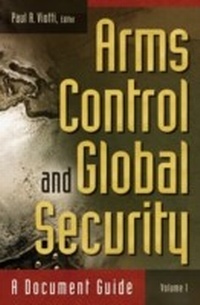
Arms Control and Global Security
A Document Guide [2 Volumes]
1st Edition
Published on 12. April 2010
620 pages
978-0-313-35431-1 (ISBN)
Description

An essential guide offers a comprehensive collection of edited and annotated arms-control documents, dating from the late-19th century to the present day.
Sometimes successful and sometimes not, arms-control agreements are strenuously negotiated by the parties involved, yet they quickly become obsolete as technology advances and new weapons come on the scene. Thus, such agreements are best understood strategically, not as ends in themselves, but rather as one essential avenue of securing national and global security-an important means of allowing countries around the world to work out their differences at the negotiating table instead of on the battlefield.
Arms Control and Global Security: A Document Guide offers an unprecedented and comprehensive collection of arms-control documents dating from the late-19th century to the present. The book includes documents addressing the control of weapons of mass destruction, the banning of biological and chemical weapons, the weaponization of space, regional arms control, and bilateral agreements, as well as the limitations of conventional weaponry. The documents are edited and annotated for nonspecialists, and charts, tables, and sidebars provide additional information throughout.
Sometimes successful and sometimes not, arms-control agreements are strenuously negotiated by the parties involved, yet they quickly become obsolete as technology advances and new weapons come on the scene. Thus, such agreements are best understood strategically, not as ends in themselves, but rather as one essential avenue of securing national and global security-an important means of allowing countries around the world to work out their differences at the negotiating table instead of on the battlefield.
Arms Control and Global Security: A Document Guide offers an unprecedented and comprehensive collection of arms-control documents dating from the late-19th century to the present. The book includes documents addressing the control of weapons of mass destruction, the banning of biological and chemical weapons, the weaponization of space, regional arms control, and bilateral agreements, as well as the limitations of conventional weaponry. The documents are edited and annotated for nonspecialists, and charts, tables, and sidebars provide additional information throughout.
More details
Series
Edition
1. Auflage
Language
English
Place of publication
New York
United States
Publishing group
Bloomsbury Publishing Plc
ISBN-13
978-0-313-35431-1 (9780313354311)
Copyright in bibliographic data and cover images is held by Nielsen Book Services Limited or by the publishers or by their respective licensors: all rights reserved.
Schweitzer Classification
Other editions
Additional editions
Book
04/2010
Praeger Publishers Inc
€145.58
Article exhausted; check different version
Person
Paul R. Viotti serves as an associate professor and executive director of the Institute on Globalization and Security at Denver University where he specializes in foreign policy and international security.
Content
- Cover
- Contents
- Chronological List of Documents
- Introduction
- Abbreviations
- Chapter One-THE EARLY LEGACY
- Opening Comments
- 1. Geneva Convention for the Amelioration of the Condition of the Wounded in Armies in the Field (Red Cross Convention
- 1864)
- 2. St. Petersburg Declaration (1868)
- 3. The Hague Conventions (1899)
- 4. The Hague Conventions (1907)
- 5. Covenant of the League of Nations (1919)
- 6. Washington Treaty Relating to the Use of Submarines and Noxious Gases in Warfare (1922)
- 7. Washington Naval Treaty (1922)
- 8. Kellogg-Briand Pact (1928)
- 9. Charter of the United Nations (1945)
- Chapter Two-BIOLOGICAL AND CHEMICAL WEAPONS
- Opening Comments
- 1. Geneva Protocol Against Using Chemical and Bacteriological Weapons (1925)
- 2. Biological Weapons Convention (BWC
- 1972)
- 3. Bilateral Destruction Agreement (1990)
- 4. Chemical Weapons Convention (CWC
- 1993)
- Chapter Three-NUCLEAR WEAPONS
- Opening Comments
- Regime Prohibiting Nuclear Tests
- 1. Treaty Banning Nuclear Weapon Tests in the Atmosphere, Outer Space, and Under Water: The Partial or Limited Test Ban Treaty (LTBT
- 1963)
- 2. Limitation of Underground Nuclear Weapon Tests: The Threshold Test Ban Treaty (TTBT
- 1974)
- 3. ''Peaceful'' Nuclear Explosions (PNE
- 1976)
- 4. Comprehensive Nuclear Test-Ban Treaty (CTBT
- 1996)
- The Nuclear Nonproliferation Regime
- 5. Nonproliferation of Nuclear Weapons Treaty (NPT
- 1968)
- 6. Zangger Committee's Commitment (1975)
- 7. Physical Protection of Nuclear Material Convention (1979)
- 8. Prohibition of the Production of Fissile Material for Nuclear Weapons or Other Nuclear Explosive Devices (UN General Assembly Resolution 48/75 L
- 1993)
- 9. U.S.-Belize Proliferation Security Initiative Ship Boarding Agreement (2005)
- Nuclear-Weapon-Free Zones
- 10. Treaty for the Prohibition of Nuclear Weapons in Latin America and the Caribbean (''Treaty of Tlatelolco''
- 1967)
- 11. South Pacific Nuclear-Free Zone Treaty (''Treaty of Rarotonga''
- 1985)
- 12. Treaty on the Southeast Asia Nuclear-Weapon-Free Zone (''Bangkok Treaty''
- 1995)
- 13. African Nuclear-Weapon-Free Zone Treaty (''Treaty of Pelindaba''
- 1996)
- 14. Treaty on a Nuclear-Weapon-Free Zone in Central Asia (2006)
- The Threat or Use of Nuclear Weapons
- 15. Legality of the Threat or Use of Nuclear Weapons: International Court of Justice Advisory Opinion (1996)
- Chapter Four-CONVENTIONAL WEAPONS
- Opening Comments
- 1. Conference on Security and Cooperation in Europe (CSCE
- 1975)
- 2. Convention on Certain Conventional Weapons (CCWC
- 1981)
- 3. Conference on Disarmament in Europe (CDE
- 1986)
- 4. Treaty on Conventional Armed Forces in Europe (CFE
- 1990)
- 5. Transparency in Armaments Transfers: The UN Registry (1991)
- 6. Missile Technology Control Regime Guidelines (MTCR
- 1996)
- 7. Wassenaar Arrangement (1996)
- 8. Land Mines Convention (''Ottawa Treaty''
- 1997)
- 9. Inter-American Convention Against the Illicit Manufacturing of and Trafficking in Firearms, Ammunition, Explosives, and Other Related Materials (CIFTA
- 1997)
- 10. Mutual Reduction of Armed Forces in the Border Area (1997)
- 11. United Nations Conference on the Illicit Trade in Small Arms and Light Weapons in All Its Aspects (2001)
- 12. Inter-American Convention on Transparency in Conventional Weapons Acquisitions (1999)
- 13. Call for an Arms Trade Treaty: International Standards for the Import, Export, and Transfer of Conventional Arms (2008)
- 14. Convention on Cluster Munitions (2008)
- Chapter Five-SPATIAL RESTRICTIONS: REGIONAL, AREA, OR ZONAL
- Opening Comments
- 1. Antarctic Treaty (1959)
- 2. Seabed Treaty (1971)
- 3. Environmental Modification Convention (1977)
- 4. Law of the Sea Convention (1982)
- Air and Space
- 5. Outer Space Treaty (1967)
- 6. Moon Treaty (1979)
- 7. Treaty on Open Skies (1992)
- Nuclear-Weapon-Free Zones
- 8. Treaty for the Prohibition of Nuclear Weapons in Latin America and the Caribbean (''Treaty of Tlatelolco''
- 1967)
- 9. South Pacific Nuclear-Free Zone Treaty (''Treaty of Rarotonga''
- 1985)
- 10. Treaty on the Southeast Asia Nuclear-Weapon-Free Zone (''Bangkok Treaty''
- 1995)
- 11. African Nuclear-Weapon-Free Zone Treaty (''Treaty of Pelindaba''
- 1996)
- 12. Treaty on a Nuclear-Weapon-Free Zone in Central Asia (2006)
- Europe (Atlantic to the Urals) and Central Asia
- 13. Conference on Security and Cooperation in Europe (CSCE
- 1975)
- 14. Conference on Disarmament in Europe (CDE
- 1986)
- 15. Treaty on Conventional Armed Forces in Europe (CFE
- 1990)
- 16. Vienna Conference on Confidence- and Security-Building Measures (CSBMs
- 1994)
- 17. Mutual Reduction of Armed Forces in the Border Area (1997)
- The Americas
- 18. Inter-American Convention Against the Illicit Manufacturing of and Trafficking in Firearms, Ammunition, Explosives, and Other Related Materials (CIFTA
- 1997)
- 19. Inter-American Convention on Transparency in Conventional Weapons Acquisitions (1999)
- Chapter Six-U.S.-RUSSIAN (FORMER USSR) BILATERAL AGREEMENTS
- Opening Comments
- 1. U.S.-Soviet Hotline Agreements (1963, 1971, and 1984)
- 2. Nuclear Incidents Agreement (1971)
- 3. Incidents on the High Seas (1972)
- 4. Strategic Arms Limitations Talks (SALT I
- 1972)
- 5. A Strategic Defense Regime: The Nixon-Brezhnev Antiballistic Missile (ABM) Treaty and Its Abrogation by the George W. Bush Administration (1972, U.S. withdrawal announced in 2001)
- 6. Prevention of Nuclear War (1973)
- 7. Strategic Arms Limitations Talks (SALT II
- 1979)
- 8. INF (Intermediate-Range Nuclear Forces) Treaty (1987)
- 9. Nuclear Risk Reduction Centers (1987)
- 10. Nunn-Lugar and Cooperative Threat Reduction (1991)
- 11. Strategic Arms Reductions Talks (START I
- 1991)
- 12. Strategic Arms Reductions Talks (START II
- 1993 and 1997)
- 13. Detargeting Agreement (1994)
- 14. Clinton-Yeltsin Plutonium Disposal Agreement (1998)
- 15. Joint Data Exchange Center Agreement (JDEC
- 2000)
- 16. Joint Statement on Management and Disposition of Weapons-Grade Plutonium (2000)
- 17. Missile Launch Notifications Agreement (2001)
- 18. Strategic Offensive Reductions Treaty (SORT
- 2002)
- Index
- A
- B
- C
- D
- E
- F
- G
- H
- I
- J
- K
- L
- M
- N
- O
- P
- R
- S
- T
- U
- V
- W
- Z
