

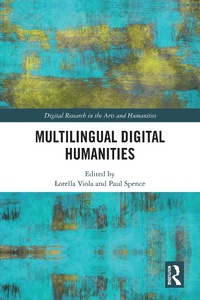
Multilingual Digital Humanities
1st Edition
Published on 28. December 2023
246 pages
978-1-003-83128-0 (ISBN)
Description

Multilingual Digital Humanities explores the impact of monolingualism-especially Anglocentrism-on digital practices in the humanities and social sciences.
The volume explores a wide range of applied contexts, such as digital linguistic injustice, critical digital literacy, digital learning, digital publishing, low-resourced, minoritised or endangered languages in a digital space, and multilingual historical intertextuality. These discussions are situated within wider work on language technologies, language documentation and international (in particular European) language-based infrastructure creation. Drawing on both primary and secondary research, this four-part book features 13 diverse case studies of infrastructural projects, pedagogical resources, computational models, interface building, and publishing initiatives in a range of languages, including Arabic, French, Russian, Portuguese, Italian, German, Spanish, Bengali, Hindi, Malayalam, and Tamil. All the debates are contextualised within a wider cultural frame, thus bridging the gap between the linguistic focus of the multilingual initiatives and wider discussion of cultural criticism in DH.
Multilingual Digital Humanities recognizes the digital as a culturally situated and organic multilingual entity embedding past, present, and future worlds, which reacts to and impacts on institutional and methodological frameworks for knowledge creation. It is essential reading for students, scholars, and practitioners working in digital humanities and digital studies.
The volume explores a wide range of applied contexts, such as digital linguistic injustice, critical digital literacy, digital learning, digital publishing, low-resourced, minoritised or endangered languages in a digital space, and multilingual historical intertextuality. These discussions are situated within wider work on language technologies, language documentation and international (in particular European) language-based infrastructure creation. Drawing on both primary and secondary research, this four-part book features 13 diverse case studies of infrastructural projects, pedagogical resources, computational models, interface building, and publishing initiatives in a range of languages, including Arabic, French, Russian, Portuguese, Italian, German, Spanish, Bengali, Hindi, Malayalam, and Tamil. All the debates are contextualised within a wider cultural frame, thus bridging the gap between the linguistic focus of the multilingual initiatives and wider discussion of cultural criticism in DH.
Multilingual Digital Humanities recognizes the digital as a culturally situated and organic multilingual entity embedding past, present, and future worlds, which reacts to and impacts on institutional and methodological frameworks for knowledge creation. It is essential reading for students, scholars, and practitioners working in digital humanities and digital studies.
More details
Series
Edition
1. Auflage
Language
English
Place of publication
London
United Kingdom
Publishing group
Taylor & Francis Ebooks
Target group
College/higher education
Professional and scholarly
Product notice
Reflowable
Illustrations
13 Tables, black and white; 37 Halftones, black and white; 37 Illustrations, black and white
ISBN-13
978-1-003-83128-0 (9781003831280)
Copyright in bibliographic data and cover images is held by Nielsen Book Services Limited or by the publishers or by their respective licensors: all rights reserved.
Schweitzer Classification
Other editions
Additional editions
Lorella Viola | Paul Spence
Multilingual Digital Humanities
Book
05/2025
1st Edition
Routledge
€67.10
Shipment within 10-20 days
Lorella Viola | Paul Spence
Multilingual Digital Humanities
Book
12/2023
1st Edition
Routledge
€206.40
Shipment within 10-20 days
Persons
Lorella Viola is Research Associate in Linguistics and Digital Humanities at the Centre for Contemporary and Digital History, University of Luxembourg. She researches the implications of the digital for the conceptualisation of digital objects, digital practices, and digital knowledge production with a focus on heritage, material culture, and preservation. She also investigates the relationship between language, media, and society and develops critical, data-driven methodologies for digital humanities and digital heritage.
Paul Spence is Reader in the Department of Digital Humanities (DDH) at King's College London, UK. His background is in modern languages, digital pedagogy, digital publishing and structured knowledge representation. His research has recently focused on interactions between languages, multilingualism, linguistic diversity, and digital practice. He researches digital transformations in how we engage with languages, while also analysing the power of language to disrupt digital monolingualism in knowledge infrastructures, methods, and data.
Paul Spence is Reader in the Department of Digital Humanities (DDH) at King's College London, UK. His background is in modern languages, digital pedagogy, digital publishing and structured knowledge representation. His research has recently focused on interactions between languages, multilingualism, linguistic diversity, and digital practice. He researches digital transformations in how we engage with languages, while also analysing the power of language to disrupt digital monolingualism in knowledge infrastructures, methods, and data.
Content
Part I - Multilingual/multicultural theory and practice; 1. A model for multilingual and multicultural digital scholarship methods publishing: the case of Programming Historian; 2. Diversifying digital biodiversity knowledge: A Latin American Multilingual Perspective on the Biodiversity Heritage Library; 3. Applications and Developments of NLP Resources for Text Processing in Indian Languages: Shared Multilingual Corpora Building and Pre-trained Models; Part II - Pedagogy; 4. Doing Digital Humanities in the Modern Languages Classroom; 5. Digital learning environments for SLA: Learning Analytics and the construction of knowledge; 6. Pedagogy and Praxis in Libraries: Natural Language Processing for Non-English Texts; 7.Bridging the Gap between Digital Humanities and Natural Language Processing: A Pedagogical Imperative for Humanistic NLP; Part III - Language models; 8. Linguistic Injustice in Multilingual Technologies: The TenTen Corpus Family as a Case Study; 9. Typological Challenges for the Application of Multilingual Language Models in the Digital Humanities; 10. Data scarcity and methodological limitations in multilingual analysis of news articles published in Brazil; Part IV - Methods and infrastructure; 11. Multilingual Interfaces for All? Localisation Strategies in Proyecto Humboldt Digital; 12. Towards Multilingually-Enabled Digital Knowledge Infrastructures: a Qualitative Survey Analysis; 13. Digital approaches to multilingual text analysis: the Dictionnaire as a code-intermediate space
