

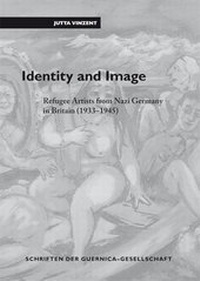
Identity and Image
Refugee Artists from Nazi Germany in Britain (1933-1945)
1st Edition
Published on 22. June 2006
400 pages
978-3-95899-303-7 (ISBN)
Description

This book explores the image and identity of émigré painters, sculptors and graphic artists from Nazi Germany in Britain between 1933 and 1945. It focuses on a neglected field of Exile Studies, that of exiled artists in Britain. Methodologies used in this study have been developed by Exile Studies and History of Art, but also by Postcolonialism, scholars of which usually apply their ideas to the Afro-Asian emigration of the second part of the twentieth century. Thus this study represents methodologically a new way of looking at the emigration from Nazi Germany.
Identity and Image is divided into five chapters: After an introductory Chapter One (historiography of the topic, methodology of the study, structure of the book), Chapter Two establishes socio-political patterns of emigration and provides an historical framework for Chapters Three and Four, which concentrate on the image and identity of the refugee artist, the former based on written sources and the latter on visual material. In detail, Chapter Three analyses the British image of the refugee artists and their works on the one hand and the émigrés' self-representations on the other, the latter exemplified by refugee organisations (the Free German League of Culture/Freier Deutscher Kulturbund, the Austrian Centre, the Anglo-Sudeten Club and the Czech Institute) and institutions founded by émigré artists (Jack Bilbo's Modern Art Gallery and Arthur Segal's Painting School). Chapter Four examines the works produced in internment and those exhibited and produced for the refugee organisations discussed in Chapter Three. Chapter Five discusses the results of this study in the light of three postcolonial concepts: diaspora communities, the notion of home and the gendered identity of the refugee. The appendix lists all painters, sculptors and graphic artists from Nazi Germany in Britain with biographical details.
Apart from visual and written sources discussed for the first time, there are two major results of the study: First, although the artists were united as refugees, this unity did not lead to a unity in art - "refugee art" is a construction put forward by the British press and the refugee organisations, particularly the Free German League of Culture. Second, contrary to claims that modern art was international and formed a universal unity that "transgressed" nationality, neither the West/Europe nor modernism form unities; instead, in the 1930s and 1940s, cultures in Europe constructed conceptions of other European cultures on the basis of nation-state identities.
Identity and Image is divided into five chapters: After an introductory Chapter One (historiography of the topic, methodology of the study, structure of the book), Chapter Two establishes socio-political patterns of emigration and provides an historical framework for Chapters Three and Four, which concentrate on the image and identity of the refugee artist, the former based on written sources and the latter on visual material. In detail, Chapter Three analyses the British image of the refugee artists and their works on the one hand and the émigrés' self-representations on the other, the latter exemplified by refugee organisations (the Free German League of Culture/Freier Deutscher Kulturbund, the Austrian Centre, the Anglo-Sudeten Club and the Czech Institute) and institutions founded by émigré artists (Jack Bilbo's Modern Art Gallery and Arthur Segal's Painting School). Chapter Four examines the works produced in internment and those exhibited and produced for the refugee organisations discussed in Chapter Three. Chapter Five discusses the results of this study in the light of three postcolonial concepts: diaspora communities, the notion of home and the gendered identity of the refugee. The appendix lists all painters, sculptors and graphic artists from Nazi Germany in Britain with biographical details.
Apart from visual and written sources discussed for the first time, there are two major results of the study: First, although the artists were united as refugees, this unity did not lead to a unity in art - "refugee art" is a construction put forward by the British press and the refugee organisations, particularly the Free German League of Culture. Second, contrary to claims that modern art was international and formed a universal unity that "transgressed" nationality, neither the West/Europe nor modernism form unities; instead, in the 1930s and 1940s, cultures in Europe constructed conceptions of other European cultures on the basis of nation-state identities.
More details
Other editions
Additional editions

Book
06/2006
1st Edition
VDG Weimar - Verlag und Datenbank für Geisteswissenschaften
€67.50
No shipping information available
