

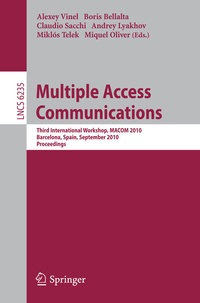
Multiple Access Communications
Third International Workshop, MACOM 2010, Barcelona, Spain, September 13-14, 2010, Proceedings
Published on 8. September 2010
XIII, 287 pages
978-3-642-15428-7 (ISBN)
Description

It is our great pleasure to present the proceedings of the Third International Workshop on Multiple Access Communications (MACOM) that was held in Barcelona during September 13-14, 2010. In 1961, Claude Shannon established the foundation for the discipline now known as "multi-user information theory" in his pioneering paper "Two-way Communication Channels," and later Norman Abramson published his paper "The Aloha System-Another Alternative for Computer Communications" in 1970 which introduced the concept of multiple access using a shared common channel. Thereafter, for more than 40 years of study, numerous elegant theories and algorithms have been developed for multiple-access communications. During the 1980s and 1990s the evolution of multiple-access techniques p- ceeded in conjunction with the evolution of wireless networks. Novel multiple access techniques like code division multiple access (CDMA) and orthogonal frequency division multiple access (OFDMA) provided increased spectral - ?ciency, dynamicity and ?exibility in radio resource allocation with intrinsic anti-multipath and anti-interference features. In this ?rst decade of the 21st century,multiple-accesstechniques,derivedfromadvancedwirelesstransmission methodologiesbasedonthediversityconcept(e. g. ,MC-CDMA,MIMO-OFDMA and SC-FDMA), opened the road to a renewed idea of multiple access. Today multiple-access communications involve many challenging aspects not only l- ited (like in the past) to physical layer design. Medium access control (MAC) techniques play a crucial role in managing the radio resources that users will exploit to transmit their data streams. Recent developments in software radios and cognitive radios have led to a signi?cant impact also on spectrum m- agement andaccess paradigms.
More details
Other editions
Additional editions
Alexey Vinel | Boris Bellalta | Claudio Sacchi
Multiple Access Communications
Third International Workshop, MACOM 2010, Barcelona, Spain, September 13-14, 2010, Proceedings
Book
09/2010
1st Edition
Springer
€53.49
Shipment within 5-7 days
Content
Medium Access Control.- Physical Model Based Interference Classification and Analysis.- Dynamic Parameter Adjustment in CSMA/ECA.- A Test-Based Scheduling Protocol (TBSP) for Periodic Data Gathering in Wireless Sensor Networks.- Multiuser Detection and Advanced Coding Techniques.- Adaptive Minimum Conditional Bit-Error-Rate Linear Multiuser Detection for STBC-MC-CDMA Systems Transmitting over Mobile Radio Channels.- On the Performance of Single LDGM Codes for Iterative Data Fusion over the Multiple Access Channel.- Preliminary Results on the Adoption of De Bruijn Binary Sequences in DS-CDMA Systems.- Queueing Systems.- Analysis of Different Channel Sharing Strategies in Cognitive Radio Networks.- A Queueing Model for SDMA Downlink Transmissions.- Queueing System with Alternating Service Rates for Free Space Optics-Radio Hybrid Channel.- An Efficient Method for Proportional Differentiated Admission Control Implementation.- A Geo m /G/1/n Queueing System with LIFO Discipline, Service Interruptions and Repeat Again Service, and Restrictions on the Total Volume of Demands.- Retrial Queueing Model MMAP/M 2/1 with Two Orbits.- Laws of Conservation in the Queueing Theory.- Wireless Mesh Networks and WIMAX.- Intra-flow Interference Study in IEEE 802.11s Mesh Networks.- Simulation Study of VoIP Performance in IEEE 802.11 Wireless Mesh Networks.- Modeling the Influence of the Real-Time Traffic on the Delay of the Non Real-Time Traffic in IEEE 802.16 Network.- Advanced Topics in Wireless Networks.- Cross-Layer Channel-Aware Approaches for Modern Wireless Networks.- On the Probabilistic Description of an Asynchronous DHA FH OFDMA System with Threshold Noncoherent Reception.- Adaptive Channel Estimation for STBC-OFDM Systems Based on Nature-Inspired Optimization Strategies.- Fractional Frequency Reuse Scheme in Cooperative Relaying For Multi-cell OFDMA Systems.- Static Inter-Cell Interference Coordination Techniques for LTE Networks: A Fair Performance Assessment.- A Two-Users Transmission Game in OFDM Wireless Networks with Resource Cost.- QoS-Driven Radio Resource Allocation for OFDMA Networks Based on a Game Theoretical Approach.- Mobile Ad-Hoc Networks.- Using Agent-Oriented Simulation System AGNES for Evaluation of Sensor Networks.- Multiple Metrics in MANET with End-to-End QoS Support for Unicast and Multicast Traffic.- Performance of MAC Protocols in Beaconing Mobile Ad-Hoc Multibroadcast Networks.- Quality of Service Oriented Analysis of Cross-Layer Design in Wireless Ad Hoc Networks.
