

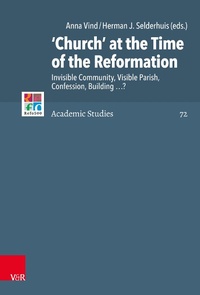
'Church' at the Time of the Reformation
Invisible Community, Visible Parish, Confession, Building ...?
1st Edition
Published on 7. June 2021
480 pages
978-3-647-57099-0 (ISBN)
Description

The present volume aims at a clarification and a discussion of the church in the 16th century: What did the reformers think about the essence and origin of the holy, apostolic and Catholic church? What was seen as the aim of it, its task and mission? Can human beings see the true church or not? Does it have one existence in this world and another in the world to come? Furthermore, the concept of church is indissolubly connected to the theological concepts of sin, faith, justification, sanctification, and salvation, and the study of the church also involves reflection upon the nature and scope of the sacraments, the role of the clergy, the aim of church-buildings, the significance of church properties and upon the constituent parts of the mass/church service. Finally, and not least, it is important to investigate the role of the church in the societies of the 16th century, such as the impact of the ruling powers upon them, their significance for education and social cohesion, and the cultural significance of migrating believers, on the run within and beyond the borders of Europe. Together with theological, philosophical and art-historical questions, these issues are considered in order to create a much fuller picture of the church at the time of the Reformation.
Anna Vind, PhD, is professor with special responsibilities at the 'Afdelinger' Department of Church History at the University in Copenhagen.
Anna Vind, PhD, is professor with special responsibilities at the 'Afdelinger' Department of Church History at the University in Copenhagen.
More details
Other editions
Additional editions
Anna Vind | Herman J. Selderhuis
'Church' at the Time of the Reformation
Invisible Community, Visible Parish, Confession, Building .?
Book
06/2021
1st Edition
Vandenhoeck & Ruprecht
€150.00
Shipment within 5-7 days
Persons
Anna Vind, PhD, is professor with special responsibilities at the 'Afdelinger' Department of Church History at the University in Copenhagen.
Content
- Cover
- Title page
- Copyright
- Table of contents
- Foreword
- List of Abbreviations
- 'Church' at the Time of the Reformation
- Peter Walter: Die 'konservative' Ekklesiologie des Erasmus von Rotterdam
- 1. Die Offenheit der ekklesiologischen Diskussion zu Beginn des 16. Jahrhunderts
- 2. Die Sicht des Erasmus
- 2.1 Kirche als Konsensgemeinschaft
- 2.2 Der Umfang des Konsenses
- 2.3 Die Träger des Konsenses: die Rolle der Universalkonzilien und des Papstes
- 3. Schluss
- Bibliografie
- Quellen
- Forschungsliteratur
- Dorothea Wendebourg: Martin Luther's Ecclesiology
- 1. The Sources
- 2. The Church as communio abscondita
- 3. The Church as communio externa
- 4. The distinctions within the communio externa
- 4.1 Corpus permixtum
- 4.2 Ministerium
- 4.3 Ecclesia vera et falsa
- 5. Conclusion
- Jon Balserak: "The church that cannot err."
- 1. The Reforming of the Church in Zurich
- 2. The Church in Christian Thought
- 3. Defending the Church in the Middle Ages
- 4. Reformed Thinking on the Church: A New Augustinianism
- 5. Concluding Reflections
- Bibliography
- Sources
- Secundary literature
- Charlotte Methuen: Ordering the Reformation Church in England and Scotland
- Introduction
- 1. Henry VIII and the Bishops
- 2. Bishops in the later Tudor Reformation
- 2.1 The Episcopate under Edward VI
- 2.2 The Episcopate under Mary I
- 2.3 The Episcopate under Elizabeth I
- 3. Bishops and the Scottish Reformation
- Conclusions
- Bibliography
- Sources
- Secondary Literature
- Florian Wöller: Corpus and Communio
- 1. Introduction: Corpus and Communio in Medieval Ecclesiology
- 2. Giles of Rome and Jean Quidort: Ecclesiastical and Imperial Power at the Beginning of the Fourteenth Century
- 3. John Wyclif: The Rise of Spiritualistic Ecclesiology
- 4. John of Ragusa: Corpus and Communio in Conciliarism
- Bibliography
- Sources
- Violet Soen: A Church or Churches?
- 1. Introduction
- 2. A Divided European Nobility
- 3. A Diverging Path of the Dutch Nobility
- 4. Negative Programs (1562-1566)
- 5. Positive Programs? (1566-1567)
- 6. The Pacification of Ghent (1576-1579)
- 7. Conclusion
- Church and Art
- Sibylla Goegebuer: St John's Hospital in Bruges in the Sixteenth and Seventeenth Centuries
- Introduction
- 1. Caritas, a Multi-Layered Principle
- 2. A Sense of Tradition - the Need for Innovation
- 3. A New Convent for the Hospital Sisters
- 4. The Interactive Hospital Story as Told in One Work of Art
- 5. In Conclusion
- Bibliography
- Sources
- Secondary Literature
- Geneviève Gross: Songs and Singing in a Developing Reformation
- Bibliography
- Sources
- Secondary Literature
- Joanna Kazmierczak: The Iconographical Motif of the Good Samaritan as a Visual Commentary on the State of the Church in the Middle of the 16th Century
- Introduction
- 1. Nicolaus Weidner: a Biography
- 2. The Epitaph of Nicolaus Weidner
- 2.1 The Iconographical Motif of the Good Samaritan
- 2.2 Interpretation of the Iconography of Weidner's Epitaph
- 3. Conclusion
- Bibliography
- Sources
- Secondary Literature
- Konrad Küster: The Impact of Liturgy on Church Music
- 1. Introduction
- 2. Basic Musicological and Liturgical Perspectives
- 3. The Eisenach Choir Book From the Early 1540s
- 4. The Part-Books From Glashütte (Saxony)
- 5. Music and Liturgy as Inseparable Aspects
- 6. Conclusion
- Bibliography
- Sources
- Secondary Literature
- Maria Lucia Weigel: Aspekte reformierter Ekklesiologie in Bildnissen von Zwingli und Bullinger
- 1. Einleitung
- 2. Gestalterische Strategien im Porträtschaffen des Zürcher Stadtmalers Hans Asper
- 2.1 Hans Aspers Bildnis von Ulrich Zwingli aus dem Jahr 1549
- 2.2 Hans Aspers Bildnis von Heinrich Bullinger aus dem Jahr 1550
- 3. Fazit
- Literatur
- Quellen
- Sekundärliteratur
- Church and Ecclesiology
- Ariane Albisser, Peter Opitz: The Concept of 'Visible' Church and 'Invisible' Church in the Reformed Tradition
- 1. The Ecclesiology of the Second Helvetic Confession in Its Mid-Sixteenth-Century Context
- 2. The Confession: a Single, Catholic Church of God
- 3. The Holiness of the Church and the Sole Head of the Church
- 4. The Marks of the Church
- 5. The Challenge and Contribution of the Second Helvetic Confession to Christian Ecclesiology
- Bibliography
- Sources
- Secundary Liturature
- Frank Ewerszumrode: The Church as a Sign and Instrument of God's Grace
- 1. Calvin's sacramental view of the Church
- 2. The Roman Catholic notion of Sacramentality
- 3. Calvin's instrumental view and Lumen Gentium's sacramentality
- Bibliography
- Csilla Gábor: Arguments, Roles, Games in a 17th Century Hungarian Polemic on Ecclesiology
- 1. Preliminary considerations
- 2. Pázmány on the Church: from the Diatribe to the Two Short Booklets
- 3. The "Matches" of the Ecclesiological Controversy
- 3.1 Two Short Booklets: Dedications, Structure, Train Of Thoughts
- 3.2 Péter Pécsváradi's Answer: Response on two Fronts and Attack
- 3.3 and Reasons, Non-Reasons: answers to the answers
- 4. The Sign system(s) of the Church(es). Signs and Sign Conceptions in the Debate
- 5. Something on the two Church concepts
- 6. As a summary
- Bibliography
- Sources
- Secondary Literature
- Gábor Ittzés: Church and Community in Luther's Sermon on Preparing to Die (1519)
- Introduction
- I.
- II.
- III.
- Bibliography
- Jeannette Kreijkes: Pastors and Teachers: Two Offices or One?
- Introduction
- 1. The Significance of Different Offices to Calvin
- 2. The Insignificance of Different Offices to Chrysostom
- 3. Calvin's and Chrysostom's Views on Pastors and Teachers
- 4. Tentative Explanations for the Differences
- 5. Conclusion
- Bibliography
- Marta Quatrale: "Et est mirabile in oculis nostris"
- 1. Metodological introduction
- 2. Luther's concept of paradox and the Augustinian harvest: the double role of the Spirit
- 3. Intermezzo. Augustine's concept of paradox: hermeneutical key per gratia
- 4. Conclusion
- Bibliography
- Herman A. Speelman: From Assembly of Believers to an Official Institute
- Introduction
- The search for a diplomatic solution
- 1. Church as a group of faithful people forming a holy communion
- 1.1 Church as a communion of believers
- 1.2 Jean de Morély's attack on the Reformed church order
- 1.3 A simultaneously visible and invisible church
- 1.4 The church as mystical body of Christ: catholic, scattered, yet one
- 1.5 Chandieu answered Morély
- 2. The dominant place of discipline
- 2.1 Flexible church ordonnances
- 2.2 Man's salvation and the ecclesiastical discipline
- 3. Church as a more or less hierarchically and clerical institution
- 3.1 The problem of leadership in the French Calvinistic movement
- 3.2 A clerical or a more democratic church structure
- 3.3 A key Bible passage
- 3.4 The right to represent
- 3.5 Membership of the church
- 3.6 The flock is inexpert
- 3.7 Election as an example
- 3.8 An independent church ruled by clergy and laity
- 4. A dominant church-shaping use of the Eucharist
- Conclusion
- Bibliography
- Sources
- Secondary Literature
- Maciej Szumowski: Visible Signs of Virtues
- 1. Introduction: (In)communicability of the invisible within the visible
- 2. Bellarmine's definition of the Church
- 3. Disconnection of the internal from the external
- 4. Do sinners and secret unbelievers belong to the Church?
- 5. Embracing the vicious circle of representation
- 6. Breaking out of the vicious circle: Christocentric ecclesiology
- 7. A "sacramental" ecclesiology?
- Bibliography
- Church and Unity
- Linda Stuckrath Gottschalk: Caspar Coolhaes
- Bibliography
- Sources
- Secondary Literature
- Tabita Landová: Ekklesiologie der Böhmischen Brüder
- 1. Ohne Christus und ohne die Kirche gibt es kein Heil: die soteriologische Relevanz der Frage nach der Kirche
- 2. Kirche als Versammlung der Erwählten: Gregor Schneider und Lukas von Prag
- 3. Augustas ekklesiologische Schriften am Hintergrund seiner Auseinandersetzung mit den Utraquisten
- 4. Grundzüge Augustas Ekklesiologie
- 4.1 Kirche als sichtbare Gemeinschaft der im Namen Christi Versammelten
- 4.2 Kirche Gottes versus Kirche des Teufels als offenbare und verborgene Wirklichkeiten
- 4.3 Einzelne Unitäten - die eine heilige Kirche Christi
- 5. Religiöse Freiheit und Toleranz im Augustas Kirchenbegriff
- Bibliographie
- Quellen
- Forschungsliteratur
- Jan Cervenka: One Church or Two Churches?
- 1. Introduction
- 2. Emperor Sigismund and the first conflict
- 3. Compacts and kings
- 4. Popes and Compacts - from tacit acceptance to abolition
- 5. Internal conflicts and securing of Compacts on the national level
- 6. Jagellonian dynasty and the Compacts - Catholic kings and heretical country
- 7. Reformation and Reunification
- Bibliography
- Pierrick Hildebrand: One Church, One Covenant, One Faith
- 1. Introduction
- 2. Zwingli's covenantal turn
- 3. Church as covenant
- 4. Church sacraments as covenant signs
- 5. Conclusion
- Bibliography
- Sources
- Secondary Literature
- Michelle C. Sanchez: Does Calvin's Church Have a History?
- 1. Introduction
- 2. To Have a History: Thinking About Presence
- 3. Calvin's Church
- 4. Summary
- 5. Conclusion
- Bibliography
- Sources
- Secondary Literature
- Ulrich Andreas Wien: Reconciliation in a Village Community in the Reformation Period in Transylvania
- Preliminary Remark
- 1. Accepting the Reformed Movements in the Pioneer Region of Religious Freedom - Transylvania Between 1520 and 1570
- 2. Damasus Dürr - Notes on his Biography
- 3. Edition of Sermons as a Desideratum
- Conclusion
- Bibliography
- Sources
- Secondary Literature
- Image Credits
- Index of Names
- List of Contributors
