

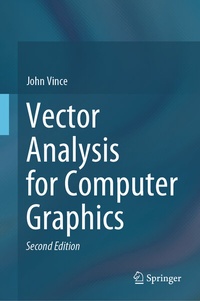
Vector Analysis for Computer Graphics
Description

Using over 150 full-colour illustrations, the author demonstrates in worked examples how this relatively young branch of mathematics has become a powerful and central tool in describing and solving a wide range of geometric problems. These may be in the form of lines, surfaces and volumes, which may touch, collide, intersect, or create shadows upon complex surfaces.
The book is divided into eleven chapters covering the history of vector analysis, linear equations, vector algebra, vector products, differentiating vector-valued functions, vector differential operators, tangent and normal vectors, straight lines, planes, intersections and rotating vectors. The new chapters are about the history, differentiating vector-valued functions, differential operators and tangent and normal vectors. The original chapters have been reworked and illustrated.
Reviews / Votes
"Each chapter presents some topic from vector analysis and contains a well-developed derivation and mathematical demonstration that makes following the topic easier. . The book is written in a very accessible fashion. The author gives many examples presenting the notations and problems considered, making study easier. The book is suitable for undergraduate students of computer science, mathematics, and engineering, and is an ideal reference for researchers and professionals in computer graphics." (Krzysztof Gdawiec, zbMATH 1478.68008, 2022)More details
Other editions
Additional editions
Previous edition
Person
Professor John Vince began working in computer graphics at Middlesex Polytechnic in 1968. His research activities centered on computer animation software and resulted in the PICASO and PRISM animation systems. Whilst at Middlesex, he designed the UK's first MSc course in Computer Graphics and developed a popular program of short courses in computer animation for television designers. In 1986 he joined Rediffusion Simulation as a Research Consultant and worked on the development of real-time computer systems for commercial flight simulators. In 1992 he was appointed Chief Scientist of Thomson Training Simulation Ltd. In 1995 he was appointed Professor of Digital Media at the National Centre for Computer Animation at Bournemouth University and in 1999 he was made Head of Academic Group for Computer Animation. He was awarded a DSc by Brunel University in recognition of his work in computer graphics. He has written and edited over 45 books on computer graphics, computer animation, computer science and virtual reality, including the following Springer titles:
Mathematics for Computer Graphics, 5 th edition (2017)
Calculus for Computer Graphics, 2 nd edition (2019)
Imaginary Mathematics for Computer Science, (2018)
Foundation Mathematics for Computer Science, 2 nd edition (2015)
Matrix Transforms for Computer Games and Animation (2012)
Expanding the Frontiers of Visual Analytics and Visualization (2012)
Quaternions for Computer Graphics (2011)
Rotation Transforms for Computer Graphics (2011)
Geometric Algebra: An Algebraic System for Computer Animation and Games (2009)Geometric Algebra for Computer Graphics (2008)
