

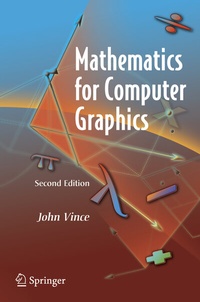
Mathematics for Computer Graphics
Description

Baffled by maths? Then don't give up hope.
John Vince will show you how to understand many of the mathematical ideas used in computer animation, virtual reality, CAD, and other areas of computer graphics.
In thirteen chapters you will rediscover - and hopefully discover for the first time a new way of understanding - the mathematical techniques required to solve problems and design computer programs for computer graphic applications. Each chapter explores a specific mathematical topic and takes you forward into more advanced areas until you are able to understand 3D curves and surface patches, and solve problems using vectors.
After reading the book, you should be able to refer to more challenging books with confidence and develop a greater insight into the design of computer graphics software.
Get to grips with mathematics fast - Numbers, Algebra, Trigonometry, Coordinate geometry, Transforms, Vectors, Curves and surfaces, Barycentric coordinates, Analytic geometry.
The book you will read once, and refer to over and over again!
Reviews / Votes
From the reviews of the second edition:
"The aim of this book is to give a computer user mathematical tools and techniques to solve problems in computer graphics. It specifically targets non-mathematicians . giving a good overview of what mathematics can do for the computer graphics user, designer and programmer. . the book does fulfil its own promise - to present the reader with the mathematics' basics useful for computer graphics, and to give the ability to refer to more challenging math topics with confidence." (A. Ulovec, Monatshefte für Mathematik, Vol. 155 (2), October, 2008)More details
Other editions
Additional editions
Person
Content
Vectors are a relatively new arrival to the world of mathematics, dating only from the 19th century. They provide us with some elegant and powerful techniques for computing angles between lines and the orientation of surfaces. They also provide a coherent framework for computing the behaviour of dynamic objects in computer animation and illumination models in rendering. We often employ a single number to represent quantities that we use in our daily lives such as, height, age, shoe size, waist and chest measurements. The magnitude of this number depends on our age and whether we use metric or imperial units. Such quantities are called scalars. In computer graphics scalar quantities include colour, height, width, depth, brightness, number of frames, etc.
On the other hand, there are some things that require more than one number to represent them: wind, force, weight, velocity and sound are just a few examples. These cannot be represented accurately by a single number. For example, any sailor knows that wind has a magnitude and a direction. The force we use to lift an object also has a value and a direction. Similarly, the velocity of a moving object is measured in terms of its speed (e.g. miles per hour) and a direction such as north-west. Sound, too, has intensity and a direction. These quantities are called vectors. In computer graphics, vectors are generally made of two or three numbers, and this is the only type we will consider in this chapter.
Mathematicians such as Caspar Wessel (1745-1818), Jean Argand (1768- 1822) and John Warren (1796-1852) were simultaneously exploring complex numbers and their graphical representation. In 1837, Sir William Rowan Hamilton (1788-1856) made his breakthrough with quaternions. In 1853, Hamilton published his book Lectures on Quaternions in which he described terms such as vector, transvector and provector. Hamilton's work was not widely accepted until 1881, when the American mathematician Josiah Gibbs (1839-1903) published his treatise Vector Analysis, describing modern vector analysis.
