

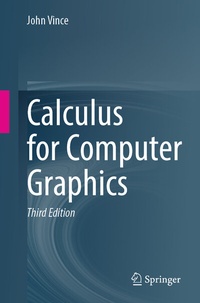
Calculus for Computer Graphics
Description

Students studying different branches of computer graphics need to be familiar with geometry, matrices, vectors, rotation transforms, quaternions, curves and surfaces. And as computer graphics software becomes increasingly sophisticated, calculus is also being used to resolve its associated problems.
In this 3
rd
edition, the author extends the scope of the original book to include vector differential operators and differential equations and draws upon his experience in teaching mathematics to undergraduates to make calculus appear no more challenging than any other branch of mathematics. He introduces the subject by examining how functions depend upon their independent variables, and then derives the appropriate mathematical underpinning and definitions. This gives rise to a function's derivative and its antiderivative, or integral. Using the idea of limits, the reader is introduced to derivatives and integrals of many common functions. Other chapters address higher-order derivatives, partial derivatives, Jacobians, vector-based functions, single, double and triple integrals, with numerous worked examples and almost two hundred colour illustrations.
This book complements the author's other books on mathematics for computer graphics and assumes that the reader is familiar with everyday algebra, trigonometry, vectors and determinants. After studying this book, the reader should understand calculus and its application within the world of computer graphics, games and animation.
More details
Other editions
Additional editions
Previous edition
Person
Professor John Vince began working in computer graphics at Middlesex Polytechnic in 1968. His research activities centered on computer animation software and resulted in the PICASO and PRISM animation systems. Whilst at Middlesex, he designed the UK's first MSc course in Computer Graphics and developed a popular program of short courses in computer animation for television designers. In 1986 he joined Rediffusion Simulation as a Research Consultant and worked on the development of real-time computer systems for commercial flight simulators. In 1992 he was appointed Chief Scientist of Thomson Training Simulation Ltd. In 1995 he was appointed Professor of Digital Media at the National Centre for Computer Animation at Bournemouth University and in 1999 he was made Head of Academic Group for Computer Animation. He was awarded a DSc by Brunel University in recognition of his work in computer graphics. He has written and edited over 40 books on computer graphics, computer animation and virtual reality, including the following Springer titles:
Mathematics for Computer Graphics (2014)
Calculus for Computer Graphics (2013)
Matrix Transforms for Computer Games and Animation (2012)
Expanding the Frontiers of Visual Analytics and Visualization (2012)Quaternions for Computer Graphics (2011)
Rotation Transforms for Computer Graphics (2011)
Content
Introduction.- Functions.- Limits and Derivatives.- Derivatives and Antiderivatives.- Higher Derivatives.- Partial Derivatives.- Integral Calculus.- Area Under a Graph.- Are Length and Parameterisation of Curves.- Surface Area.- Volume.- Vector-Valued Functions.- Vector Differential Operators.- Tangent and Normal Vectors.- Continuity.- Curvature.- Solving Differential Equations.- Conclusion. Appendix A.- Appendix B.- Index.
