

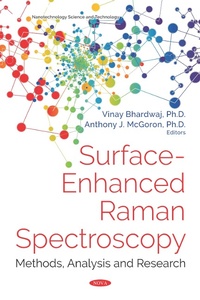
Surface-Enhanced Raman Spectroscopy: Methods, Analysis and Research
Published on 28. May 2019
265 pages
978-1-5361-5379-8 (ISBN)
Description

In the last decade, we have seen spurring growth in academic and industrial interest in Raman spectroscopy and its modifications, in particular, Surface-Enhanced Raman Spectroscopy (SERS). This is evident by the number of SERS publications in the last decade, from 580 in 2005 to almost 2000 in 2014. There are now companies worldwide that are dedicated to manufacturing SERS substrate, sensors, and other SERS-based products. The miniaturization of Raman instrumentation from bulky and expensive bench-top designs to inexpensive handheld spectrometers has allowed SERS to be employed as an in situ detection technique. Some examples of the industrial success of Raman and SERS are rapid raw material identification (RMID), Process Analytical Technology (PAT) and drug screening in pharma and biotech industries, continuous surveillance of food, water, and environmental safety, and the diagnosis and continuous monitoring of diseases like cancer, diabetes, etc. This progress in translating Raman and SERS techniques into commercial use and commercial products is possible because of the close collaboration between scientists and engineers. However, the weak signals of Raman spectroscopy is an inherent limitation of the spontaneous Raman spectroscopy technique. Therefore, several modifications have been made, including but not limited to, surface-enhanced Raman spectroscopy (SERS), spatially offset Raman spectroscopy (SORS), transmission Raman spectroscopy (TRS), coherent anti-Stoke's Raman spectroscopy (CARS), and tip-enhanced Raman spectroscopy (TERS). Spontaneous Raman spectroscopy has become a one-of-a kind, portable, and affordable technology for in-situ detection and continuous monitoring in resource-limited-settings. The primary focus of this textbook is to try to cover the fundamentals in SERS methods of preparing substrates and sensors, and efficient spectral analysis approaches like chemometrics for diverse applications, listed in the paragraph above. However, with a goal to give a true picture to the audience when assessing the scope of spontaneous Raman and Surface-enhanced Raman for specific applications, we have briefly introduced industrially successful examples of other types of Raman spectroscopy techniques, such as SORS, TRS, and CARS.
More details
Other editions
Additional editions
Book
05/2019
Nova Science Publishers Inc
€256.99
Shipment within 15-20 days
Content
- Intro
- Contents
- Preface
- Acknowledgments
- Chapter 1
- Fundamentals of Surface-Enhanced Raman Spectroscopy (SERS)
- Abstract
- Introduction
- (a) Raman Scattering
- (b) Raman Spectroscopy
- (c) CARS
- (d) SORS
- Surface-Enhanced Raman Phenomenon
- (a) Surface Plasmon Resonance (SPR)
- (b) Surface Enhanced Raman Spectroscopy (SERS)
- SERS Mechanisms
- (a) The Electromagnetic Enhancement Mechanism
- (b) Molecular or Chemical Enhancement Mechanism
- Sers Enhancement Factors (EF)
- SERS Applications
- (a) Biosensors
- (b) Spectro-Electrochemistry
- (c) Single Molecule SERS (SMSERS)
- (d) Detection of Chemical Warfare Agents
- (e) Other Miscellaneous Applications
- Conclusion
- References
- Chapter 2
- Applications of SERS for Ultrasensitive Detection of Small Molecules
- Abstract
- Raman Spectroscopy
- (a) Basis of Raman Spectroscopy
- (b) An Example of a Raman Spectra
- Surface-Enhanced Raman Spectroscopy (SERS)
- Some Examples of SERS Spectra
- (a) SERS of NO2- Ion
- (b) Benzenethiol
- (c) Coronene
- (d) Oxidation Induced Decomposition of Graphite
- (e) Laser Induced Decomposition
- (f) Detection of Hazardous Materials
- References
- Chapter 3
- Applications of SERS in Cancer Diagnosis and Therapy Monitoring
- Abstract
- Introduction
- SERS and Liquid Biopsy
- SERS for Detection of Circulating Nucleic Acids
- SERS for Detection of Circulating Proteins
- SERS for Detection of Circulating Vesicles
- SERS for Detection of Circulating Tumor Cells
- SERS for Monitoring Metastasis
- SERS for Monitoring the Tumor Microenvironment
- SERS for Monitoring Therapy
- SERS for Multimodal Imaging and Image-Guided Surgery
- SERS for Theranostic Applications
- Limitations and Future Perspectives
- Conclusion
- References
- Chapter 4
- SERS for Continuous Glucose Monitoring (CGM) to Manage Diabetes
- Abstract
- Diabetes: The Disease
- Current Status of Devices for Glucose Monitoring
- Potential of Raman and SERS
- Some Examples of SERS for CGM
- Future Directions
- References
- Chapter 5
- SLISA (SERS-Linked Immuno Sensor Assay): Method of Development and Validation with Reference to ELISA
- Abstract
- Introduction
- Materials
- Synthesis of SERS Substrate
- Characterization of SERS Substrate
- Functionalization of Antibodies on SERS Substrate (SERS Sensor)
- Characterization of SERS Sensor
- Measurement of Proteins Using ELISA and SLISA
- Methods
- Notes
- References
- Chapter 6
- SERS for the Forensic Toxicological Screening of Drugs
- Abstract
- Introduction
- Current Position of SERS in the Forensic Practice
- Advantages of SERS for Drug Analysis in Bodily Fluids
- Challenges of SERS for Drug Analysis in Bodily Fluids
- Multivariate Analysis for the Identification and Quantification of Drugs by SERS
- Experimental Considerations
- Sample Preparation
- SERS Substrates
- Colloidal Sols
- Solid-Supported Nanoparticle Assemblies
- Substrates for Indirect SERS Detection
- Conclusion and Future Directions
- Acknowledgments
- References
- Chapter 7
- Raman and SERS in Pharma: Drug Discovery, Development and Targeted Delivery
- Abstract
- Introduction
- Need of Raman and Sers in Pharma
- Drug Discovery
- Anti-Microbial Drugs (Antibiotics)
- Anti-Cancer Drugs
- Drug Development
- Targeted Drug Delivery and Therapy Monitoring
- Conclusion
- References
- Chapter 8
- Raman and SERS as Process Analytical Technology/Tool (PAT) in Biotech and Pharma
- Abstract
- Process Analytical Technology (PAT)
- Raman and SERS as PAT Tool
- Raman Pectroscopy
- Surface Enhanced Raman Spectroscopy (SERS)
- Applications
- Pharmaceutical Industries
- Reaction Monitoring
- Crystallization to Make Polymorph
- Drug Quality Testing
- Biotechnology Industry
- Fermentation to Produce Penicillin and Alcohol
- Cell Culture Growth
- Challenges and Future Prospects
- References
- Chapter 9
- SERS for Surveillance of Food, Water and Environment Safety
- Abstract
- Need of continuous monitoring (surveillance)
- Standard Analytical Techniques: Challenges and Scope
- Raman and SERS
- Pathogens
- Bacteria
- Virus
- Fungus
- Pesticides
- Metals
- Food Adulterants
- Food Allergens, Colorants, and Other Additives
- Antibiotics and Hormones
- Antibiotics
- Hormones
- Chemical Warfare Agents
- Conclusion
- References
- Index
- Blank Page
