

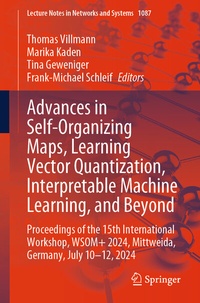
Advances in Self-Organizing Maps, Learning Vector Quantization, Interpretable Machine Learning, and Beyond
Description

The book presents the peer-reviewed contributions of the 15th International Workshop on Self-Organizing Maps, Learning Vector Quantization and Beyond (WSOM$+$ 2024), held at the University of Applied Sciences Mittweida (UAS Mitt\-weida), Germany, on July 10-12, 2024.
The book highlights new developments in the field of interpretable and explainable machine learning for classification tasks, data compression and visualization. Thereby, the main focus is on prototype-based methods with inherent interpretability, computational sparseness and robustness making them as favorite methods for advanced machine learning tasks in a wide variety of applications ranging from biomedicine, space science, engineering to economics and social sciences, for example. The flexibility and simplicity of those approaches also allow the integration of modern aspects such as deep architectures, probabilistic methods and reasoning as well as relevance learning. The book reflects both new theoretical aspects in this research area and interesting application cases.
Thus, this book is recommended for researchers and practitioners in data analytics and machine learning, especially those who are interested in the latest developments in interpretable and robust unsupervised learning, data visualization, classification and self-organization.
More details
Other editions
Additional editions
Content
Unsupervised Learning-based Data Collection Planning with Dubins Vehicle and Constrained Data Retrieving Time.- Hyperbox GLVQ Based on Min Max Neurons.- Sparse clustering with K means which penalties and for which data.- Is t SNE Becoming the New Self organizing Map Similarities and Differences.- Pursuing the Perfect Projection A Projection Pursuit Framework for Deep Learning.- Generalizing self organizing maps large scale training of GMMs and applications in data science.- A Self Organizing UMAP For Clustering.- Knowledge Integration in Vector Quantization Models and Corresponding Structured Covariance Estimation.- Exploring data distributions in Machine Learning models with SOMs.- Interpretable Machine Learning in Endocrinology a Diagnostic Tool in Primary Aldosteronism.- The Beauty of Prototype Based Learning.
