

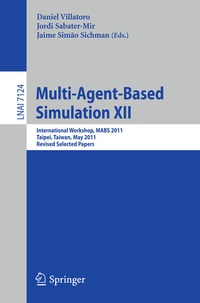
Multi-Agent-Based Simulation XII
International Workshop, MABS 2011, Taipei, Taiwan, May 2-6, 2011, Revised Selected Papers
Published on 27. February 2012
IX, 127 pages
978-3-642-28400-7 (ISBN)
Description

This book constitutes the refereed proceedings of the 12th International Workshop on Multi-Agent-Based Simulation, MABS 2011, held in Taipei, Taiwan, in May 2011.
The 10 revised selected and extended papers presented were carefully reviewed and selected from 21 submissions. The topics covered are MABS in scientometrics; MABS in politics, transit and policy; pedestrian, crowds and large scale MABS; and MABS modeling.
More details
Other editions
Additional editions
Daniel Villatoro | Jordi Sabater-Mir | Jaime Simao Sichman
Multi-Agent-Based Simulation XII
International Workshop, MABS 2011, Taipei, Taiwan, May 2-6, 2011, Revised Selected Papers
Book
02/2012
Springer
€53.49
Shipment within 7-9 days
Content
- Title page
- Preface
- Organization
- Table of Contents
- MABS in Scientometrics
- Agent Simulation of Peer Review: The PR-1 Model
- Introduction
- Description of the Proposed Model
- PR-M
- PR-1
- Implementation Details
- Results
- Measured Quantities
- Uniform Ability
- Low Average Skill
- Polarized Skill
- Discussion and Future Work
- References
- Simulating Research Behaviour
- Introduction
- Background
- Simulation Basics
- The Simulator's Input and Output
- Journals' Profiles
- Researchers' Profiles
- Simulation Algorithm
- Assumptions and Hypotheses
- Assumptions
- Hypotheses
- Results and Analysis
- Conclusion
- References
- MABS in Politics, Transit and Policy
- Agent-Based Modeling of the Prediction Markets for Political Elections
- Introduction
- Basic Model
- Simulation and Analysis
- Prediction Power and Favorite-Longshot Bias
- Neighborhood Scope and Prediction Accuracy
- Information Distribution and Prediction Accuracy
- The Origin of the Favorite-Longshot Bias
- Conclusion
- References
- Using Multi-agent Simulation to Improve the Security of Maritime Transit
- Domain Background
- Piracy Around the Horn of Africa
- Existing Antipiracy Measures
- International Recommended Transit Corridor.
- Navy Patrols.
- Group Transit Scheme.
- Model Description
- Merchant Vessel Model
- Pirate Vessel Model
- Naval Vessel Model
- Model Implementation
- Agent Behavior Implementation.
- Model Validation
- Long-Range Shipping Traffic Model Validation
- Piracy Model Validation
- Group Transit Schedule Optimization
- Conclusion
- References
- How to Do Social Simulation in Logic: Modelling the Segregation Game in a Dynamic Logic of Assignments
- Introduction
- The Segregation Game
- The Original Model
- The Implemented Model
- Dynamic Logic with Assignments
- Language
- Semantics
- Reduction Axioms for the Star-Free Fragment
- Complexity for the Star-Free Fragment
- The Segregation Game in DL-PA
- Propositional Variables
- Describing Inhabitants' Moves
- Initial State
- Describing and Proving Properties
- Varying the Inhabitants' Tolerance
- More Expressive Languages
- Conclusion
- References
- Pedestrian, Crowds and Large Scale MABS
- An Agent-Based Proxemic Model for Pedestrian and Group Dynamics: Motivations and First Experiments
- Introduction
- Related Works
- Particle-Based Approach
- Cellular Automata Approach
- Autonomous Agents Approach
- Interdisciplinary Approach
- Proxemics
- Crowds: Canetti's Theory
- An Agent-Based Proxemic Model
- Basic Proxemic Rules
- Group Dynamic Rules
- Experimental Results
- Proxemic Distance Evaluation
- Groups and Individuals
- Conclusions and Future Works
- References
- Validation of Agent-Based Simulation through Human Computation: An Example of Crowd Simulation
- Introduction
- Related Work
- Human Computation
- The Game: Escape
- Test Scenarios
- Density and Distance
- Exit Size
- Discussion and Future Work
- References
- Observation of Large-Scale Multi-Agent Based Simulations
- Introduction
- Filtrated Direct Observation of MABS
- Implementation of Filtrated Direct Observation Methods
- Self-observation
- Statistical Survey
- Discussion
- Conclusion and Perspectives
- References
- MABS Modelling
- Between Agents and Mean Fields
- Introduction
- Agents and Mean Fields
- Pheromone-Based Agents
- An Experiment
- Description of Experiment
- Adaptation for Pheromone-Based Agents
- Discussion
- Conclusion
- References
- Author Index
