

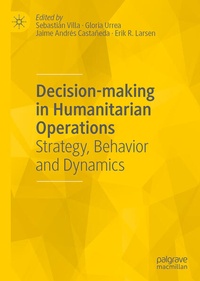
Decision-making in Humanitarian Operations
Description

This book brings together research in humanitarian operations, behavioral operations and dynamic simulation. Part I outlines the main characteristics and strategic challenges of humanitarian organizations in preparedness, knowledge management, climate change and issues related to refugees and social inclusion. Part II gives an introduction to behavioral operations and experiments in single- and multi-agent settings, followed by discussions on quantal theory, framing effect and possible applications in the humanitarian sector. Part III introduces system dynamics and agent-based modeling and discusses how these techniques can be used to study dynamics and decision-making in humanitarian operations. This book is unique in providing a holistic view of the decision-making process and challenges in the humanitarian sector.
More details
Other editions
Additional editions
Persons
Sebastián Villa is Assistant Professor in the School of Management at the Universidad de Los Andes, Colombia.
Gloria Urrea is a visiting researcher at the Kelley School of Business, Indiana University, USA. She holds a Ph.D. from the Università della Svizzera italiana (USI), Switzerland.
Jaime Andrés Castañeda is Principal Professor in the School of Management at the Universidad del Rosario, Colombia.
Erik R. Larsen is Professor in the Department of Management, School of Business and Social Sciences, Aarhus University, Denmark.
Content
Part I Strategy.-1 Logistics Preparedness and Response: A Case of Strategic Change.- 2 Private Donations for Humanitarian Operations.- 3 Strategy and Knowledge Management in Humanitarian Organizations.- 4 Innovating Short-Term Preparedness Actions Using Climate Information.- 5 Refugees and Social Inclusion: The Role of Humanitarian Information Technologies.- Part II Behavior - 6 Behavioral Experiments in Single-Agent Operational Problems.- 7 Behavioral Operations in Multi-agent Settings and Humanitarian Operations.- 8 Quantal Theory in Operations Management.- 9 The Framing Effect in Humanitarian Operations.- Part III Dynamics.- 10 Modeling Disaster Operations Management Problems with System Dynamics.- 11 Collaborative Strategies for Humanitarian Logistics with System Dynamics and Project Management.- 12 Agent-Based Modeling in Humanitarian Operations.- 13 Effects of Wholesale Competition in Supply Chains: An Analysis with Heterogeneous Decision-Makers.
