

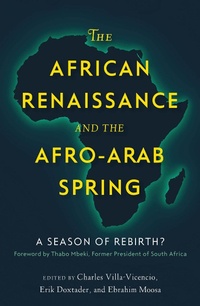
The African Renaissance and the Afro-Arab Spring
Description

The African Renaissance and the Afro-Arab Spring addresses the often unspoken connection between the powerful call for a political-cultural renaissance that emerged with the end of South African apartheid and the popular revolts of 2011 that dramatically remade the landscape in Egypt, Libya, and Tunisia. Looking between southern and northern Africa, the transcontinental line from Cape to Cairo that for so long supported colonialism, its chapters explore the deep roots of these two decisive events and demonstrate how they are linked by shared opposition to legacies of political, economic, and cultural subjugation. As they work from African, Islamic, and Western perspectives, the book's contributors shed important light on a continent's difficult history and undertake a critical conversation about whether and how the desire for radical change holds the possibility of a new beginning for Africa, a beginning that may well reshape the contours of global affairs.
More details
Other editions
Additional editions
Persons
Charles Villa-Vicencio is a visiting professor in the Conflict Resolution Program at Georgetown University and senior research fellow at the Institute for Justice and Reconciliation in Cape Town.
Erik Doxtader is a professor of rhetoric at the University of South Carolina and a senior research fellow at the Institute for Justice and Reconciliation in Cape Town.
Ebrahim Moosa is a professor of Islamic Studies with appointments in the Department of History and the Kroc Institute for International Peace Studies at the University of Notre Dame.
Content
Foreword: The Arab Reawakening: An Africa Renaissance Perspective
Thabo Mbeki
Introduction: Beginning Again? The Question of a Continent
Erik Doxtader, Charles Villa-Vicencio, and Ebrahim Moosa
1. From Cairo to the Cape: The Dilemmas of Revolution
Shamil Jeppie
2. Gathering the Pieces: The Structural, Social, and Psychological Elements of African Renewal
Don Foster
3. Understanding a Flawed Miracle: The History, Dynamics, and Continental Implications of South Africa's Transition
Charles Villa-Vicencio
4. Irreconcilable Truths: Gender-Based Violence and the Struggle to Build an Inclusive History
Helen Scanlon
5. Managing Transition: Lessons from Tunisia
Ibrahim Sharqieh
6. Is There a Center to Hold? The Problem of Transition in Post-Qaddafi Libya
Asif Majid
7. The Pharaoh Returns: The ?Politics of Order? and the Muslim Yearning for Freedom
Ebrahim Rasool
8. Political Theology in the Aftermath of the Arab Spring: Returning to the Ethical
Ebrahim Moosa
9. The One and the Many: Religious Coexistence and Belonging in Postapartheid Society
Abdulkader Tayob
10. A Popular Revolution? Gender Inequality and Political Change in North Africa
Katherine Marshall
11. A ?New? Pan-Africanism: Future Challenges
Chris Landsberg
12.The Potential of an African Assertion?Once More, in the Name of a Renaissance
Erik Doxtader
Appendices
A. Colonization and Independence of African Countries
B. Select Chronology of Afro-Arab Spring
C. Pan-Africanism: Select Initiatives, Organizations, and Conventions
Acknowledgments
Abbreviations
Contributors
