

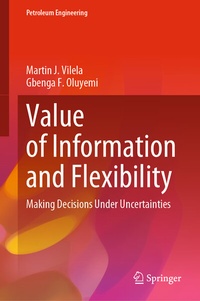
Value of Information and Flexibility
Description

This book presents a consistent methodology for making decisions under uncertain conditions, as is almost always the case. Tools such as value of information and value of flexibility are explored as a means to make more complex and nuanced decisions.
The book develops the complete formalism for assessing the value of acquiring information with two novel approaches. Firstly, it integrates the fuzzy characteristics of data, and secondly develops a methodology for assessing data acquisition actions that optimize the value of projects from a holistic perspective. The book also discusses the formalism for including flexibility in the project decision assessment. Practical examples of oil- and gas-related decision problems are included and discussed to facilitate the learning process.
This book provides valuable advice and case studies applicable to engineers, researchers, and graduate students, particularly in the oil and gas industry and pharmaceutic industry.
More details
Other editions
Additional editions
Persons
Dr Martin J. Vilela holds a Bachelor degree in Physics from Venezuela Central University, Venezuela, a Master degree in Physics from Boston University, USA and a PhD in Engineering from Robert Gordon University, Aberdeen. He has worked in numerous research and managerial positions in Venezuela, Mexico, Libya, Spain, Algeria, Great Britain, Qatar, UAE, and Kuwait. Currently, he is an oil and gas consultant and CEO/Director of Aura Energy Solutions based in Madrid, Spain, and a Technical Reviewer for two prestigious Journals. His expertise lies in reservoir characterization, simulation, reservoir analysis, reservoir engineering operations, field development plan preparation, and field development and operations. He has been involved in uncertainty and risk valuations, decision-making processes, and decision optimisation. He has recently developed interest in energy transition and its impact in different domains.
Dr Gbenga Oluyemi gained his Bachelor degree in Geology from University of Ibadan, Nigeria in 1998, and his Master and PhD degrees from Robert Gordon University, Aberdeen, UK in 2002 and 2007, respectively. He has worked in several industry, research, and academic positions in Nigeria, Ghana, and the UK. He is currently the Lead for the Petroleum Engineering Research Group at Robert Gordon University. His research interest and expertise lie in formation evaluation, petroleum geomechanics, oilfield chemistry and fluid flow and characterisation in porous media. He is a Chartered Engineer in the UK and an active member of Energy Institute, UK, and Society of Petroleum Engineer (SPE). He is also a Technical Reviewer for more than 8 peer-reviewed journals. He has written more than 70 peer-reviewed journal articles, conference papers and 2 book chapters, and is the Editor-in-Chief of Springer's Petroleum Engineering Book series.
Content
Chapter 1. Decision-making: Concepts, Principles, and Uncertainty.- Chapter 2. Utility Theory.- Chapter 3. Probability.- Chapter 4. Probabilistic Evaluation of Uncertainties: Monte Carlo Method.- Chapter 5. Assessing the Importance of the Uncertainties: Design of Experiments.- Chapter 6. Fuzzy Logic.- Chapter 7. Uncertainty, data acquisition and Value of Information.- Chapter 8. The value of flexibility - Real Options.- Chapter 9. Case studies for the Value of Information and Flexibility in the oil and gas industry.
