

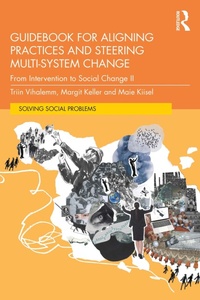
Guidebook for Aligning Practices and Steering Multi-System Change
From Intervention to Social Change II
1st Edition
Published on 25. November 2024
196 pages
978-1-040-25933-7 (ISBN)
Description

Building on the work of the authors' previous volume, the Guidebook for Aligning Practices and Steering Multi-System Change translates cutting-edge theoretical concepts into the language and applied toolkits of change practitioners. This empirically grounded and theoretically sophisticated book provides policymakers and change-managers methods and toolkits for conceptual modelling of change when handling cross-sectoral issues. The authors both 'zoom in' to the granular unfolding change of everyday life and 'zoom out' to examine the 'big picture' of socio-technical systems such as energy, mobility, food and healthcare. In addition to the social practice theories introduced in the first volume, the authors draw on the multi-level perspective that underpins sustainability transition studies and combine two theories. They are also inspired by the Deep Transition concept that tackles multi-systems change. Bridging the gap between the theorisation of sustainability transitions and practical guidelines, it will appeal to policymakers, sustainability project managers and students of management, social and political sciences, technology and innovation.
Reviews / Votes
"This book is a must-read for practitioners, researchers and students who are taking part in or are studying societal change! The book outlines a theoretically well-informed, systematic and subtle way of bringing together everyday practices and conditional systems that sustain or challenge these practices into one framework with the ambition of showing ways to social change in the light of pressing societal crises such as the climate. Cutting-edge insights meet an imaginative range of concrete examples and end with an overview of how to create a program for social change." - Bente Halkier, University of Copenhagen, Denmark"This lively and reader-friendly book not only provides a profound scholarly source to steering multi-system change by drawing upon social practice theories and transition theories for researchers, but it also serves as an informative guidebook for practitioners willing to act as changemakers towards sustainability. With its diverse empirical examples and exercises, the book will be a fruitful source for teaching. Most importantly, the authors do not let the reader to become discouraged in the face of systemic sustainability challenges, but the book essentially offers hope and stimulation for solving these challenges step by step while keeping in mind the bigger picture." - Senja Laakso, University lecturer in Environmental Policy, Tampere University
"This guidebook is an engaging, beautifully illustrated set of insights, tools and guidelines for how to navigate systems change. It builds bridges across many divides: between practitioners and academics, resilience and transformation, transition and social practice theories. This book offers a compelling and well argued and much-needed overview that will help its readers to work on confronting the unprecedented polycrisis moment we are living today." - Johan Schot, Professor of Global History and Sustainability Transitions, Utrecht University
More details
Series
Edition
1. Auflage
Language
English
Place of publication
London
United Kingdom
Publishing group
Taylor & Francis Ltd
Target group
Professional and scholarly
College/higher education
Illustrations
20 Tables, black and white; 34 Halftones, black and white; 34 Illustrations, black and white
File size
12,35 MB
ISBN-13
978-1-040-25933-7 (9781040259337)
Copyright in bibliographic data and cover images is held by Nielsen Book Services Limited or by the publishers or by their respective licensors: all rights reserved.
Schweitzer Classification
Other editions
Additional editions

Triin Vihalemm | Margit Keller | Maie Kiisel
Guidebook for Aligning Practices and Steering Multi-System Change
From Intervention to Social Change II
Book
11/2024
1st Edition
Routledge
€195.20
Shipment within 10-20 days
Triin Vihalemm | Margit Keller | Maie Kiisel
Guidebook for Aligning Practices and Steering Multi-System Change
From Intervention to Social Change II
Book
11/2024
1st Edition
Routledge
€57.90
Shipment within 10-20 days
Persons
Triin Vihalemm is Professor of Communication Research at the University of Tartu. She is also director of the highly regarded master's programme, Change Management in Society.
Margit Keller (PhD) is an Associate Professor of Social Communication and the Dean of the Faculty of Social Sciences, University of Tartu, Estonia. She has been the chair of the Research Network of the Sociology of Consumption within the European Sociological Association.
Maie Kiisel (PhD) is a sociologist-analyst of the sustainability team at the Centre for Applied Social Sciences, University of Tartu, Estonia. Her consulting activities have mainly been related to volunteer and public sector organisations and performance, thematically to nature conservation, environmental protection and forestry.
Margit Keller (PhD) is an Associate Professor of Social Communication and the Dean of the Faculty of Social Sciences, University of Tartu, Estonia. She has been the chair of the Research Network of the Sociology of Consumption within the European Sociological Association.
Maie Kiisel (PhD) is a sociologist-analyst of the sustainability team at the Centre for Applied Social Sciences, University of Tartu, Estonia. Her consulting activities have mainly been related to volunteer and public sector organisations and performance, thematically to nature conservation, environmental protection and forestry.
Content
List of Figures
List of Tables
Acknowledgements
1. Setting the scene: the aims, audiences and "relatives" of this book
2. Conceptual toolkit for social interventions
3. Conceptualization of landscapes and their pressure
4. Accelerating niches
5. Changing systems
6. Public communication of interventions
7. Wrap up
Index
List of Tables
Acknowledgements
1. Setting the scene: the aims, audiences and "relatives" of this book
2. Conceptual toolkit for social interventions
3. Conceptualization of landscapes and their pressure
4. Accelerating niches
5. Changing systems
6. Public communication of interventions
7. Wrap up
Index
