

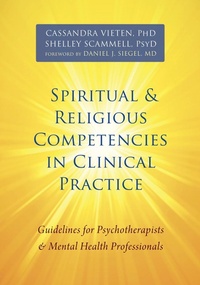
Spiritual and Religious Competencies in Clinical Practice
Description

Spirituality lies at the heart of many clients' core values, and helps shape their perception of themselves and the world around them. In this book, two clinical psychologists provide a much-needed, research-based road map to help professionals appropriately address their clients' spiritual or religious beliefs in treatment sessions.
More and more, it has become essential for mental health professionals to understand and competently navigate clients' religious and spiritual beliefs in treatment. In Spiritual and Religious Competencies in Clinical Practice, you'll find sixteen research-based guidelines and best practices to help you provide effective therapy while being conscious of your clients' unique spiritual or cultural background.
With this professional resource as your guide, you will be prepared to:
- Take a spiritual and religious history when treating a client
- Attend to spiritual or religious topics in a clinical setting
- Hold clear ethical boundaries regarding your own religious or spiritual beliefs
- Know when and how to make referrals if topics emerge which are beyond the scope of your competence
This book is a must-read for any mental health professional looking to develop spiritual, religious, and cultural competencies.
More details
Other editions
Additional editions
Content
- Intro
- Contents
- Foreword
- Preface
- Acknowledgments
- Introduction
- Part 1
- Attitudes
- Chapter 1
- Demonstrating Empathy, Respect, and Appreciation
- Chapter 2
- Appreciating Religious and Spiritual Diversity
- Chapter 3
- Being Aware of Your Own Beliefs
- Part 2
- Knowledge
- Chapter 4
- Exploring Diverse Beliefs and Practices
- Chapter 5
- Understanding Spirituality and Religion as Different but Overlapping
- Chapter 6
- Knowing the Difference Between Spirituality and Psychopathology
- Chapter 7
- Recognizing Life Span Development
- Chapter 8
- Learning About Clients' Spiritual and Religious Resources
- Chapter 9
- Recognizing Harmful Involvement
- Chapter 10
- Being Aware of Legal and Ethical Issues
- Part 3
- Skills
- Chapter 11
- Working with Religious and Spiritual Diversity
- Chapter 12
- Taking a Religious and Spiritual History
- Chapter 13
- Helping Clients Access Their Religious and Spiritual Resources
- Chapter 14
- Identifying Spiritual and Religious Problems
- Chapter 15
- Staying Up-to-Date
- Chapter 16
- Acknowledging Your Limits
- Conclusion
- Appendix
- Provisional Training Guidelines
- Resources
- References
