

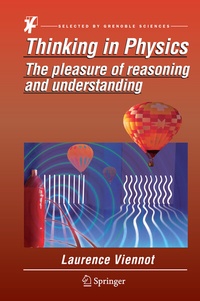
Thinking in Physics
Description

The book has three parts:
making sense of special scientific ways of reasoning (words, images, functions)
making connections between very different topics, each illuminating the other
simplifying, looking for consistency and avoiding incoherent over-simplification
The book is enhanced with supplementary online materials that will allow readers to further expand their teaching or research interests and think about them more deeply.
More details
Other editions
Additional editions
Person
Previous books:
VIENNOT L. 1979. Le raisonnement spontané en dynamique élémentaire. Paris : Hermann.
VIENNOT L. 1996. Raisonner en physique: la part du sens commun. Avec la contribution de A. Benséghir, H. Caldas, F.Chauvet, J.L. Closset, W. Kaminski, L. Maurines, J. Menigaux, S. Rainson, S. Rozier, E. Saltiel, Bruxelles: De Boeck.
VIENNOT L. 2002. Razonar en fisica. La contribucion del sentido comun. Trad: M.J. Pozo Municio. Madrid: Ant Machado libros (Visor Distribuciones).
VIENNOT L. 2001. Reasoning in Physics The part of common sense, Trad. A. Moisy. Dordrecht: Kluwer Ac. Pub.
VIENNOT L. 2002. Enseigner la Physique. Avec la collaboration de U.Besson, F. Chauvet, P. Colin, C. Hirn-Chaine, W. Kaminski, S. Rainson. Bruxelles: De Boeck.
VIENNOT L. 2003. Teaching physics. With the collaboration of U. Besson, F. Chauvet, P. Colin, C. Hirn-Chaine, W. Kaminski, S. Rainson. Trad. M. Greenwood & A. Moisy. Dordrecht: Kluwer Ac. Pub.
VIENNOT L. & DEBRU C. (Eds.) 2003. Enquête sur le concept de causalité. Paris: PUF.
VIENNOT L (Dir.) 2009. Didactique, épistémologie et histoire des sciences - Penser l'enseignement. Collection Sciences, histoire et société, Paris : PUF.
VIENNOT, L. 2011. En physique, pour comprendre . Collection Grenoble Sciences. Paris : EDP Sciences.
Content
Foreword.- Foreword to the French Edition.- Preface.- Part I Learning to think: words, images and functions.- 1 Essential tools for comprehension.- 2 Some surprising invariances.- 3 Analysis of functional dependence: a powerful tool.- 4 Putting things into practice.- Part II Physics: linking factors.- 5 Links between phenomena in terms of type of functional dependence.- 6 The relationship between different approaches to the same phenomenon.- Part III Simplicity: ruin or triumph of coherence?.- 7 Optimising simple experiments.- 8 Popularising physics: what place for reasoning?.- 9 Conclusion.- Appendix A - What this book owes to physics education research.- Appendix B - The weight of air and molecular impacts: how do they relate?.- Appendix C -Causal linear reasoning.- Appendix D - When physics should conform to beliefs: pierced bottles.- Appendix E - Reactions of trainee journalists and scientific writers confronted with inconsistency.- Appendix F - "Facilitating elements" of communication: Year 11 students ranking the risks of misunderstanding.
