

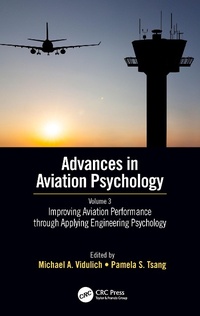
Improving Aviation Performance through Applying Engineering Psychology
Advances in Aviation Psychology, Volume 3
1st Edition
Published on 11. February 2019
266 pages
978-0-429-96014-7 (ISBN)
Description

Aviation remains one of the most active and challenging domains for human factors and applied psychology. Since 1981, the biennial International Symposium on Aviation Psychology (ISAP) has convened for the purposes of (a) presenting the latest research on human performance problems and opportunities within aviation systems, (b) envisioning design solutions that best utilize human capabilities for creating safe and efficient aviation systems, and (c) the bringing together of scientists, research sponsors, and operators in an effort to bridge the gap between research and application.
Based upon the potential impact of emerging trends, current debates, or enduring issues presented at the 19th ISAP, select authors were invited to expand on their work following the benefit of interactions at the symposium. The authors include leading scientists, prominent researchers, and aviation operators contributing to the discussion of the most pressing technical challenges and research priorities.
Visions for the incorporation of new interface technologies within next-generation cockpits, tools for future air traffic control research, neuroergonomic findings in aviation settings, and human limitations affecting safety are offered. The aim of these volumes is to report the latest findings in aviation psychology and to suggest new directions for advancing the field.
FEATURES
Bridges the gap between aviation psychology research and real-world challenges
Includes work of the distinguished researchers and seasoned practitioners with select contributions reflecting significant developments in aviation psychology
Reports on the latest findings in aviation psychology and suggests new directions for advancing the field
Contains work on perceptual and cognitive influences on performance, the impact of advanced modeling techniques, and the potential of neuroergonomics
Based upon the potential impact of emerging trends, current debates, or enduring issues presented at the 19th ISAP, select authors were invited to expand on their work following the benefit of interactions at the symposium. The authors include leading scientists, prominent researchers, and aviation operators contributing to the discussion of the most pressing technical challenges and research priorities.
Visions for the incorporation of new interface technologies within next-generation cockpits, tools for future air traffic control research, neuroergonomic findings in aviation settings, and human limitations affecting safety are offered. The aim of these volumes is to report the latest findings in aviation psychology and to suggest new directions for advancing the field.
FEATURES
Bridges the gap between aviation psychology research and real-world challenges
Includes work of the distinguished researchers and seasoned practitioners with select contributions reflecting significant developments in aviation psychology
Reports on the latest findings in aviation psychology and suggests new directions for advancing the field
Contains work on perceptual and cognitive influences on performance, the impact of advanced modeling techniques, and the potential of neuroergonomics
More details
Edition
1. Auflage
Language
English
Place of publication
London
United Kingdom
Publishing group
Taylor & Francis Ltd
Target group
College/higher education
File size
14,54 MB
ISBN-13
978-0-429-96014-7 (9780429960147)
Copyright in bibliographic data and cover images is held by Nielsen Book Services Limited or by the publishers or by their respective licensors: all rights reserved.
Schweitzer Classification
Other editions
Additional editions
Michael A. Vidulich | Pamela S. Tsang
Improving Aviation Performance through Applying Engineering Psychology
Advances in Aviation Psychology, Volume 3
Book
02/2019
1st Edition
CRC Press
€242.00
Shipment within 10-20 days
Persons
Michael A. Vidulich is a research psychologist in the Air Force Research Laboratory, Ohio. His research interests are aviation psychology, mental workload and situation awareness, and adaptive aiding.
Pamela S. Tsang is Professor of psychology at Wright State University in Dayton, Ohio. Her research interests are aviation psychology, attention and performance, extralaboratory-developed expertise, and cognitive aging.
Together they have co-edited Principles and Practice of Aviation Psychology and both previous volumes of Advances in Aviation Psychology.
Pamela S. Tsang is Professor of psychology at Wright State University in Dayton, Ohio. Her research interests are aviation psychology, attention and performance, extralaboratory-developed expertise, and cognitive aging.
Together they have co-edited Principles and Practice of Aviation Psychology and both previous volumes of Advances in Aviation Psychology.
Content
I. Perceptual and Cognitive Influences on Performance
1. Bob Cheung (Canada) - Comprehensive Approach to Pilot Disorientation
2. Hans Hoermann (Germany) - Influences of Fatigue and Alcohol on Cognitive Performance
3. Sylvain Houlier (France) - Avionics Touch Screen in Turbulence: Simulation for Design
II. Modeling for Aviation Psychology
3. Kevin Gluck (USA) - A Prospective Assessment of Performance Prediction for Aviation Psychology
4. Matijin IJtsma (student winner) - Amy Pritchett (USA) - Development of an Objective Function Allocation Method for Manned Spaceflight Operations
III. Neuroergonomics
7. Frederic Dehais (France) - A neuroergonomics approach to human performance in aviation
8. Leandro Di Stasi (Spain) - Eye Tracking in Aviation: Past, Present, and Future
9. Kurt Izzetoglu (USA & UK) - Human Performance Assessment: Evaluation of Wearable Sensors for Monitoring Brain Activity
IV. Applications
10. Michael Hagler (USA) - 177 Cold Bay Alaska Engine Change
11. Practitioner Panel Chapter (USA & Canada)
12. Jerry Crutchfield (USA) - Standardized Scenarios for Air Traffic Control Researchers.
1. Bob Cheung (Canada) - Comprehensive Approach to Pilot Disorientation
2. Hans Hoermann (Germany) - Influences of Fatigue and Alcohol on Cognitive Performance
3. Sylvain Houlier (France) - Avionics Touch Screen in Turbulence: Simulation for Design
II. Modeling for Aviation Psychology
3. Kevin Gluck (USA) - A Prospective Assessment of Performance Prediction for Aviation Psychology
4. Matijin IJtsma (student winner) - Amy Pritchett (USA) - Development of an Objective Function Allocation Method for Manned Spaceflight Operations
III. Neuroergonomics
7. Frederic Dehais (France) - A neuroergonomics approach to human performance in aviation
8. Leandro Di Stasi (Spain) - Eye Tracking in Aviation: Past, Present, and Future
9. Kurt Izzetoglu (USA & UK) - Human Performance Assessment: Evaluation of Wearable Sensors for Monitoring Brain Activity
IV. Applications
10. Michael Hagler (USA) - 177 Cold Bay Alaska Engine Change
11. Practitioner Panel Chapter (USA & Canada)
12. Jerry Crutchfield (USA) - Standardized Scenarios for Air Traffic Control Researchers.
